ToolMage
Sign in

Best 1 Conversation Practice AI tools for Speech

Popular Conversation Practice AI tools in Speech include yourteacher.ai, helping you work more efficiently.

yourteacher.ai
Freemium

yourteacher.ai

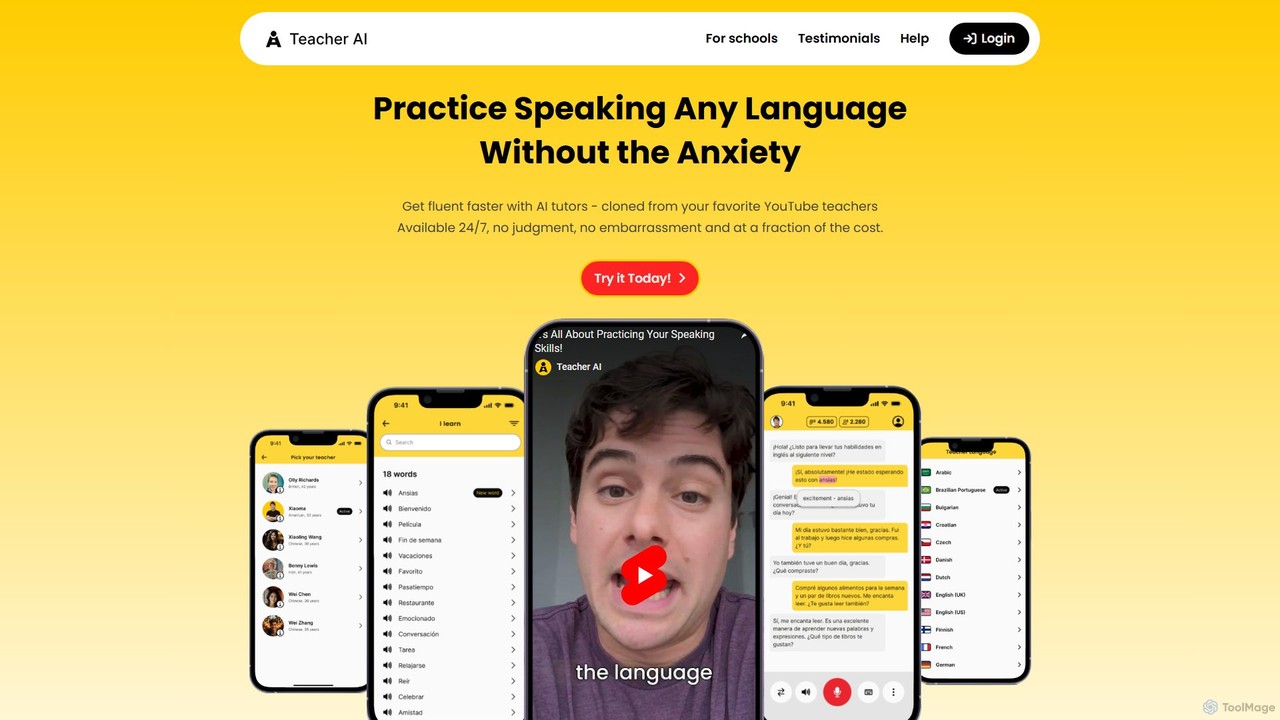
yourteacher.ai offers unlimited foreign language conversation practice with AI tutors, some cloned from famous YouTube polyglots. It's designed for intermediate learners to build fluency and confidence through 24/7, judgment-free, personalized conversations. The platform features real-time transcription, instant corrections, and progress tracking on web, iOS, and Android.

Language Learning
Visits 51.5KFavorites 143Likes 136

About Conversation Practice

AI Conversation Practice tools are specialized applications designed to simulate realistic dialogues with an AI partner, helping users improve their speaking skills. These tools integrate advanced speech recognition, natural language understanding, and speech synthesis to create an interactive and responsive environment. They are primarily used for language learning, public speaking training, and professional communication rehearsals, such as sales pitches or job interviews. Unlike general voice assistants, they provide targeted feedback on pronunciation, fluency, intonation, and grammar, enabling structured and effective practice.

Core Features

  • Real-time Feedback: Provides instant analysis of pronunciation, grammar, speaking pace, and use of filler words.
  • Customizable Scenarios: Allows users to practice specific situations, from ordering coffee in a new language to handling a difficult client call.
  • AI Role-Playing: Simulates conversations with various AI personas, such as an interviewer, a customer, or a native speaker.
  • Performance Analytics: Tracks user progress over time with detailed metrics on clarity, confidence, and vocabulary usage.
  • Transcript and Recording Review: Enables users to listen back to their responses and review transcripts with AI-generated suggestions.

Use Cases

These tools are widely adopted by language learners seeking to build conversational fluency in a pressure-free setting. In the corporate world, sales and customer service teams use them for role-playing and de-escalation training. Professionals and students also leverage them to rehearse for important presentations, public speeches, and job interviews, building confidence and refining their delivery.

How to Choose

When selecting an AI Conversation Practice tool, consider the quality and specificity of the feedback; some tools offer phonetic-level analysis while others provide more general advice. Evaluate the library of available scenarios and the ability to create custom ones. Also, check the range of supported languages and accents. Finally, consider the analytics and progress tracking features to ensure they align with your learning or training objectives.

Featured tool rankings

Conversation Practice use cases

1

Mastering a New Language for Travel

A tourist preparing for an international trip needs to practice common conversational situations like ordering food, asking for directions, or checking into a hotel. Using an AI conversation practice tool, they can role-play these specific scenarios with an AI partner that speaks the target language fluently. The AI provides immediate corrections on pronunciation and suggests more natural phrasing. This allows for unlimited, judgment-free practice, building the user's confidence to handle real-life conversations abroad and significantly improving their travel experience by reducing communication barriers.

2

Rehearsing for a High-Stakes Job Interview

A job candidate is preparing for a crucial interview and wants to practice answering common and behavioral questions. They use an AI tool to set up a mock interview scenario with an AI interviewer programmed with industry-specific questions. The candidate practices articulating their skills and experience, receiving instant feedback on their speaking pace, use of filler words like 'um' and 'ah', and the clarity of their responses. After several practice sessions, the candidate enters the real interview more polished and confident, able to deliver clear and impactful answers, which increases their chances of success by over 50%.

3

Training Sales Teams on Product Pitches

A sales manager needs to train a new team to handle customer objections and deliver a compelling sales pitch. They create custom role-playing scenarios in an AI tool that simulate common customer interactions. Sales reps practice their pitches with an AI prospect programmed to raise typical objections. The platform records each session and provides analytics on response time, confidence level, and effectiveness of objection handling. This allows the manager to review performance and provide targeted coaching, accelerating the team's readiness by 70% and ensuring consistent messaging across the board.

4

Improving Public Speaking and Presentation Skills

A corporate professional needs to deliver an important presentation and wants to practice in a private, non-judgmental environment. They upload their script to an AI conversation tool and rehearse it with a simulated AI audience. The tool provides feedback on their tone, intonation, pace, and flags moments where their speech lacks clarity or confidence. By practicing repeatedly, the professional can identify and correct weak points in their delivery, resulting in a more engaging and polished presentation that captivates the real audience.

5

Preparing Medical Students for Patient Consultations

A medical school educator needs to train students on patient communication and diagnostic questioning in a safe, repeatable environment. They deploy an AI conversation tool with scenarios simulating patients with various symptoms and emotional states. Students practice their bedside manner, empathy, and clinical questioning skills. The AI provides feedback on their communication style, such as whether they used open-ended questions or showed sufficient empathy, allowing for standardized and scalable training before students interact with real patients.

6

Call Center Agent De-escalation Training

A customer service manager is training agents to handle difficult or angry customers. Using an AI conversation tool, they create scenarios that simulate irate customers with common complaints. Agents practice active listening, using empathy statements, and applying de-escalation techniques. The AI analyzes their tone of voice and word choice, providing feedback on whether their response was calming or potentially inflammatory. This training method reduces role-playing anxiety for agents and provides consistent, objective feedback, leading to a 30% improvement in first-call resolution for escalated issues.

Conversation Practice FAQ

What are AI Conversation Practice tools?

AI Conversation Practice tools are applications that use artificial intelligence to simulate a conversation partner for skill development. They combine speech recognition to understand what you say, and speech synthesis to respond, creating an interactive dialogue. Unlike a standard chatbot focused on tasks, these tools are designed to help you improve how you speak by providing feedback on aspects like pronunciation, fluency, grammar, and tone. They are commonly used for learning a new language, preparing for interviews, or rehearsing presentations.

How do I choose the right AI Conversation Practice tool?

To choose the right tool, consider these factors:

  • Feedback Quality: Look for tools that offer specific, actionable feedback. Do they analyze pronunciation at a phonetic level, or just give general grammar corrections?
  • Scenario Customization: Check if you can create your own practice scenarios relevant to your goals, or if you are limited to a pre-built library.
  • AI Realism: Evaluate how natural and varied the AI's responses are. A good tool should be able to handle unexpected turns in conversation.
  • Language and Accent Support: Ensure the tool supports the specific language, dialect, or accent you need to practice.
  • Progress Tracking: A valuable tool will provide analytics and reports to help you monitor your improvement over time.
What's the difference between Conversation Practice AI and a standard chatbot?

The primary difference lies in their purpose and feedback mechanism. A standard chatbot (like a customer service bot) is task-oriented; its goal is to answer questions or complete a task for you. It doesn't evaluate your speech. In contrast, a Conversation Practice AI is development-oriented; its main goal is to improve your communication skills. It actively analyzes your speech for pronunciation, grammar, pace, and filler words, and then provides constructive feedback to help you get better. It's a coach, not just an information provider.

Who can benefit from using Conversation Practice tools?

A wide range of individuals can benefit from these tools. Key users include:

  • Language Learners: To practice speaking with a 'native' partner anytime, improving fluency and confidence without fear of judgment.
  • Students and Job Seekers: To rehearse for oral exams, presentations, and job interviews, refining their answers and delivery.
  • Sales and Customer Service Professionals: For role-playing customer interactions, practicing objection handling, and improving communication clarity.
  • Public Speakers and Executives: To practice speeches and presentations, receiving feedback on tone, pace, and engagement.
  • Medical Professionals: To train for patient consultations, practicing empathy and clear communication of complex information.
How does the AI provide feedback on my speech?

AI provides feedback through a multi-layered process. First, Speech-to-Text (STT) technology converts your spoken words into text. This text is then analyzed by Natural Language Processing (NLP) algorithms to check for grammar, vocabulary choice, and sentence structure. Simultaneously, acoustic analysis models examine the audio signal itself to evaluate your pronunciation against a native speaker model, your speaking pace, the length and frequency of pauses, and your intonation patterns. The tool then combines these different analyses to give you a comprehensive report with actionable suggestions for improvement.