ToolMage
Sign in

Best 1 Accent Reduction AI tools for Speech

Popular Accent Reduction AI tools in Speech include Tomato.ai, helping you work more efficiently.

Tomato.ai
Paid

Tomato.ai

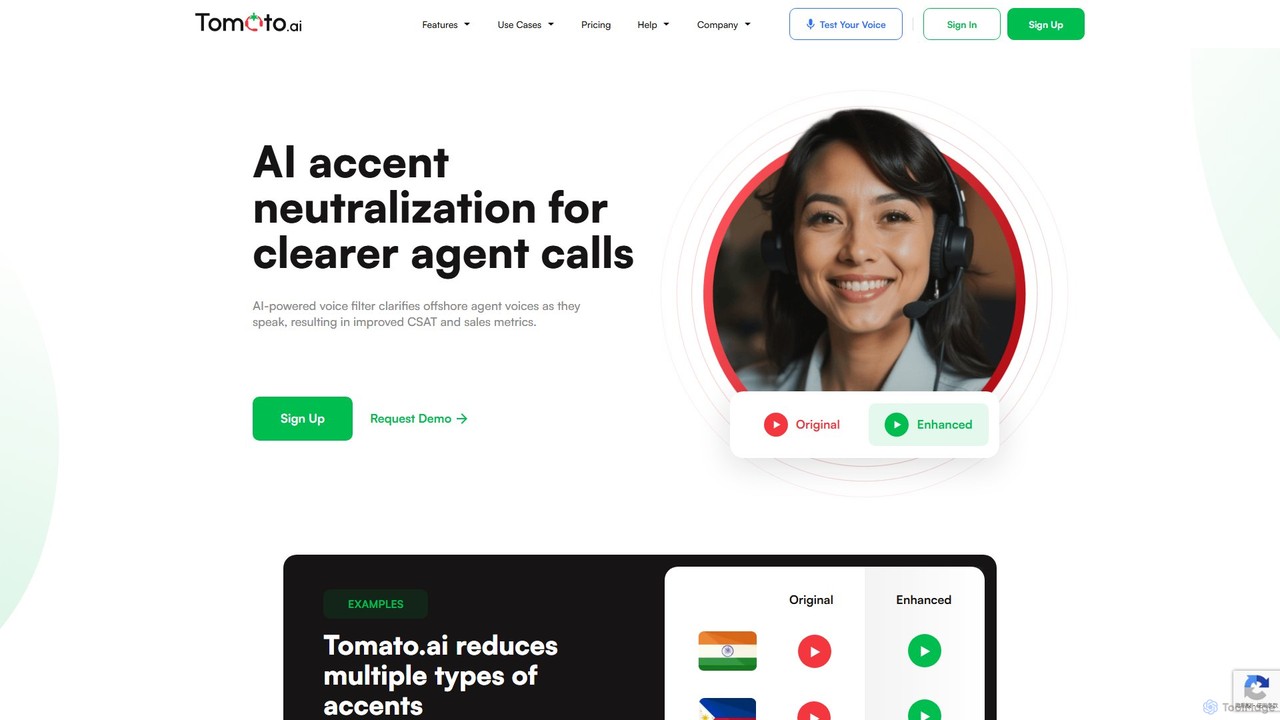
Tomato.ai is an AI-powered voice filtering solution designed for call centers. It neutralizes and reduces the accents of offshore agents in real-time, making their speech clearer to customers. This enhances communication, improves customer satisfaction (CSAT), and boosts sales metrics by reducing misunderstandings and frustration.

Voice Modulation
Visits 11.2KFavorites 142Likes 130

About Accent Reduction

AI Accent Reduction tools are a specialized category of speech technology designed to help users modify their pronunciation and intonation to sound more like a native speaker. Leveraging advanced speech recognition and phoneme analysis, these tools compare a user's speech against a standard model, providing real-time, granular feedback. They are highly effective for language learners, professionals in global roles, and actors who need to master a specific accent for clear communication. Unlike general language apps, they focus specifically on the nuances of prosody, rhythm, and individual sound articulation.

Core Features

  • Phoneme-Level Analysis: Provides detailed feedback on the articulation of individual vowel and consonant sounds.
  • Intonation & Prosody Visualization: Maps and corrects speech melody, stress patterns, and rhythm to match native speakers.
  • Real-Time Audio Comparison: Allows users to record their voice and immediately compare it with a native speaker's model.
  • Personalized Learning Paths: Generates custom exercises based on the user's specific pronunciation challenges and progress.
  • Speech Scoring: Offers objective scores on clarity, fluency, and accuracy to track improvement over time.

Applicable Scenarios

These tools are widely used by non-native professionals in multinational corporations to enhance communication clarity in meetings and presentations. They are also essential for customer service agents in global call centers to ensure they are easily understood by customers. Additionally, actors and voice artists use them for dialect coaching and preparation for specific roles.

Selection Criteria

When choosing an Accent Reduction tool, evaluate the range of target accents available (e.g., General American, British RP). Assess the granularity of the feedback—tools that offer phoneme-level diagnostics are more effective. Consider the quality and variety of practice materials, such as conversational dialogues and business-specific vocabulary. Finally, check for progress tracking features to monitor your improvement effectively.

Featured tool rankings

Accent Reduction use cases

1

Enhancing Clarity for International Business Professionals

A project manager from Japan working with a US team uses an accent reduction tool to practice for presentations. The AI analyzes their pronunciation of key business terms and the intonation of questions, providing instant feedback. This practice helps them communicate more confidently and avoids misunderstandings in high-stakes meetings, ensuring their points are clearly understood by stakeholders.

2

Improving Customer Service Communication Quality

A call center in the Philippines trains its agents using AI accent reduction software. The tool provides standardized training on a neutral American accent, focusing on common customer service phrases. Agents practice dialogues and receive scores on clarity and rhythm, leading to higher customer satisfaction scores and reduced call times due to clearer, more efficient communication.

3

Preparing Actors for Roles with Specific Accents

An actor preparing for a role requiring a Received Pronunciation (RP) British accent uses the tool. They upload lines from the script, and the AI compares their delivery to a native RP model. It highlights differences in vowel sounds and sentence stress, allowing for targeted practice. This process accelerates their dialect coaching and helps them achieve a more authentic and consistent performance.

4

Aiding Language Learners in Advanced Pronunciation

An advanced Spanish learner of English has mastered grammar but struggles with pronunciation. They use an accent reduction app that creates a personalized curriculum focusing on difficult sounds like 'th' and 'r'. Daily, gamified exercises help them build muscle memory and sound more natural in conversations, moving beyond textbook learning to achieve near-native fluency.

5

Assisting University Students with Academic Presentations

An international student at an American university uses an AI speech coach to rehearse their thesis defense. The tool provides feedback on their pacing, use of pauses, and clarity of technical terms. This practice builds their confidence, ensuring their complex research is presented clearly and professionally to the academic committee, removing language barriers as a potential obstacle.

6

Training for Standardized Language Tests (IELTS/TOEFL)

A candidate preparing for the speaking section of the TOEFL test uses an accent reduction tool to improve their pronunciation score. They practice answering sample questions, and the AI provides a predicted score based on fluency, intonation, and phoneme accuracy. This allows them to identify specific weak areas, such as vowel length or sentence stress, and focus their practice for a higher score on exam day.

Accent Reduction FAQ

What is an AI Accent Reduction tool?

An AI Accent Reduction tool is a software application that uses artificial intelligence to analyze your speech and help you modify your accent. It provides specific, real-time feedback on pronunciation, intonation, rhythm, and stress to help you sound clearer and more like a native speaker of your target language. These tools function as a personal, on-demand speech coach, offering targeted exercises and progress tracking.

How to choose the right Accent Reduction tool?

When choosing a tool, consider these key factors:

  • Supported Accents: Ensure it offers the specific accent you want to learn (e.g., General American, British RP, Australian).
  • Feedback Detail: Look for tools that provide phoneme-level analysis and intonation feedback, not just a general score.
  • Practice Content: Check for a rich library of real-world scenarios, dialogues, and industry-specific vocabulary.
  • Technology: Prioritize tools that use advanced speech recognition for more accurate and personalized analysis.
What's the difference between Accent Reduction tools and general language learning apps?

General language learning apps (like Duolingo or Babbel) focus broadly on vocabulary, grammar, and basic pronunciation. AI Accent Reduction tools are highly specialized. They assume you already know the language and focus exclusively on the mechanics of speech—fine-tuning individual sounds, rhythm, and intonation to match a specific native accent. They offer much more granular phonetic feedback than general-purpose language apps.

Can these tools completely eliminate my accent?

The goal of these tools is typically 'accent modification' or 'reduction,' not complete elimination. The primary aim is to improve clarity, reduce communication barriers, and increase confidence. While consistent practice can lead to a significantly more native-like accent, completely eliminating an accent is very difficult and often not necessary. The focus is on clear and effective communication rather than achieving a 'perfect' accent.

Who can benefit from using Accent Reduction software?

A wide range of individuals can benefit, including:

  • Non-native professionals working in an international environment.
  • Customer support agents who need to be clearly understood by a global audience.
  • Actors and voice-over artists preparing for specific dialects.
  • Advanced language learners aiming for near-native fluency.
  • International students and academics who give presentations.

Anyone who wants to improve their spoken clarity and confidence in a second language can find these tools useful.