
ToolMage
Sign in

Best 1 Funding AI tools for Startup

Popular Funding AI tools in Startup include PitchPal, helping you work more efficiently.

PitchPal
Freemium

PitchPal

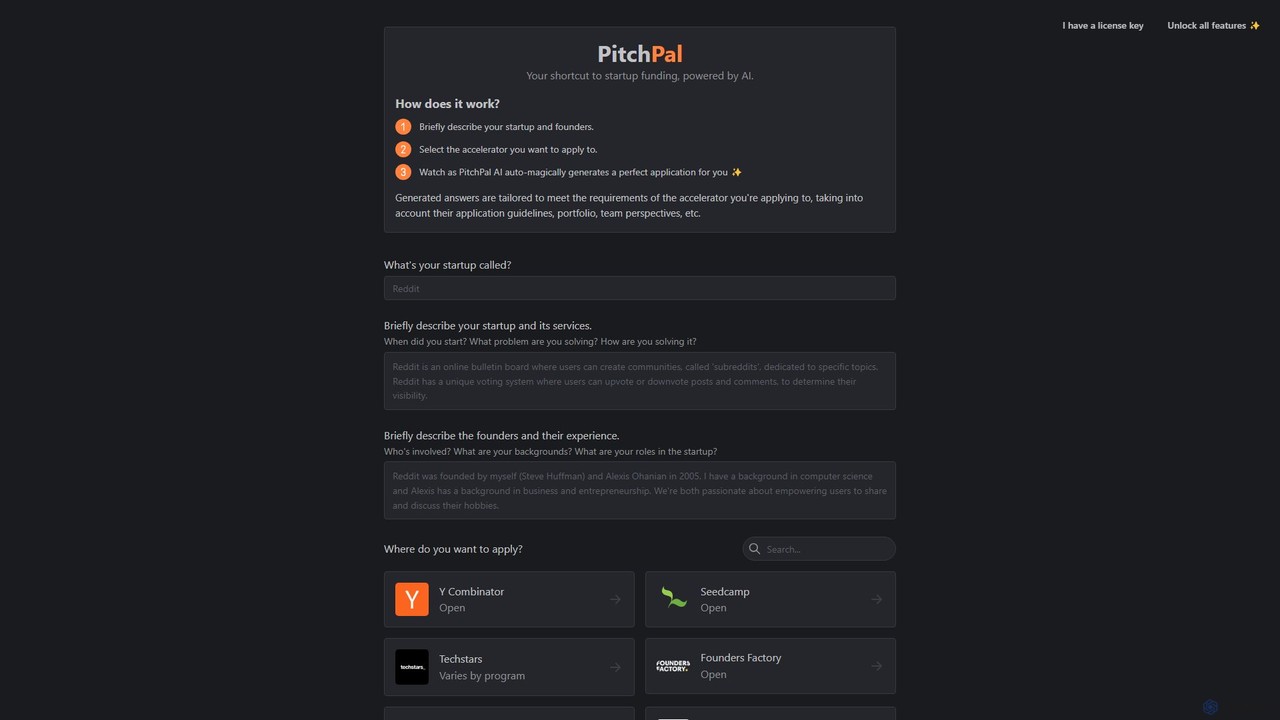
PitchPal is an AI-powered platform designed to help startups streamline their application process for accelerators like Y Combinator and Techstars. By inputting basic information about their company and founders, users can generate perfectly tailored, high-quality application answers that align with each accelerator's specific guidelines, portfolio, and values, significantly increasing their chances of securing funding.

Venture Capital
Visits 6.6KFavorites 120Likes 125

About Funding

AI Funding tools are specialized platforms that leverage artificial intelligence to streamline and optimize the fundraising process for startups and businesses. These tools utilize machine learning algorithms to analyze market data, identify potential investors, and automate various aspects of due diligence and investor relations. They empower founders to efficiently secure capital, make data-driven investment decisions, and accelerate growth within the competitive startup landscape.

Core Features

  • Investor Matching & Discovery: AI algorithms connect startups with suitable investors based on industry, stage, and investment thesis.
  • Due Diligence Automation: Tools rapidly analyze financial documents, market trends, and legal data to flag risks and opportunities.
  • Financial Modeling & Projections: AI assists in generating accurate revenue forecasts, valuation models, and scenario analyses for strategic planning.
  • Pitch Deck Optimization: Provides data-driven feedback and suggestions to enhance pitch deck content, messaging, and visual appeal.
  • Deal Flow Management: Automates tracking of investor interactions, communication, and fundraising pipeline progress.

Applicable Scenarios

These tools are invaluable for early-stage startups seeking seed or angel investment, growth-stage companies preparing for Series A/B rounds, and venture capital firms or angel investors looking to optimize deal sourcing and analysis. They support founders in navigating complex fundraising landscapes and investors in making informed decisions.

How to Choose

When selecting an AI Funding tool, consider the accuracy and relevance of its investor matching algorithms, the depth of its due diligence automation capabilities, and its integration with existing financial and CRM systems. Evaluate data privacy and security measures, customization options for specific industry needs, and the overall user experience to ensure it aligns with your fundraising strategy.

Funding use cases

1

Automated Investor Matching for Seed Rounds

Early-stage startup founders can input their company profile, industry, and funding requirements into an AI funding platform. The AI then analyzes thousands of investor portfolios and investment theses to identify and recommend the most suitable angel investors or seed-stage venture capitalists, significantly reducing the time spent on manual outreach and increasing the likelihood of a successful match.

2

Enhanced Due Diligence for Venture Capital Firms

Venture capital analysts utilize AI funding tools to accelerate their due diligence process. By uploading financial statements, market research, and legal documents, the AI can rapidly scan for discrepancies, identify potential risks, and highlight key opportunities, providing a comprehensive overview that would take human analysts days or weeks to compile, thus speeding up investment decisions.

3

Optimizing Pitch Deck Content and Delivery

Founders preparing for investor presentations can leverage AI tools to refine their pitch decks. The AI analyzes the deck's structure, messaging, data presentation, and even tone, comparing it against a vast database of successful pitches. It provides actionable feedback on areas like clarity, conciseness, and persuasive language, helping founders create a more compelling and impactful presentation.

4

Predictive Financial Modeling for Strategic Growth

Growth-stage companies use AI funding platforms to generate sophisticated financial models and revenue projections. By feeding historical data and market assumptions, the AI can forecast future performance with greater accuracy, identify key growth drivers, and model various scenarios. This capability is crucial for strategic planning, setting realistic milestones, and negotiating terms with potential investors.

5

Identifying Emerging Market Opportunities for Investors

Investment firms employ AI to continuously monitor global news, social media trends, academic research, and industry reports. The AI identifies nascent technologies, disruptive business models, and underserved markets that present high-growth investment opportunities. This proactive approach allows investors to spot emerging trends and potential unicorns early, gaining a competitive edge in deal sourcing.

6

Streamlining Grant Application Processes for Research Startups

Research-focused startups or non-profits often rely on grants. AI funding tools can help by identifying relevant grant opportunities from various governmental and private organizations based on the startup's mission and research focus. Furthermore, some AI tools can assist in drafting compelling proposals by analyzing grant requirements and successful past applications, improving the chances of securing non-dilutive funding.

Funding FAQ

What are AI Funding tools?

AI Funding tools are software solutions that use artificial intelligence, primarily machine learning and natural language processing, to automate and enhance various stages of the fundraising and investment process. They help startups find investors, optimize their pitches, and manage investor relations, while also assisting investors in deal sourcing, due diligence, and portfolio analysis.

How do AI Funding tools assist startups in securing capital?

AI Funding tools assist startups by providing data-driven insights for investor matching, connecting them with VCs and angel investors whose investment thesis aligns with the startup's profile. They also help optimize pitch decks, create robust financial models, and streamline communication, significantly increasing efficiency and the likelihood of securing capital compared to traditional, manual fundraising efforts.

What's the difference between traditional fundraising methods and using AI Funding tools?

Traditional fundraising relies heavily on personal networks, manual research, and often time-consuming outreach. AI Funding tools, in contrast, offer a data-driven, automated, and more efficient approach. They can rapidly analyze vast datasets to identify optimal investor matches, automate due diligence, and provide predictive analytics, reducing human bias and accelerating the entire fundraising cycle.

What should I consider when choosing an AI Funding platform?

When selecting an AI Funding platform, evaluate its core functionalities such as investor matching accuracy, due diligence automation, and financial modeling capabilities. Consider its integration with your existing tools, data security protocols, and the platform's reputation. Also, assess the user interface's intuitiveness and whether it offers customization options tailored to your specific industry or fundraising stage.

Can AI Funding tools help with post-investment management?

Yes, many AI Funding tools extend their capabilities beyond securing initial capital to assist with post-investment management. They can help track key performance indicators (KPIs), automate investor reporting, manage communication with stakeholders, and even provide insights for follow-on funding rounds. This ensures ongoing transparency and efficient management of investor relations throughout the startup's lifecycle.