Startup Best in category 1 results Ideation AI Tool

Popular AI tools in the Ideation field of Startup include APEX, etc., helping you quickly improve efficiency.

APEX

APEX

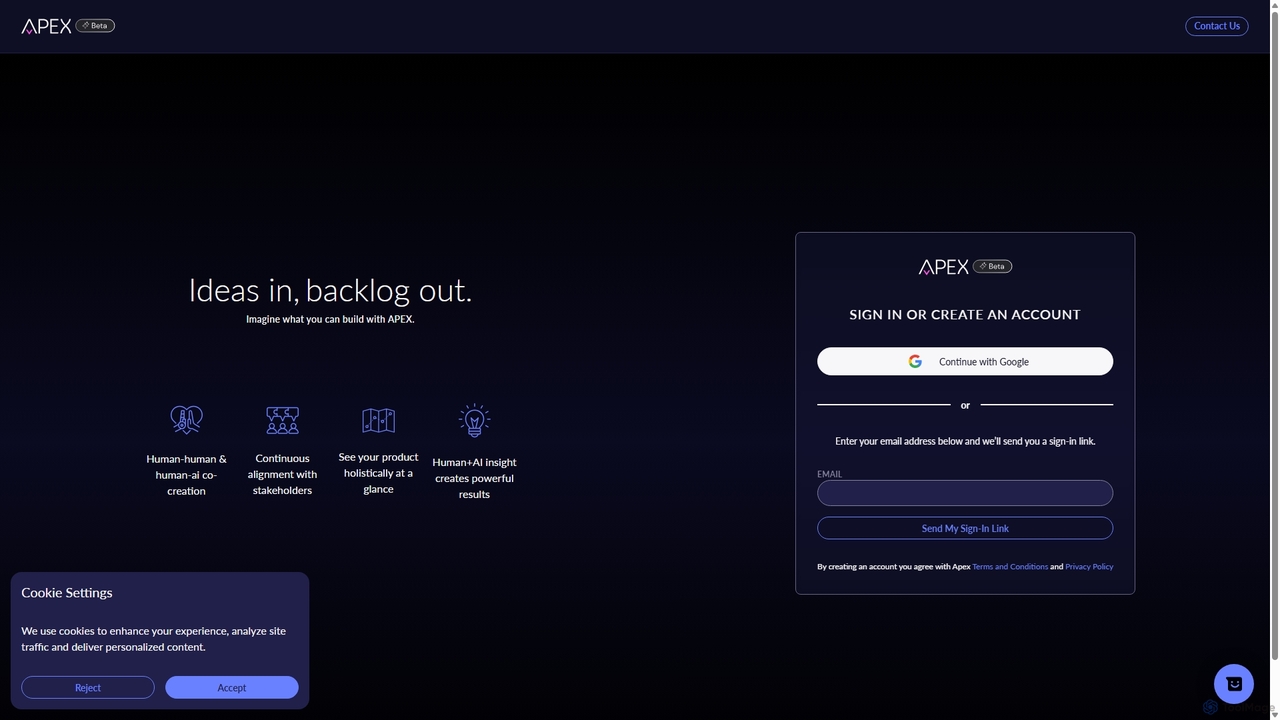
APEX is an AI-powered product exploration and management platform designed to streamline the journey from idea to backlog. …

2.6K

About Ideation

AI Ideation tools are specialized platforms designed to help startup founders and innovators generate, analyze, and refine business concepts. These tools leverage large language models and data analysis to transform simple prompts into structured business ideas, market analyses, and creative strategies. They are invaluable for overcoming creative blocks, identifying market gaps, and accelerating the initial, most critical phase of a startup's journey. By providing data-driven insights and diverse perspectives, they help validate ideas before significant resources are invested.

Core Features

  • Business Concept Generation: Creates novel business ideas, product names, and value propositions based on user-defined parameters like industry and target audience.
  • Market Trend Analysis: Scans and synthesizes market data to identify emerging trends, customer needs, and potential opportunities for disruption.
  • Competitive Landscape Mapping: Analyates existing competitors to identify their strengths, weaknesses, and strategic positioning, revealing potential market gaps.
  • User Persona Creation: Generates detailed, fictional user profiles based on target demographics and psychographics to guide product development.
  • Structured Brainstorming: Utilizes established business frameworks like SWOT analysis or Lean Canvas to guide and structure the ideation process.

Use Cases

AI Ideation tools are primarily used by entrepreneurs, product managers, and marketing strategists in the early stages of a new venture or product launch. For instance, a founder can use them to brainstorm niche SaaS ideas, a product team can generate feature lists for a Minimum Viable Product (MVP), and a marketing team can develop unique campaign angles by understanding the competitive landscape.

How to Choose

When selecting an AI Ideation tool, consider the following: First, evaluate the depth and source of its data; tools with real-time market data offer more relevant insights. Second, check for support of specific business frameworks that align with your process. Third, assess collaboration features if you are working in a team. Finally, consider the tool's focus—some are better for creative branding, while others excel at data-driven business model analysis.

IdeationUse Cases

1

Discovering a Niche SaaS Product Idea

A solo founder with a background in software development wants to build a new SaaS product but is unsure which market to enter. They use an AI Ideation tool by inputting broad areas of interest like 'project management for creative agencies' and 'productivity tools for remote teams'. The tool analyzes market saturation, recent funding trends, and online discussions to suggest several underserved niches. One suggestion is a lightweight project management tool specifically for freelance motion designers, highlighting their unique workflow needs that larger platforms ignore. The founder receives a preliminary feature set, target user persona, and potential pricing models, saving weeks of manual research.

2

Generating Brand Names and Taglines

A new e-commerce startup selling sustainable home goods needs a memorable brand name and tagline. The marketing team is stuck on generic ideas. They turn to an AI Ideation tool, providing keywords like 'eco-friendly', 'minimalist', 'home', and 'conscious living', along with their core brand values. The AI generates hundreds of options categorized by style (e.g., modern, classic, abstract). It also produces taglines that communicate the brand's mission. The team is able to quickly shortlist five strong candidates and use the AI's suggestions to A/B test taglines, accelerating their brand launch process significantly.

3

Validating a Business Concept with Data

An entrepreneur has an idea for a mobile app that connects local farmers with urban consumers. Before building an MVP, she uses an AI Ideation tool to validate the concept. She inputs her core idea, target geography, and user demographics. The tool performs a preliminary market analysis, pulling data on the size of the urban organic food market, identifying key competitors (both direct and indirect), and summarizing common customer complaints about existing solutions. It generates a SWOT analysis, highlighting the strength of her community-focused approach but also the threat of large grocery delivery services. This data-driven report helps her refine her value proposition and identify key risks early on.

4

Brainstorming a Content Strategy for a New Blog

A startup launching a B2B fintech solution needs to build authority through content marketing. A content strategist uses an AI Ideation tool to develop a content plan. They input their target audience ('CFOs in mid-sized companies') and core topics ('automating accounts payable', 'financial forecasting'). The AI generates a list of pillar page ideas, such as 'The Ultimate Guide to AP Automation', and suggests dozens of related cluster topics for blog posts, like 'Top 5 AP Automation Software in 2024' and 'How to Calculate ROI on Fintech Investments'. For each topic, it provides target keywords, common user questions, and suggested outlines, creating a comprehensive content calendar in minutes.

5

Developing an MVP Feature Roadmap

A product manager is tasked with defining the Minimum Viable Product (MVP) for a new mobile application. To avoid feature bloat, they use an AI Ideation tool. They describe the core problem the app solves: 'Helping amateur gardeners identify and treat plant diseases'. The AI, using frameworks like the MoSCoW method (Must-have, Should-have, Could-have, Won't-have), generates a prioritized feature list. 'Must-haves' include image recognition for disease identification and a database of treatments. 'Could-haves' include a community forum. This structured output helps the team focus development efforts on core functionalities that deliver immediate value to early adopters, ensuring a leaner and faster launch.

6

Crafting a Unique Value Proposition (UVP)

A startup team is developing a new project management tool in a crowded market. They struggle to articulate what makes their product different. Using an AI Ideation tool, they input information about their top three competitors and their own planned features. The AI analyzes competitor websites, user reviews, and marketing copy to identify common themes and customer pain points. It then generates several potential UVPs for the startup, such as 'The first project management tool with built-in automated time tracking for billing' or 'The simplest visual task board for non-technical teams'. This helps the team clarify their unique selling point and build their entire marketing message around it.

IdeationFrequently Asked Questions