ToolMage
Sign in

Best 1 Validation AI tools for Startup

Popular Validation AI tools in Startup include Valident, helping you work more efficiently.

Valident
Freemium

Valident

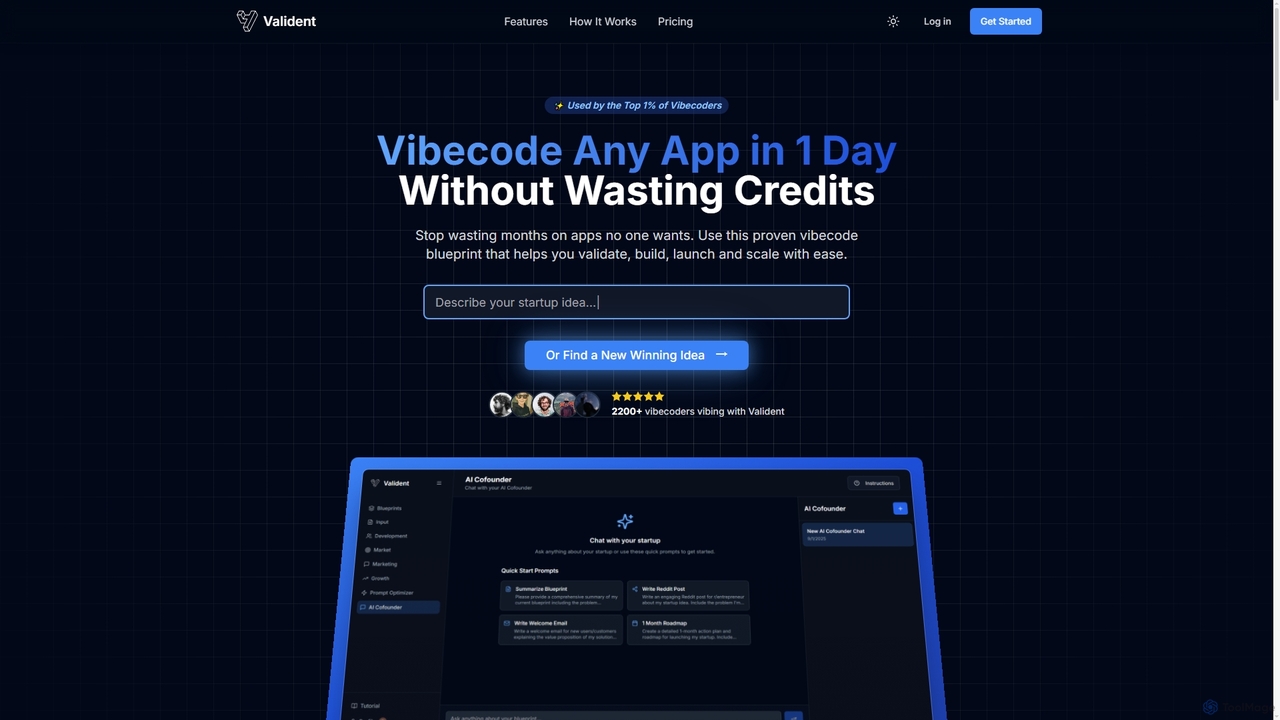
Valident is an AI-powered platform designed for entrepreneurs and no-code builders to validate, build, and launch their startup ideas rapidly. It offers a comprehensive blueprint, market validation, competitive analysis, and marketing content generation, aiming to help users launch their MVP in as little as 24 hours without wasting resources.

Business Coaching
Visits 9.6KFavorites 155Likes 160

About Validation

AI Validation tools are a specialized category of software designed to help startups and entrepreneurs test business ideas and product concepts with data-driven methods. These tools leverage artificial intelligence to analyze market signals, simulate user feedback, and generate predictive insights from minimal input. This enables founders to quickly assess the viability of a new venture, identify the target audience, and refine their strategy before committing significant time and capital. They effectively reduce the risk associated with launching a new product or service.

Core Features

  • Hypothesis Testing: Automatically generate landing pages, ad copy, and surveys to measure user interest in a specific value proposition.
  • Market Signal Analysis: Scans social media, forums, and search trends to identify underserved needs and gauge demand for a potential solution.
  • Simulated User Feedback: Creates AI-generated user personas and feedback to anticipate potential objections, questions, and feature requests.
  • Competitive Landscape Mapping: Identifies and analyzes existing and potential competitors, summarizing their offerings, pricing, and market positioning.
  • Idea Viability Scoring: Provides a data-backed score or analysis on the potential success of a business idea based on various market factors.

Use Cases

These tools are primarily used by early-stage founders, product managers, and intrapreneurs within larger organizations. They are crucial during the ideation and pre-launch phases to validate a core problem, test a solution's appeal, and find a product-market fit without building a full-scale product.

How to Choose

When selecting an AI Validation tool, consider the specific validation method you need (e.g., landing page testing vs. market trend analysis). Evaluate the quality and sources of its data, the speed at which it generates insights, and its ability to integrate with other marketing or analytics platforms. Also, assess the user interface's simplicity, as speed is critical in the validation stage.

Validation use cases

1

Testing a New SaaS Idea Before Development

An entrepreneur has an idea for a project management SaaS tool for remote teams. Instead of spending months on development, they use an AI Validation tool to generate a professional landing page in minutes. The tool creates multiple versions of the value proposition and pricing tiers. By running a small ad campaign directed at this page, the founder can measure sign-up intent and collect email addresses, validating real market interest before writing a single line of code.

2

Validating a Niche E-commerce Product

A small business owner wants to launch a line of biodegradable pet toys. To confirm if a sufficient market exists, they use an AI tool to analyze online conversations on platforms like Reddit, pet owner forums, and social media groups. The AI identifies key themes, pain points (e.g., durability of eco-friendly toys), and purchase intent signals. This data helps them validate the niche and refine their product features to meet specific customer demands.

3

Assessing Demand for a New App Feature

A product manager for a fitness app is considering adding an AI-powered meal planning feature. To gauge user interest, they use a validation tool to create an in-app survey and a "coming soon" feature preview. The tool's AI analyzes open-ended survey responses for sentiment and common themes, while the preview page tracks how many users click "notify me." This provides quantitative and qualitative data to justify the development resources required.

4

Refining a Go-to-Market Message

A B2B startup is preparing to launch but is unsure which messaging will resonate with its target audience of CTOs. They use an AI validation platform to test three different core messages focused on cost savings, security, and developer productivity. The platform generates simple, one-page websites for each message and analyzes engagement metrics. This A/B test quickly reveals which value proposition is most compelling to their ideal customer profile.

5

Simulating Customer Objections for Sales Training

A startup is launching a new fintech service and needs to prepare its sales team. They use an AI validation tool to create a profile of their ideal customer and the proposed service. The AI then generates a list of likely questions, concerns, and objections a potential customer might raise during a sales call. This allows the team to prepare well-researched answers and refine their sales pitch for higher effectiveness from day one.

6

Pre-launch Competitive Landscape Analysis

Before entering a crowded market, a startup needs a clear picture of its competitors. They use an AI tool that scans the web to identify all direct and indirect competitors. The tool automatically creates a report summarizing each competitor's key features, pricing models, target audience, and recent marketing activities. This provides a comprehensive overview of the competitive landscape in hours, a task that would manually take weeks.

Validation FAQ

What are AI Validation tools for startups?

AI Validation tools are software applications that use artificial intelligence to help entrepreneurs and businesses test the viability of their ideas before full-scale development. They automate tasks like market research, competitor analysis, and user interest testing. By analyzing data from various sources and even simulating user feedback, these tools provide quick, data-driven insights to reduce the risk of business failure and guide strategic decisions in the crucial early stages.

How do I choose the right AI Validation tool?

Choosing the right tool depends on your specific goal. Consider the following factors:

  • Validation Method: Do you need to test a landing page, analyze market trends, or get simulated feedback? Pick a tool that specializes in your required method.
  • Data Sources: Check what data the tool analyzes (e.g., social media, search data, proprietary datasets) to ensure it's relevant to your market.
  • Speed and Usability: The primary benefit is speed. Choose a tool with an intuitive interface that allows you to get results quickly.
  • Cost: Evaluate the pricing model. Some tools offer one-time reports, while others are subscription-based.

What's the difference between AI Validation tools and traditional market research?

The main differences are speed, cost, and scale. Traditional market research often involves manual processes like surveys, focus groups, and interviews, which can be time-consuming and expensive. AI Validation tools automate much of this process, delivering insights in hours or days instead of weeks or months. They can analyze massive datasets (like the entire web) that are inaccessible to manual research, and often use predictive models to forecast potential outcomes, whereas traditional research is typically retrospective.

What key features should I look for in an AI Validation tool?

Look for features that align with the lean startup methodology. Key functions include:

  • Landing Page Generation & Testing: To quickly test value propositions.
  • Audience Analysis: To identify and understand your target customer segment.
  • Market Trend & Keyword Analysis: To gauge demand and discover market gaps.
  • Competitor Identification: To understand the competitive landscape.
  • AI-Generated Feedback & Reports: To get quick, actionable insights without manual data sifting.

Who can benefit most from using AI Validation tools?

AI Validation tools are most beneficial for early-stage startup founders, solo entrepreneurs, and product managers. These individuals need to make critical decisions with limited resources and time. They use these tools to de-risk their ventures by ensuring they are building something customers actually want. Additionally, intrapreneurs within large corporations can use them to test new product initiatives or business units before seeking significant internal investment.