
ToolMage
Sign in

Best 1 Assistance AI tools for Travel

Popular Assistance AI tools in Travel include Voyana AI, helping you work more efficiently.

Voyana AI
Freemium

Voyana AI

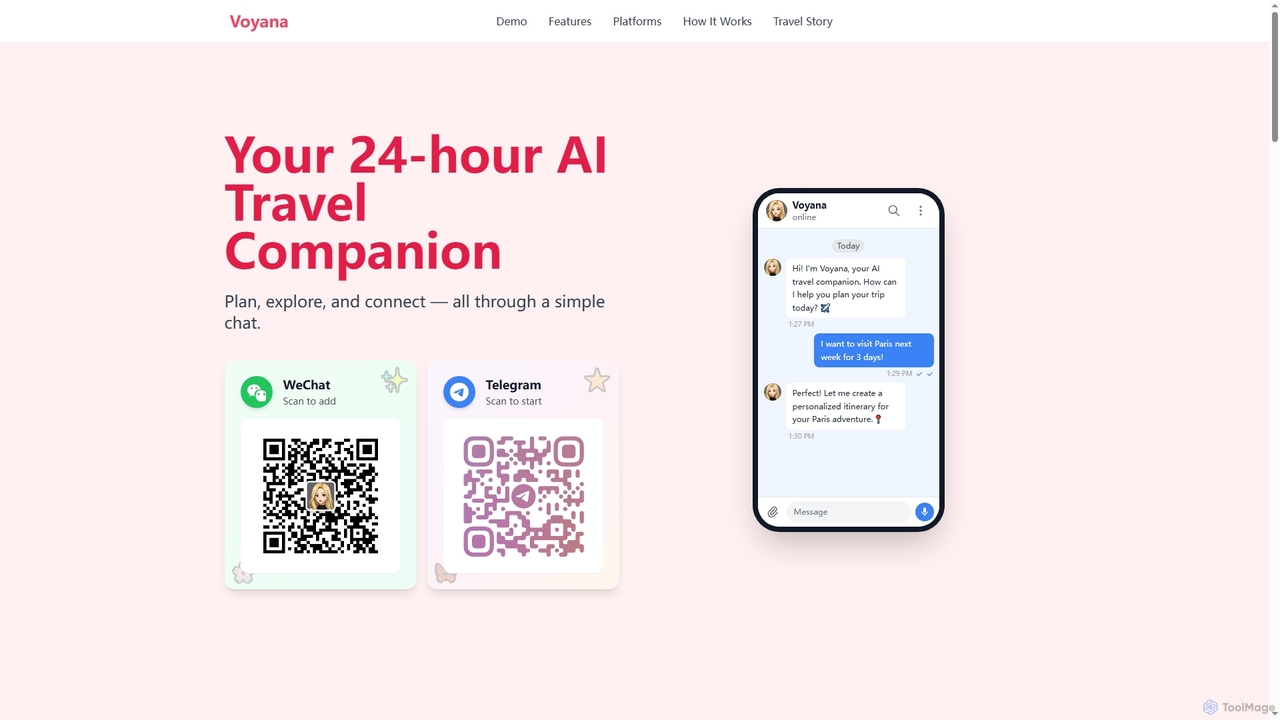
Voyana AI is your 24/7 AI travel companion designed to simplify trip planning, provide real-time assistance, and connect you with like-minded travelers. Available on WeChat and Telegram, it offers personalized itineraries, instant answers to travel questions, and a unique travel buddy matching service, making every journey smoother and more enjoyable.

Travel
Visits 8.3KFavorites 104Likes 120

About Assistance

AI Travel Assistance tools are digital companions that provide real-time, on-the-go support for travelers during their journey. These tools leverage technologies like natural language processing and geolocation to offer instant solutions to common travel challenges. They enhance the travel experience by providing safety, convenience, and immediate access to local information. This makes navigating unfamiliar environments simpler and more secure.

Core Features

  • Real-time Translation: Instantly translate conversations, text, and signs to overcome language barriers.
  • Intelligent Local Guidance: Receive context-aware suggestions for attractions, restaurants, and transport based on your location and preferences.
  • Emergency Support: Quickly access contact information for local emergency services, embassies, and hospitals.
  • Dynamic Itinerary Management: Get live updates on flight delays, gate changes, and booking reminders.
  • AI-Powered Concierge: Ask questions and get help with tasks like booking last-minute tours or finding specific services.

Use Cases

These tools are ideal for international tourists, solo travelers, and business professionals on assignment. For example, a traveler can use the tool to communicate a dietary allergy at a restaurant in a foreign language, or a business traveler can find the quickest route to a meeting after a sudden train cancellation.

How to Choose

When selecting an AI Travel Assistance tool, consider its offline capabilities, as internet access can be unreliable. Evaluate the breadth of language support for your destination. Check for integrations with your calendar and booking apps for seamless itinerary management. Finally, determine if you need a simple translator or a comprehensive assistant with emergency and concierge features.

Assistance use cases

1

Overcoming Language Barriers While Dining

A solo traveler in Japan with a severe nut allergy needs to communicate this clearly at a local restaurant. Using an AI Travel Assistance tool on their phone, they utilize the real-time voice translation feature. They speak their allergy information in English, and the app instantly translates and vocalizes it in fluent Japanese to the waiter. This ensures the chef is aware of the critical dietary restriction, allowing the traveler to enjoy their meal safely and without communication stress.

2

Handling a Minor Medical Emergency

While hiking in Italy, a tourist suffers a minor sprain. Unsure of where to go, they use their AI assistant. The tool identifies the nearest 'farmacia' (pharmacy) that is currently open and provides walking directions. Once there, they use the app's text translation feature to show the pharmacist a pre-written description of their symptoms. The pharmacist understands immediately and provides the appropriate bandage and pain relief cream, resolving the situation quickly and efficiently.

3

Adapting to Unexpected Travel Disruptions

A business traveler's flight to Berlin is delayed by three hours, jeopardizing their first meeting. Their AI Travel Assistance tool, synced with their airline app and calendar, sends an instant alert. It automatically calculates the new arrival time, suggests an alternative S-Bahn route from the airport to bypass traffic, and drafts an email in German to their client explaining the delay and providing an updated ETA. This proactive support turns a stressful situation into a manageable one.

4

Discovering Authentic Local Experiences

A couple in Lisbon wants to avoid tourist traps and find an authentic Fado music venue. Instead of generic web searches, they ask their AI assistant: 'Where can we see traditional Fado tonight that's popular with locals?' The tool analyzes local blogs, social media check-ins, and event listings in Portuguese. It returns three highly-rated, non-touristy options with reviews, sample menus, and integrated booking links, providing a curated and culturally rich experience they wouldn't have found otherwise.

5

Navigating Public Transportation with Ease

A first-time visitor to Paris is intimidated by the complex Métro system. They use their AI assistant to plan a multi-stop journey. The tool provides the most efficient route, including which lines to take, where to transfer, and which exit to use at the final station. It also sends real-time alerts about service disruptions on their chosen line and suggests an alternative bus route instantly, turning a potentially confusing experience into a simple, guided process.

6

Ensuring Family Safety in Crowded Places

A family visiting a large theme park uses an AI assistance app with group features. The parents create a geofenced 'safe zone' within the park on a map. If one of the children's phones moves outside this zone, the parents receive an immediate alert. The app also provides a one-tap 'meet me' button that shares the user's live location with the rest of the group, making it simple to reunite in crowded areas and providing peace of mind throughout the day.

Assistance FAQ

What are AI Travel Assistance tools?

AI Travel Assistance tools are mobile applications or services that act as a real-time digital companion for travelers. Unlike trip planners used for booking in advance, these tools are designed for on-the-go use during a trip. They provide instant support for challenges like language barriers, navigation in unfamiliar cities, and handling unexpected disruptions. Key features often include real-time translation, local recommendations, and emergency support.

How do I choose the right AI Travel Assistant?

To choose the right tool, consider these factors:

  • Offline Functionality: Check if key features like maps and translation work without an internet connection, which is crucial for areas with poor connectivity.
  • Language Coverage: Ensure the tool supports the languages of your destination for both text and voice translation.
  • Scope of Features: Decide if you need a simple translator or a comprehensive assistant with itinerary management, emergency contacts, and local recommendations.
  • Integrations: Look for tools that can sync with your calendar, email, or booking confirmations to automate itinerary updates.
What's the difference between a Travel Assistance tool and a trip planner?

The main difference is their primary use case. A trip planner is used before you travel. Its main purpose is to help you research, organize, and book flights, accommodations, and activities. A Travel Assistance tool is used during your trip. It focuses on real-time problem-solving, such as live translation, navigating local transport, finding nearby services, and adapting to unexpected changes like flight delays.

Do AI Travel Assistance tools work without an internet connection?

It varies by tool and feature. Many leading AI Travel Assistance apps offer offline functionality for essential features. For example, you can often download maps for a specific city or language packs for translation before your trip. This allows you to navigate and translate basic phrases without needing a data connection. However, real-time features like live traffic updates, flight status alerts, or online bookings will always require an internet connection.

Who can benefit most from AI Travel Assistance tools?

While any traveler can benefit, these tools are particularly valuable for:

  • Solo Travelers: Providing an extra layer of safety and support when navigating alone.
  • First-Time International Visitors: Helping to overcome the initial challenges of language barriers and unfamiliar public transport systems.
  • Business Travelers: Offering efficiency for managing tight schedules, adapting to flight changes, and navigating to meetings.
  • Families: Assisting with coordination, finding family-friendly activities, and providing safety features like location sharing.