Web3 Best in category 1 results Development AI Tool

Popular AI tools in the Development field of Web3 include CrackedDevs, etc., helping you quickly improve efficiency.

CrackedDevs

CrackedDevs

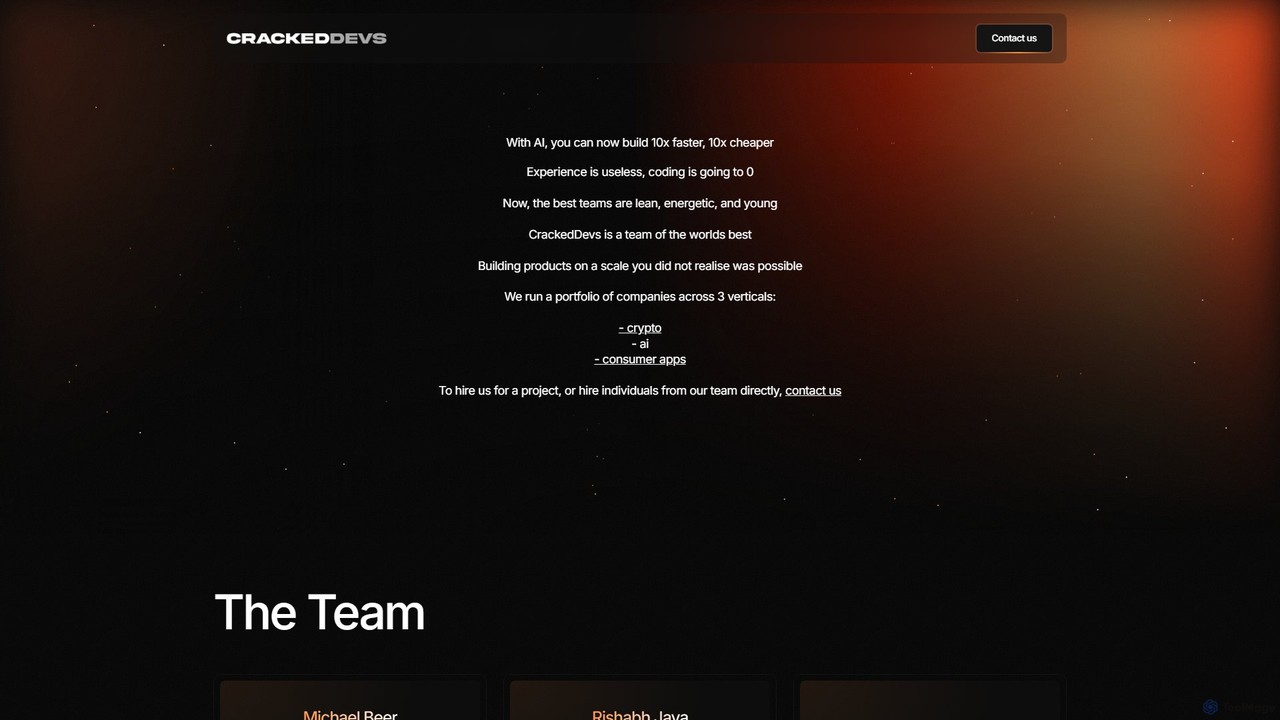
CrackedDevs is an elite development agency offering custom software solutions. Comprised of top-tier developers, designers, and hackathon winners, …

4.6K

About Development

AI Web3 Development tools are a specialized category of software that leverages artificial intelligence to streamline the creation, testing, and security of decentralized applications (dApps) and smart contracts. These tools utilize machine learning models to automate complex tasks like code generation, vulnerability detection, and on-chain data analysis. They empower developers to build more robust, secure, and efficient blockchain solutions while significantly reducing development time and human error. This enables faster innovation in areas like DeFi, NFTs, and DAOs.

Core Features

  • AI-Powered Code Generation: Automatically generates code snippets or entire smart contracts in languages like Solidity or Rust based on natural language prompts.
  • Smart Contract Auditing: Uses AI to scan code for common security vulnerabilities, logical flaws, and gas optimization opportunities before deployment.
  • On-Chain Data Analytics: Applies machine learning algorithms to interpret complex blockchain data, identify trends, and predict market behavior.
  • Automated Testing: Generates comprehensive test cases to ensure the reliability and correctness of smart contract logic under various scenarios.
  • Natural Language to Query: Translates plain English queries into specific data retrieval commands for blockchain explorers and databases.

Use Cases

These tools are primarily used by blockchain developers, security auditors, and data analysts in the Web3 space. They are crucial for building DeFi protocols, creating secure NFT marketplaces, developing governance mechanisms for DAOs, and performing in-depth analysis of on-chain activities for investment or research purposes.

How to Choose

When selecting an AI Web3 Development tool, consider the following: compatibility with your target blockchain (e.g., Ethereum, Solana), supported programming languages (e.g., Solidity, Rust), the depth and accuracy of its security auditing features, integration with existing development environments like Hardhat or Truffle, and the clarity of its data analysis reports.

DevelopmentUse Cases

1

Automating Smart Contract Security Audits

A DeFi protocol developer is preparing to launch a new lending platform on Ethereum. Before deployment, they use an AI-powered auditing tool to scan their Solidity smart contracts. The tool automatically identifies potential vulnerabilities such as reentrancy risks, integer overflow/underflow issues, and access control flaws. It provides a detailed report with code-level suggestions for remediation, allowing the developer to fix critical security holes in hours instead of weeks, significantly reducing the risk of exploits post-launch.

2

Generating dApp Frontend Components from ABIs

A frontend developer is tasked with building a user interface for an NFT marketplace. Instead of manually writing code to interact with the smart contract, they use an AI development tool. By providing the contract's ABI (Application Binary Interface), the tool generates ready-to-use React or Vue.js components for functions like 'mintNFT', 'transferToken', and 'viewOwner'. This accelerates UI development, ensures the frontend correctly interfaces with the blockchain, and reduces boilerplate coding by over 70%.

3

Analyzing On-Chain Wallet Behavior

A Web3 investment analyst needs to understand the strategies of successful DeFi traders. They use an AI tool that processes raw blockchain transaction data. By inputting a list of whale wallets, the AI analyzes transaction patterns, identifies preferred protocols, calculates profit and loss, and visualizes complex yield farming strategies. The analyst receives a concise, human-readable summary, enabling them to uncover alpha and make informed investment decisions without manually parsing thousands of transactions on Etherscan.

4

Optimizing Smart Contract Gas Consumption

A development team is building a high-frequency trading bot on a layer-2 network where gas fees, though lower, are still a factor. They use an AI development tool to analyze their smart contract code for gas inefficiencies. The AI suggests specific optimizations, such as changing data types from `uint256` to `uint128` where appropriate, reordering state variable declarations to enable better packing, and replacing complex loops with more efficient patterns. Implementing these suggestions reduces the average transaction cost by 15-20%, enhancing the bot's profitability.

5

Generating Unit Tests for Smart Contracts

A quality assurance (QA) engineer for a DAO tooling project needs to ensure the reliability of a new governance contract. Instead of manually writing dozens of test cases in frameworks like Hardhat or Foundry, they use an AI tool. The tool analyzes the contract's functions and state variables, then automatically generates a comprehensive suite of unit tests. It covers positive paths, negative paths (e.g., unauthorized access attempts), and edge cases (e.g., voting with zero balance), achieving over 95% code coverage and saving the engineer days of tedious work.

6

Translating Natural Language to Blockchain Queries

A product manager at a crypto wallet company wants to know 'how many users who hold Bored Ape Yacht Club NFTs also interacted with the Uniswap V3 protocol in the last 30 days'. Instead of asking a data engineer to write a complex SQL or GraphQL query, they type this question into an AI-powered analytics platform. The AI translates the natural language into the precise query, executes it against indexed blockchain data, and returns the answer (e.g., '1,234 users') along with a list of the relevant wallet addresses, enabling quick, data-driven decision-making for non-technical team members.

DevelopmentFrequently Asked Questions