Deepgram is an enterprise-grade voice AI platform providing developers with powerful APIs for speech-to-text (STT), text-to-speech (TTS), audio intelligence, and conversational AI agents. It's renowned for its high accuracy, low latency, and cost-effective performance, enabling businesses to build advanced voice-enabled applications and experiences at scale.
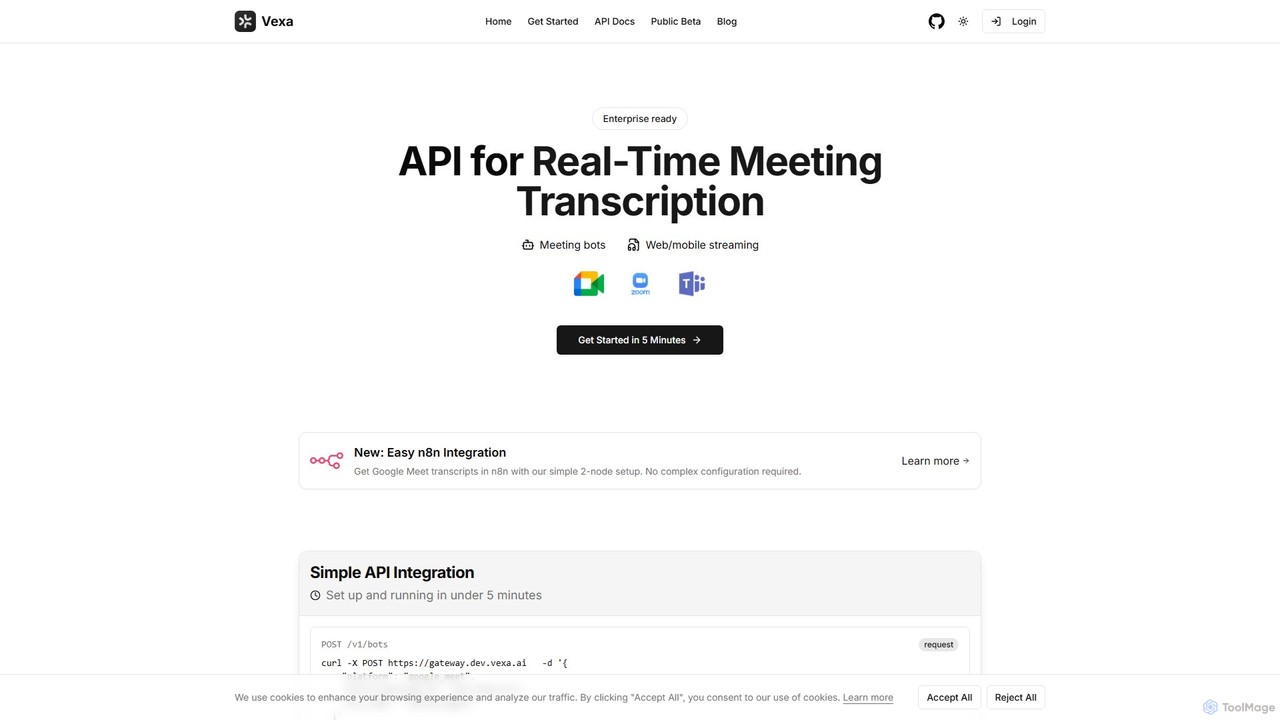
Vexa is a developer-focused, open-source API for real-time meeting transcription and translation. It deploys bots into meetings on platforms like Google Meet to capture live, multilingual conversations, enabling seamless integration with automation workflows and business applications.
Product overview
Deepgram Product overview
Deepgram is an enterprise-grade voice AI platform providing developers with powerful APIs for speech-to-text (STT), text-to-speech (TTS), audio intelligence, and conversational AI agents. It's renowned for its high accuracy, low latency, and cost-effective performance, enabling businesses to build advanced voice-enabled applications and experiences at scale.
Vexa Product overview
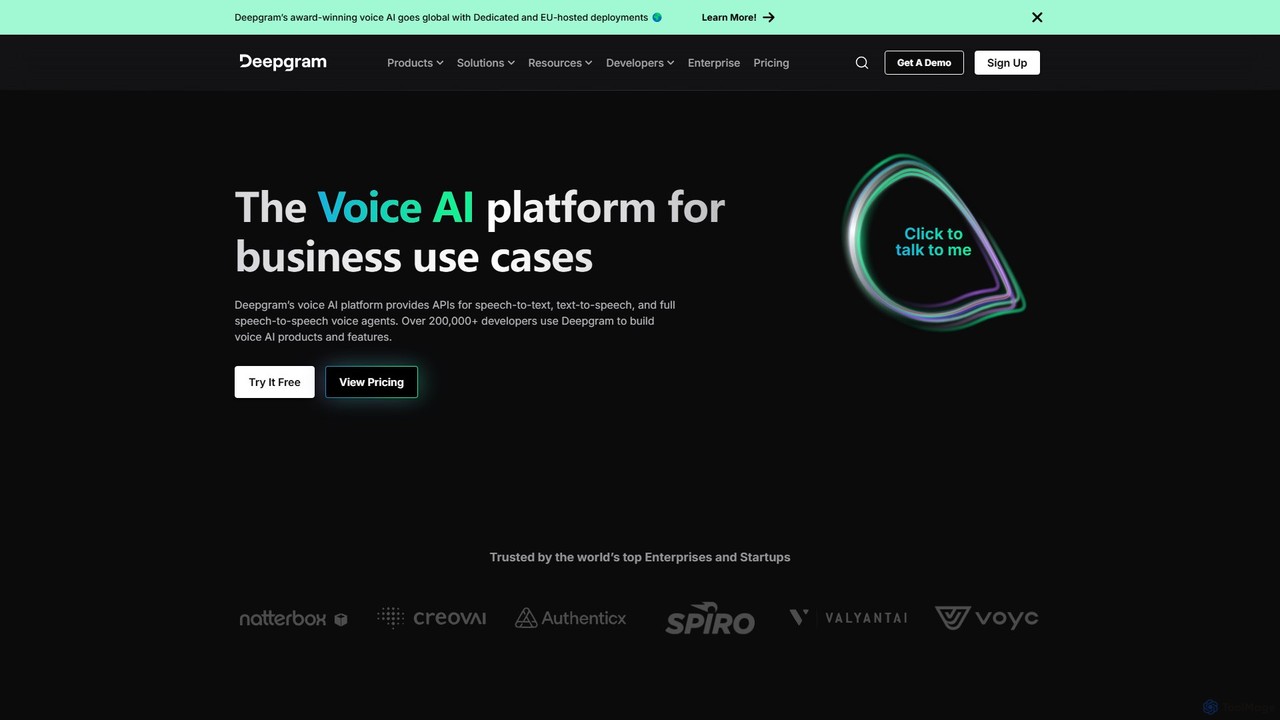
Vexa is a developer-focused, open-source API for real-time meeting transcription and translation. It deploys bots into meetings on platforms like Google Meet to capture live, multilingual conversations, enabling seamless integration with automation workflows and business applications.
Detailed feature comparison
| Feature | Deepgram | Vexa |
|---|---|---|
| Primary category | Speech To Text | Speech To Text |
| Added | 2025-08-10 | 2025-08-11 |
| Pricing | Freemium | Freemium |
| Official website | deepgram.com | vexa.ai |
| Product type | Website | Website |
| Performance data | ||
| User rating | Not verified | Not verified |
| Comments | 0 | 0 |
| Monthly visits | 740.4K | 12.8K |
| Monthly growth | -5.8% | 12.6% |
| Favorites | 123 | 111 |
| Details | View details | View details |
Deepgram vs Vexa monthly traffic
Compare Deepgram and Vexa by monthly reach, traffic trend, visit depth, top regions, and acquisition sources.
How to interpret the traffic data
In the Deepgram vs Vexa monthly traffic comparison, Deepgram currently shows 740.4K visits and Vexa shows 12.8K; Deepgram has about 57.8 times the visible traffic of Vexa, an absolute difference of about 727.6K visits. This reflects visible reach, not feature quality or paid users.
Both tools provide verified traffic details, so monthly trends, visit depth, regions, and acquisition sources can be compared on the same basis.
Deepgram monthly traffic:
Latest traffic
Monthly traffic trend
- 2025/9: 835.9K Monthly visits
- 2026/1: 834.1K Monthly visits
- 2026/2: 693.7K Monthly visits
- 2026/3: 762.9K Monthly visits
- 2026/4: 785.8K Monthly visits
- 2026/5: 740.4K Monthly visits
Top regions
Top 5 countries/regions
| Country/region | Percentage | Traffic |
|---|---|---|
| 🇺🇸United States | 52.52% | 388.8K |
| 🇮🇳India | 20.3% | 150.3K |
| 🇵🇪Peru | 9.52% | 70.5K |
| 🇩🇪Germany | 9.28% | 68.7K |
| 🇪🇸Spain | 8.38% | 62K |
Traffic sources
| Source type | Percentage | Traffic |
|---|---|---|
| Direct | 86.4% | 639.7K |
| Referral | 10.14% | 75.1K |
| 3.46% | 25.6K |
Search keywords
Vexa monthly traffic:
Latest traffic
Monthly traffic trend
- 2025/9: 5.3K Monthly visits
- 2026/1: 9.9K Monthly visits
- 2026/2: 8.2K Monthly visits
- 2026/3: 14.2K Monthly visits
- 2026/4: 11.4K Monthly visits
- 2026/5: 12.8K Monthly visits
Top regions
Top 5 countries/regions
| Country/region | Percentage | Traffic |
|---|---|---|
| 🇮🇳India | 37.57% | 4.8K |
| 🇧🇷Brazil | 26.37% | 3.4K |
| 🇺🇸United States | 19.5% | 2.5K |
| 🇩🇪Germany | 8.38% | 1.1K |
| 🇹🇷Turkey | 8.18% | 1K |
Search keywords
Usage comparison
Compare the core capabilities of Deepgram and Vexa
Deepgram Core features
Vexa Core features
Use cases
Deepgram Use cases
Vexa Use cases
Deepgram vs Vexa:In-depth comparison and selection guidance
First decide whether the products solve the same kind of need
This in-depth Deepgram vs Vexa comparison uses only the product records, taxonomy, audience, traffic, and community signals available on this page. Deepgram is primarily listed under “Speech To Text”, while Vexa is primarily listed under “Speech To Text”, so the first decision is whether your actual task matches their recorded scope.
The structured fields currently show these decision-relevant differences: Monthly visits (Deepgram: 740.4K; Vexa: 12.8K); Monthly growth (Deepgram: -5.8%; Vexa: 12.6%); Favorites (Deepgram: 123; Vexa: 111); Website (Deepgram: deepgram.com; Vexa: vexa.ai); Added (Deepgram: 2025-08-10; Vexa: 2025-08-11). These facts are more useful for selection than brand visibility alone.
What market visibility and monthly traffic mean
In the Deepgram vs Vexa monthly traffic comparison, Deepgram currently shows 740.4K visits and Vexa shows 12.8K; Deepgram has about 57.8 times the visible traffic of Vexa, an absolute difference of about 727.6K visits. This reflects visible reach, not feature quality or paid users.
Both tools provide verified traffic details, so monthly trends, visit depth, regions, and acquisition sources can be compared on the same basis.
If public market visibility is an important first-pass criterion, investigate Deepgram first. The final choice should still follow taxonomy, use case, and a real trial because higher traffic does not prove broader capabilities or better workflow fit.
Product positioning, use cases, and roles
Deepgram and Vexa currently overlap in shared categories: Speech To Text, Api, and Transcription; shared tags: speech to text. This can place both on the same shortlist, but it does not prove equal implementation, depth, or cost.
Deepgram's unique categories/tags are audio intelligence, conversational AI, developer API, STT, text to speech, transcription API, TTS, and voice agent; Vexa's are Meeting Assistant, API, automation, developer tools, Google Meet, meeting transcription, n8n, and open source. These unique fields are the strongest differentiators: validate the product whose recorded scope matches the task instead of following traffic alone.
What ratings, comments, and favorites can tell you
Deepgram has no verified rating, 0 comments, 123 favorites, and 115 likes;Vexa has no verified rating, 0 comments, 111 favorites, and 122 likes。
Neither product has enough rating or comment samples for a credible reputation ranking.
Selection guidance by actual need
When to evaluate Deepgram first
Put Deepgram on the priority trial list when the task aligns with “Speech To Text” and especially audio intelligence, conversational AI, developer API, STT, text to speech, and transcription API. This follows recorded positioning and does not imply unlisted capabilities are absent.
Deepgram also currently records: pricing is freemium, product type is website, 740.4K verified monthly visits, no verified user rating. Verify any hard requirement around price, platform, or reach before trial, and do not let sparse review data substitute for testing.
When to evaluate Vexa first
Put Vexa on the priority trial list when the task aligns with “Speech To Text” and especially Meeting Assistant, API, automation, developer tools, Google Meet, and meeting transcription. This follows recorded positioning and does not imply unlisted capabilities are absent.
Vexa also currently records: pricing is freemium, product type is website, 12.8K verified monthly visits, no verified user rating. Verify any hard requirement around price, platform, or reach before trial, and do not let sparse review data substitute for testing.
How to validate the recommendation before deciding
The available data describes positioning, public visibility, and community signals, but it cannot prove output quality, speed, integration effort, privacy, or long-term cost in your workflow. Before deciding, run the same representative tasks in Deepgram and Vexa, then record completion time, accuracy, manual corrections, and the real paid threshold. A like-for-like trial turns this comparison into a defensible adoption decision.
Comparison FAQ
How should I choose between Deepgram and Vexa?
Where does this comparison data come from?
What do unknown fields mean?
Related AI tools

Cartesia
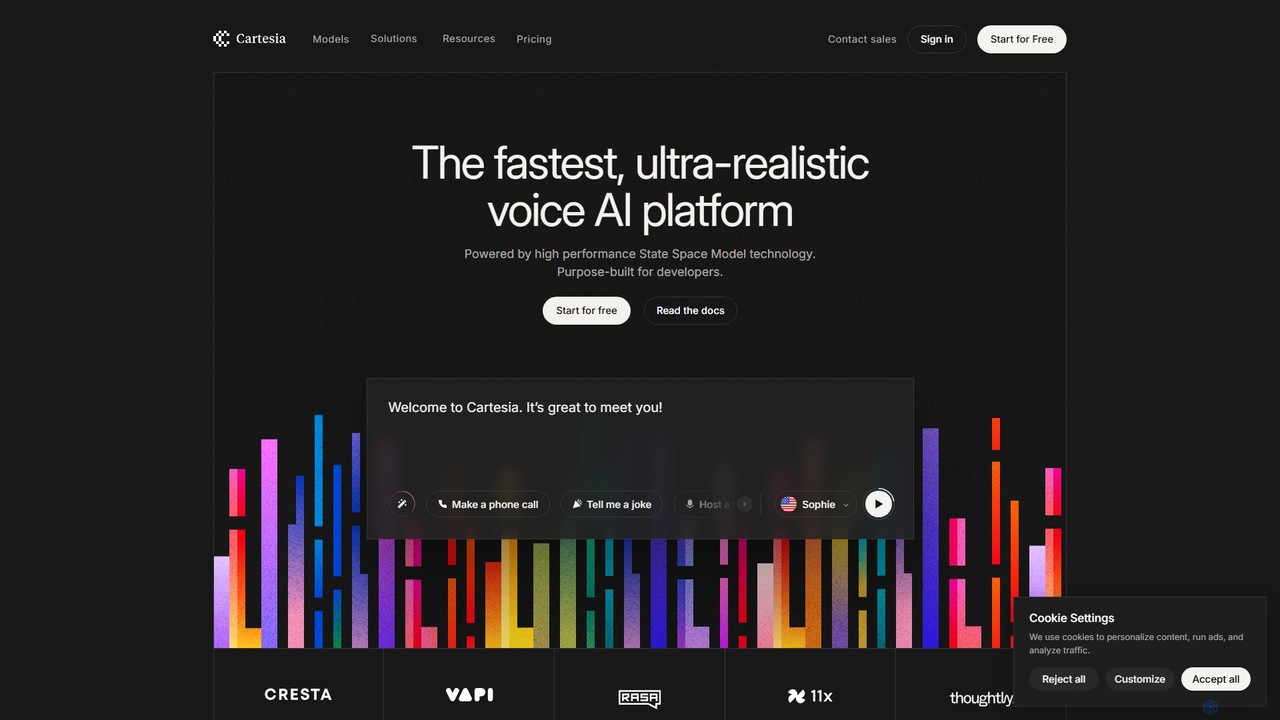
Cartesia is a high-performance voice AI platform for developers, offering the fastest, ultra-realistic Text-to-Speech (TTS), real-time Voice Cloning, and low-latency Speech-to-Text (STT). Powered by proprietary State Space Model technology, it's designed for building interactive and immersive voice applications with seamless integration and enterprise-grade security.
Voice Synthesis
AssemblyAI
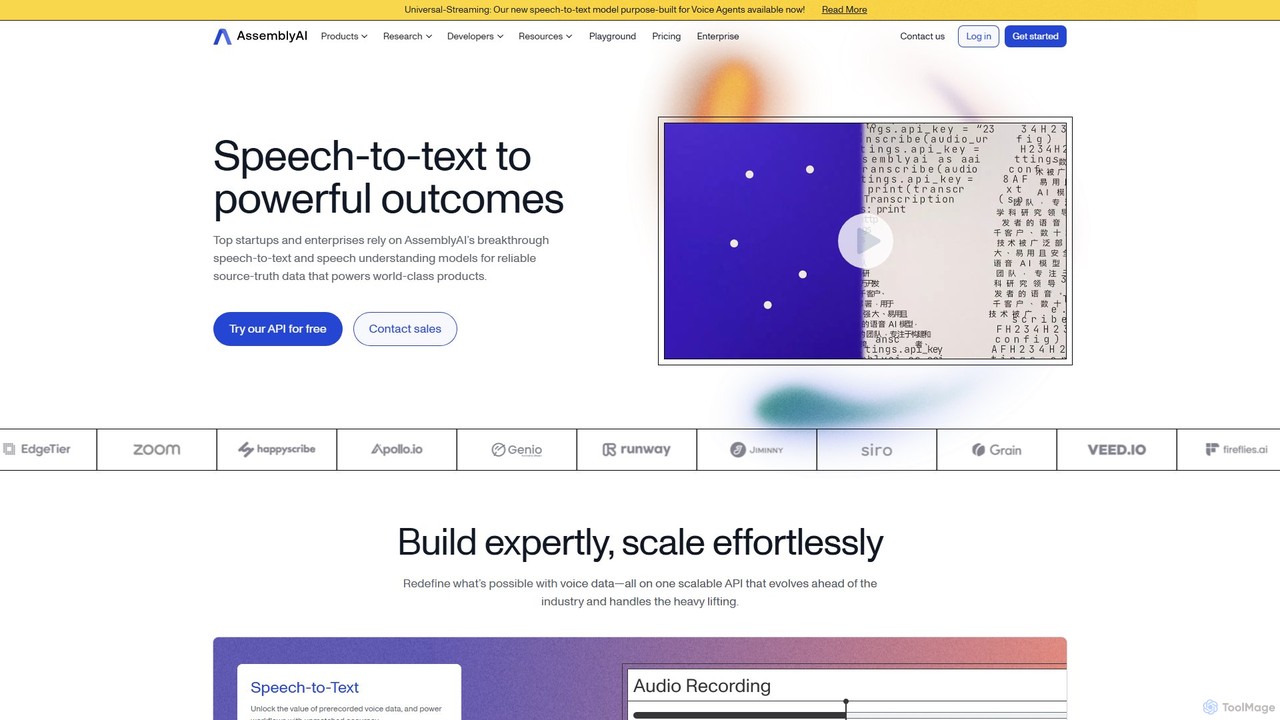
AssemblyAI provides powerful AI models through a single, developer-friendly API for highly accurate speech-to-text transcription and deep speech understanding. It enables businesses to build advanced voice-powered applications, from real-time voice agents to in-depth conversational intelligence platforms, with features like speaker diarization, PII redaction, and summarization.
Speech To Text
Tunk.ai
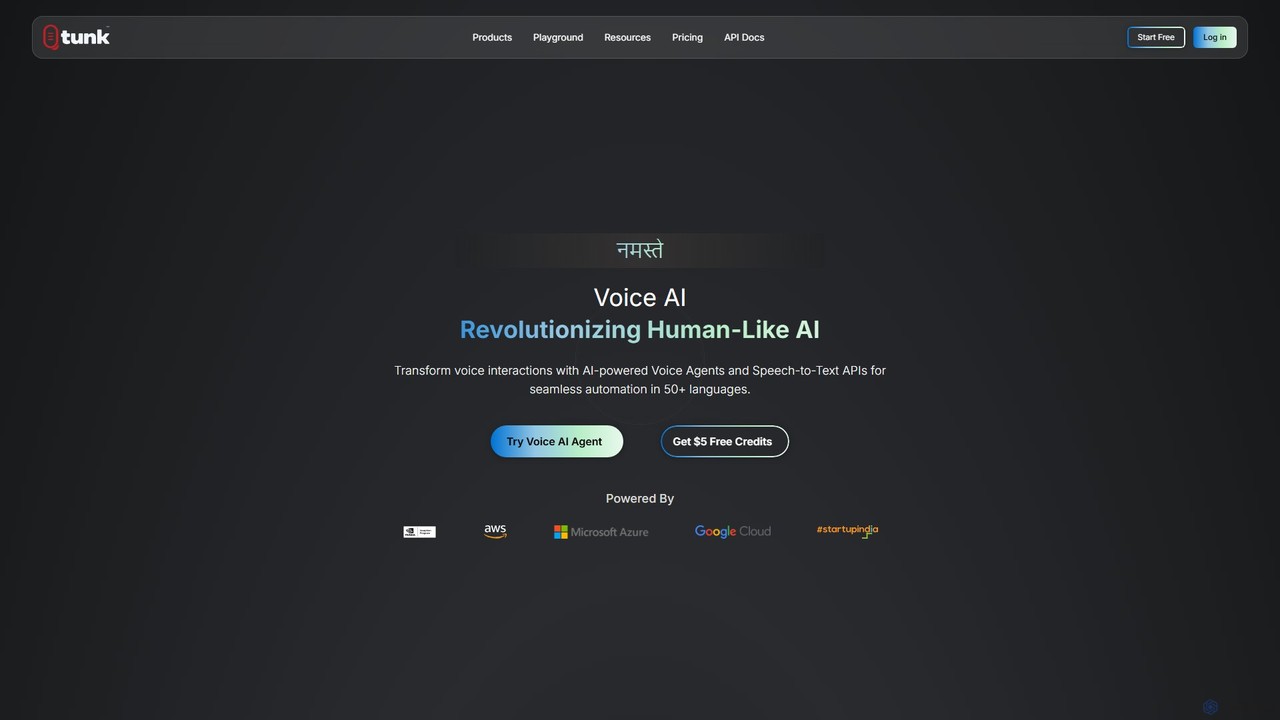
Tunk.ai is an advanced voice AI platform offering highly accurate Speech-to-Text APIs, intelligent Voice Agents, and real-time audio analysis. It supports over 50 languages, providing seamless automation for contact centers, financial services, education, and more. Transform voice interactions into structured, actionable insights with features like diarization, summarization, and sentiment analysis.
Speech To Text
Outspeed
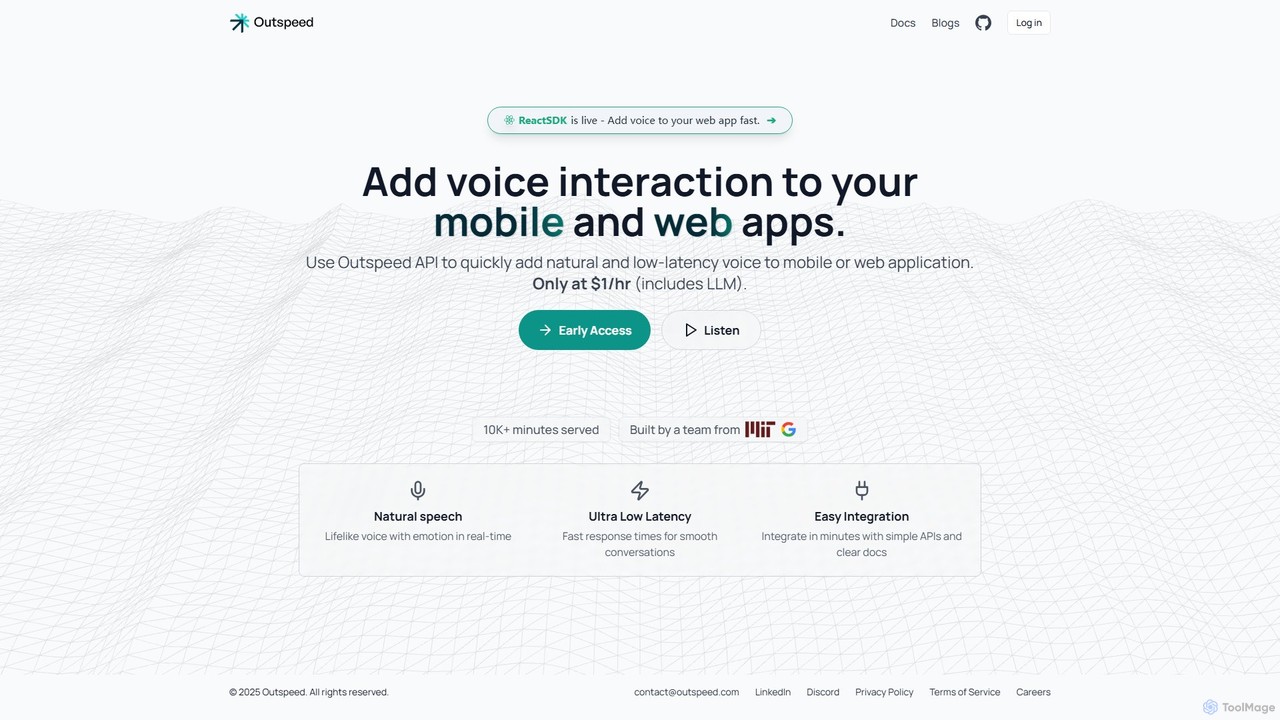
An API and SDK for developers to build and deploy AI voice companions with real-time emotion and memory. Easily integrate natural, low-latency voice interactions into web and mobile applications.
Voice Chatbot
vocode
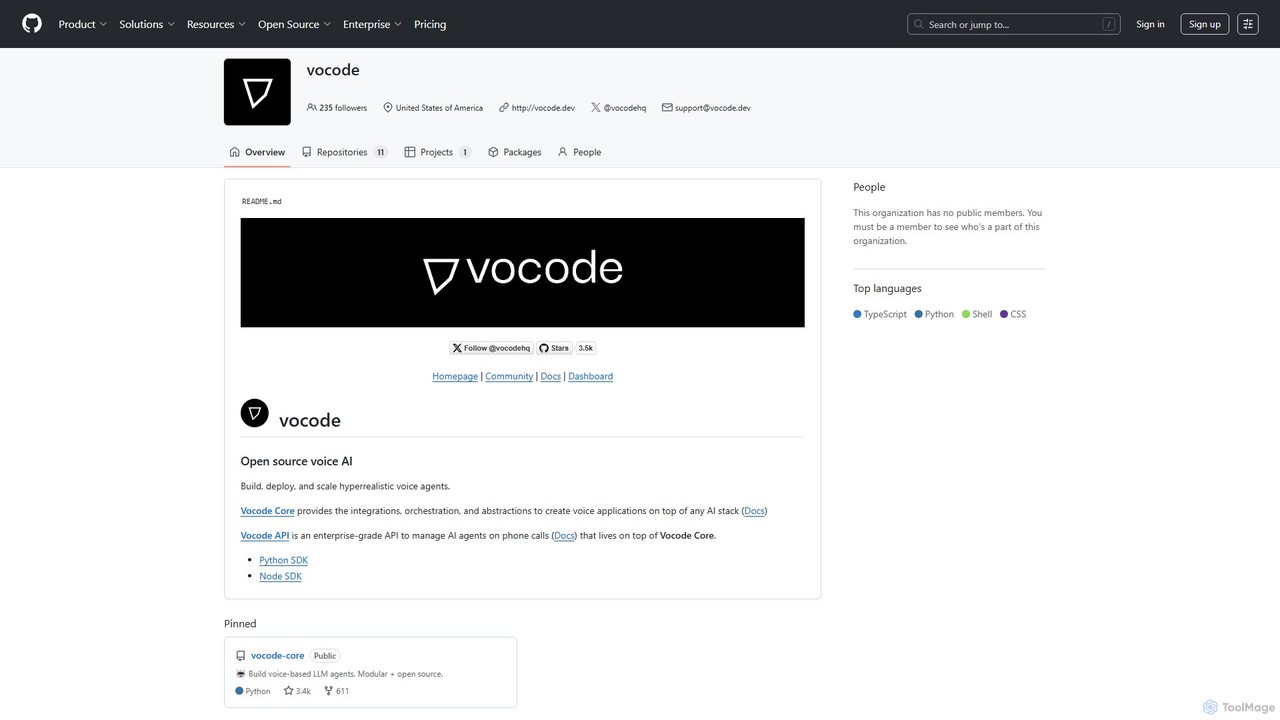
Vocode is an open-source platform for building, deploying, and scaling hyperrealistic voice AI agents. It provides developers with a core framework and an enterprise-grade API to create sophisticated voice-based LLM applications for tasks like automated customer service, sales calls, and interactive voice response (IVR) systems.
Voicebot
smallest.ai
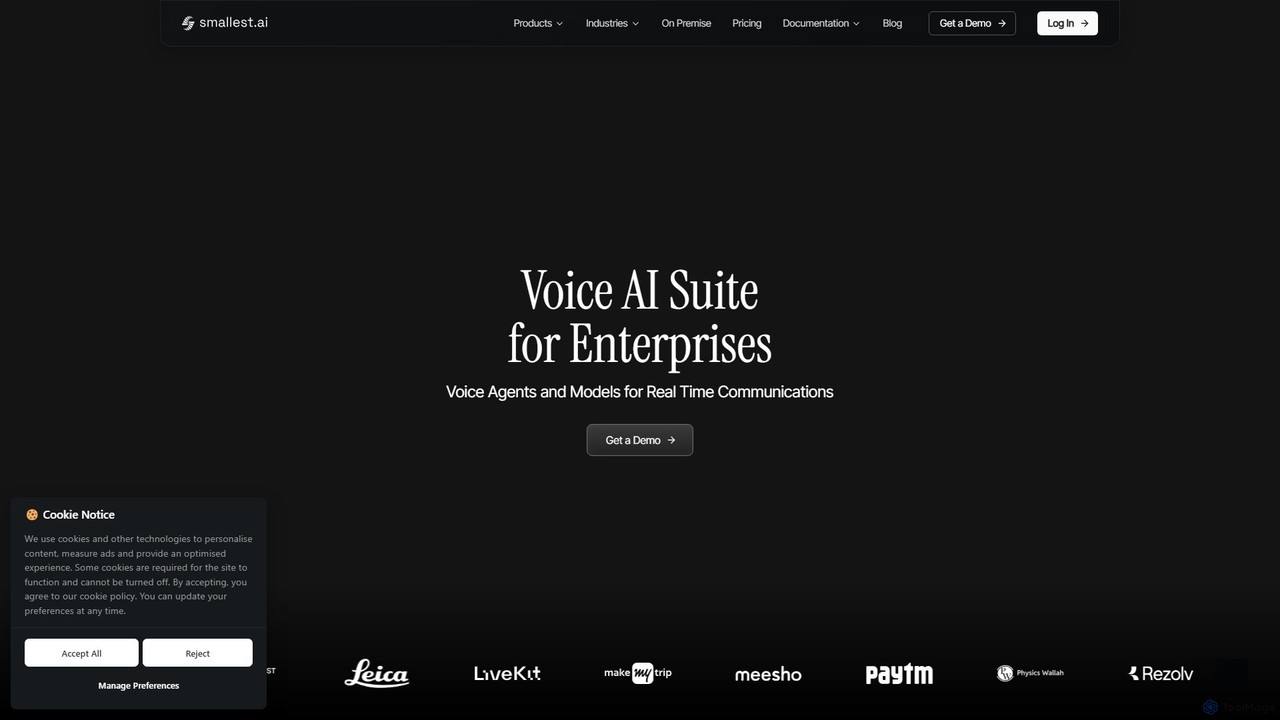
Smallest.ai provides enterprise-grade AI voice agents for contact centers, designed to automate and enhance customer interactions. It offers high-quality, low-latency Text-to-Speech (TTS), voice cloning, and a no-code builder to create human-like conversational AI for various industries like finance, real estate, and logistics.
Voice Assistant
Play
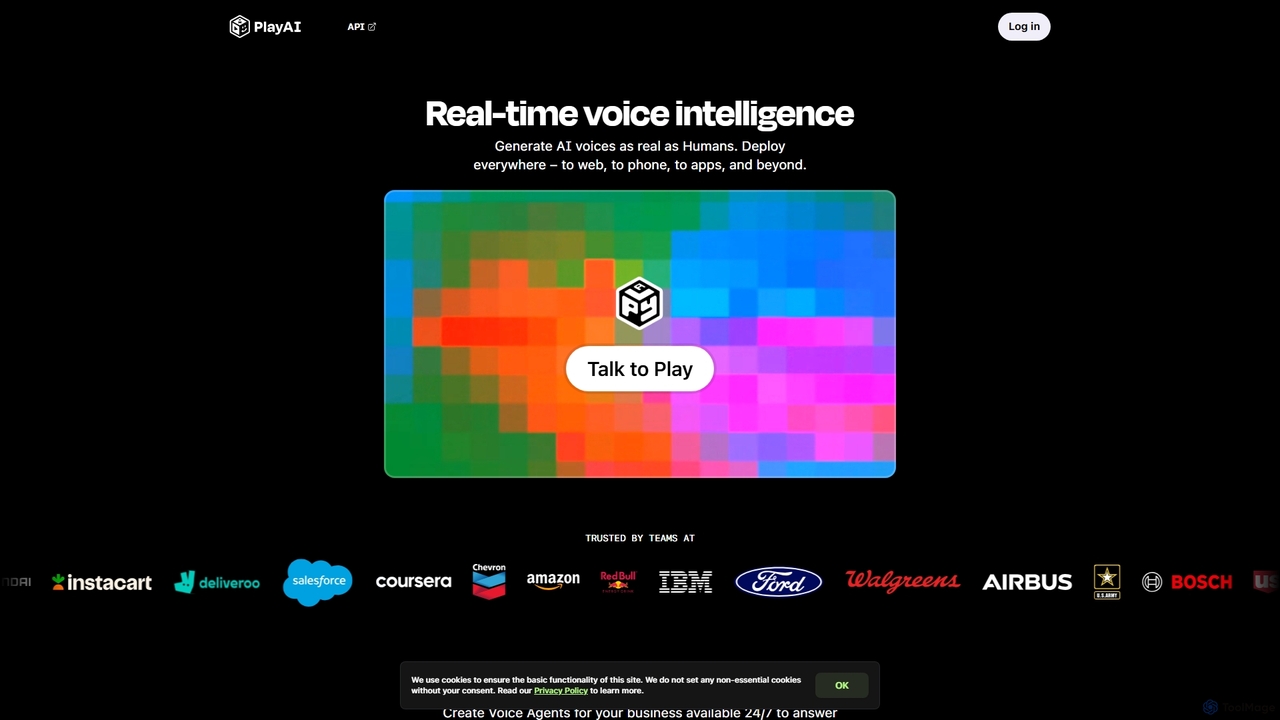
play is an advanced Voice AI platform for businesses, specializing in ultra-realistic Text-to-Speech (TTS) models and intelligent Voice Agents. It enables companies to create 24/7 automated agents for customer service, sales, and operations. With features like custom knowledge bases, API integrations for real-world actions, on-premise deployment for data security, and support for over 30 languages, play helps businesses scale their voice communications and enhance customer interactions globally.
Text To Speech
Millis AI
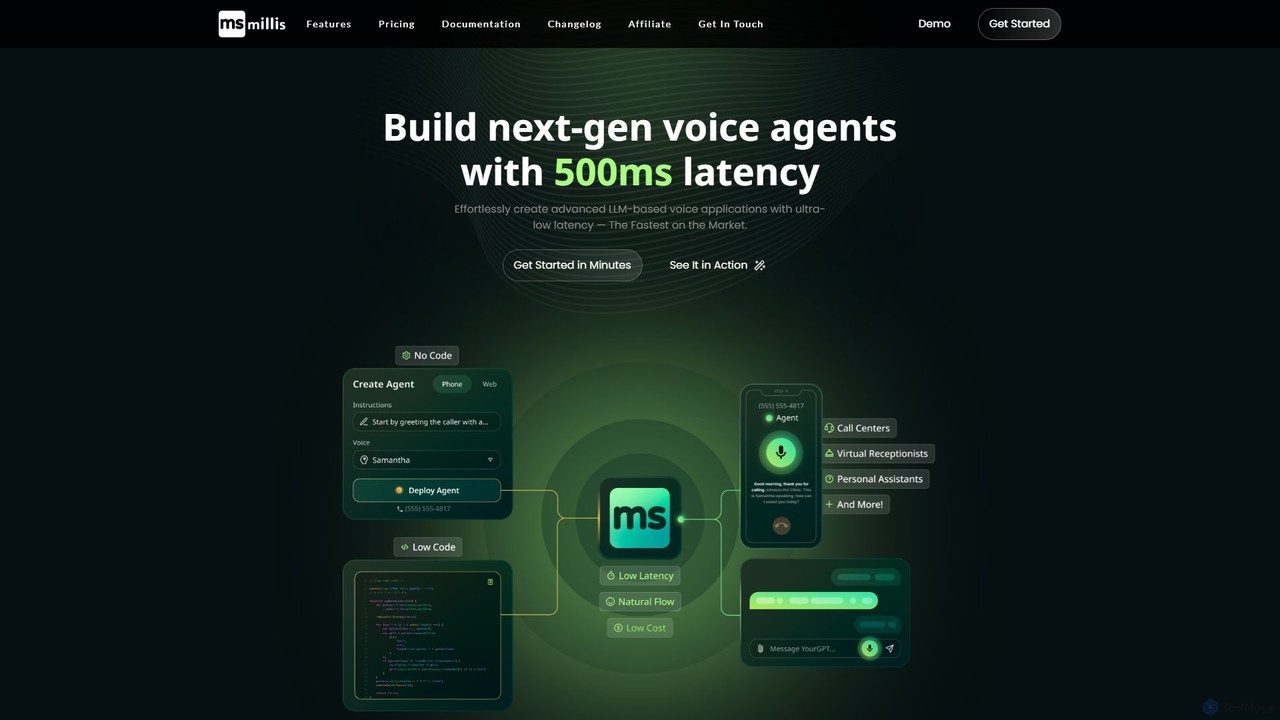
Millis AI is a platform for building next-generation voice agents with ultra-low 600ms latency. It enables both developers and non-technical users to create and deploy human-like, affordable voice agents for inbound and outbound calls in minutes, with easy integration capabilities.
Voice Agents
Vagent
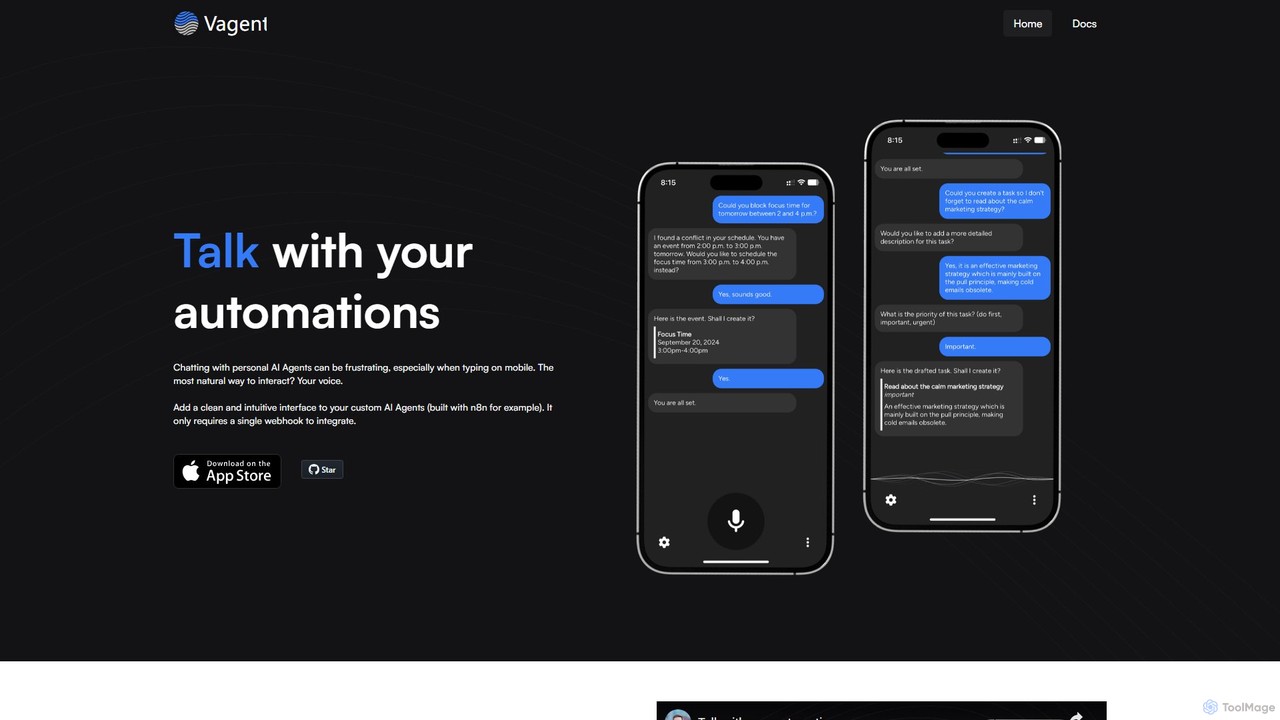
Vagent is a privacy-focused application that provides a voice interface for your custom automations. Connect it to any backend system, like n8n or your own scripts, via a simple webhook. Use high-quality, natural-sounding speech powered by OpenAI to interact with and control your personal or professional workflows, all while keeping your data stored locally on your device.
Voice Assistant
Models
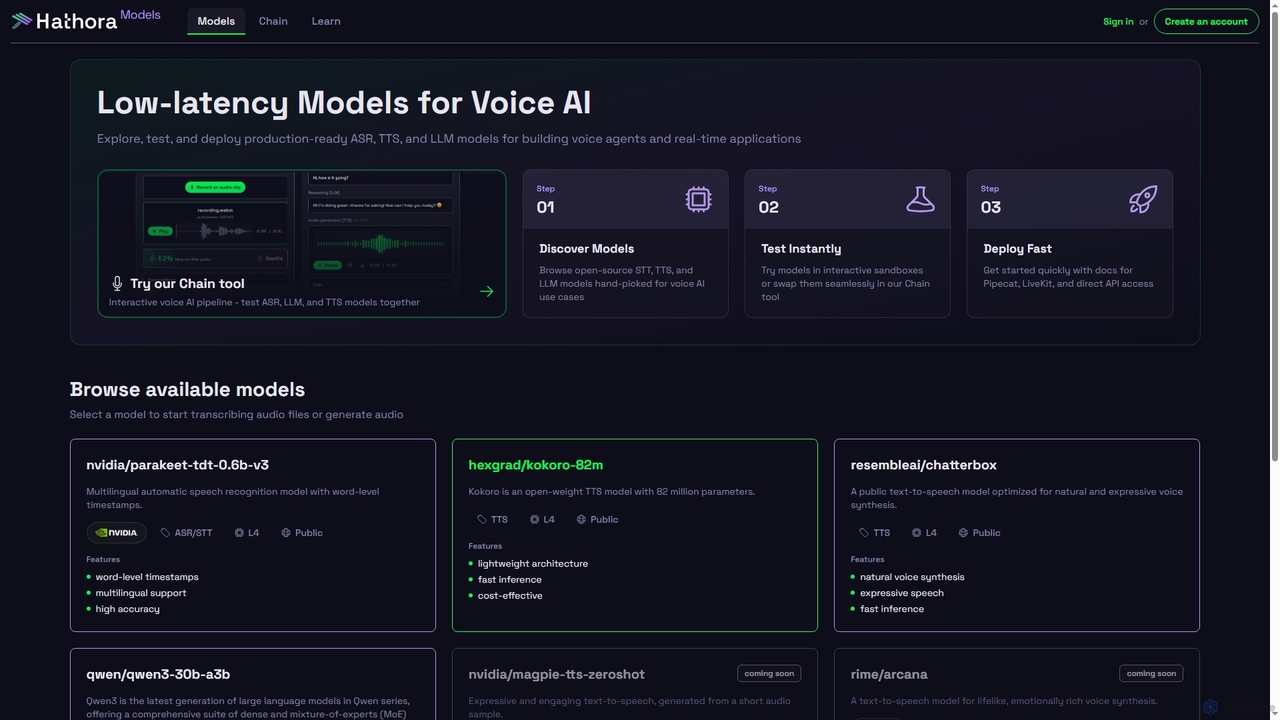
Models by Hathora offers a curated catalog of low-latency ASR, TTS, and LLM models optimized for voice AI and real-time applications. Developers can explore, test, and deploy production-ready models quickly, featuring interactive sandboxes and direct API access for seamless integration into voice agents and other applications.
Api
vatis
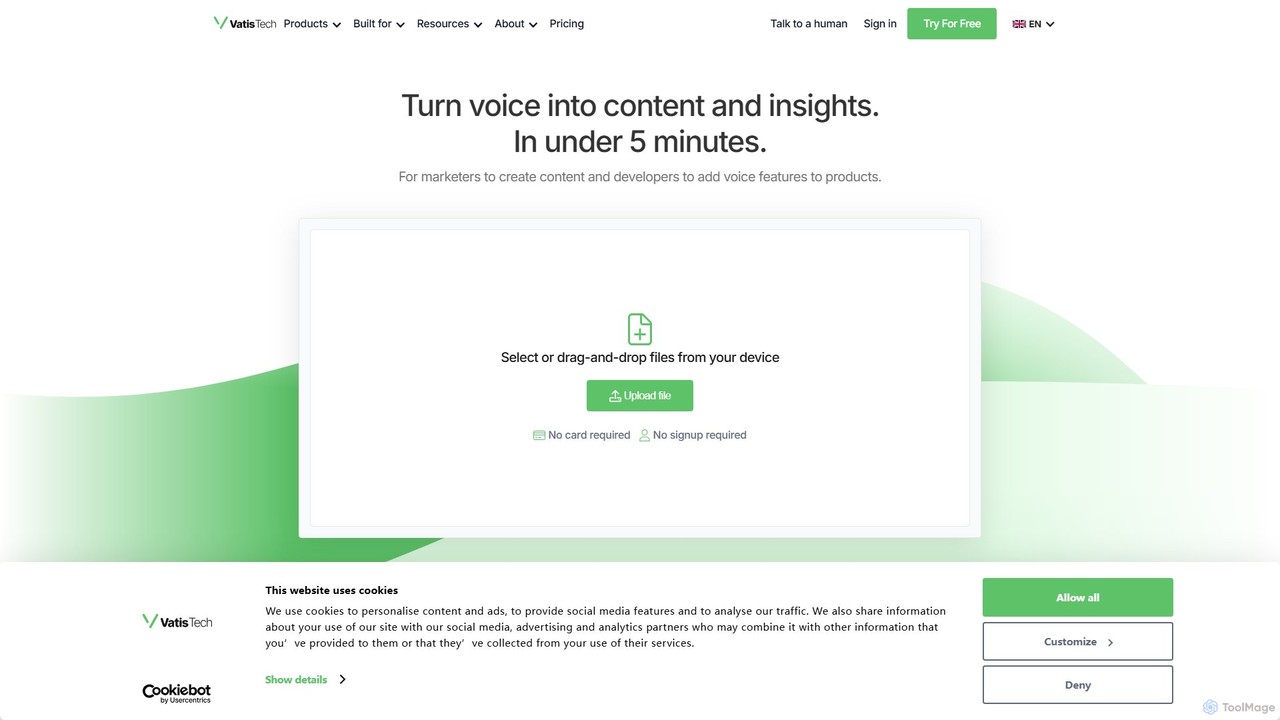
Vatis is a developer-focused AI infrastructure for highly accurate speech-to-text conversion. It provides a robust API for both real-time and batch transcription across multiple languages. Designed for scalability and easy integration, Vatis helps businesses in media, call centers, and education to unlock insights from their audio and video data efficiently.
Speech To Text
Vapi
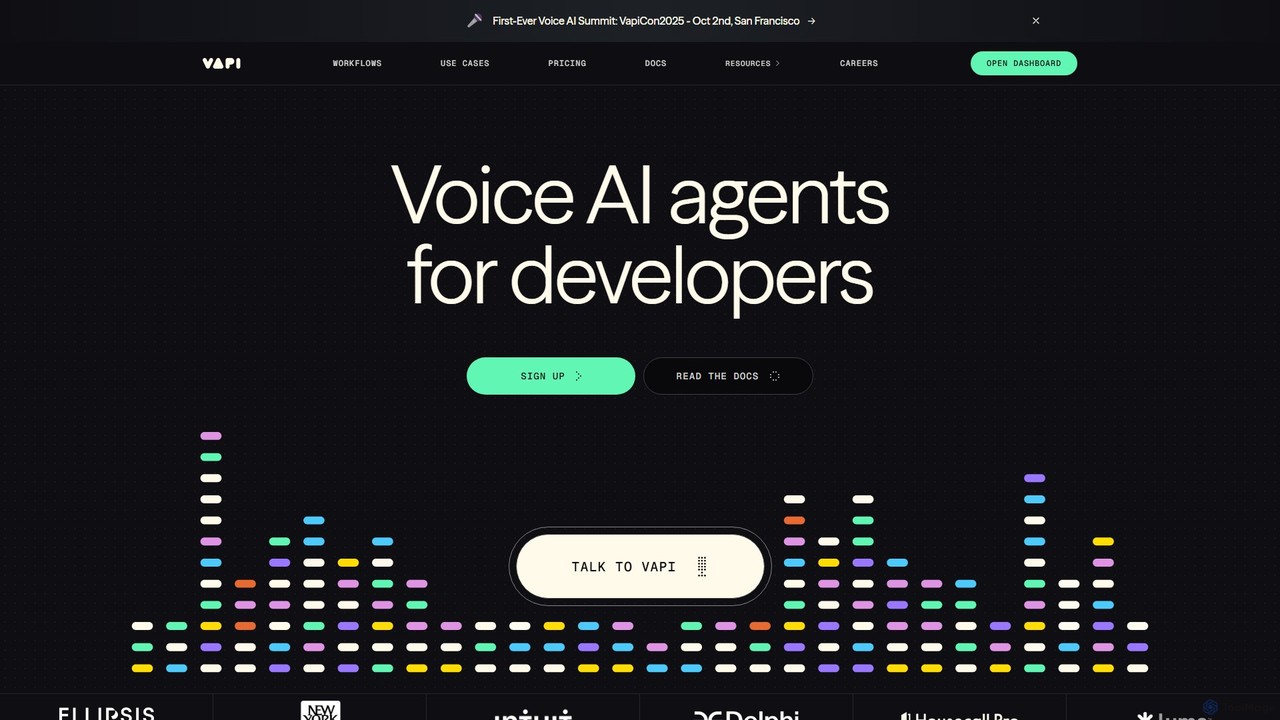
Vapi is a developer-first API platform for building, deploying, and scaling advanced, human-like voice AI agents. It enables the creation of sophisticated conversational AI for inbound/outbound calls, in-app assistants, and more, with ultra-low latency and high configurability.
Voice Assistant
Voice AI Space
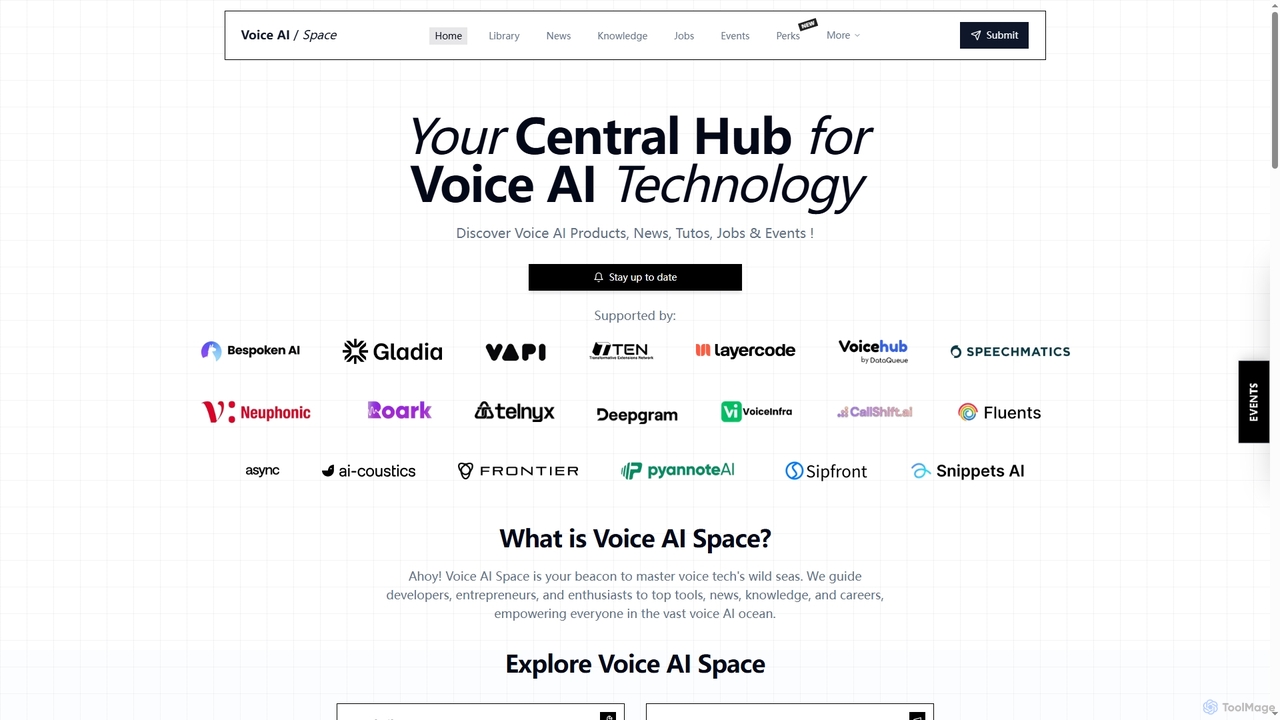
Voice AI Space is a comprehensive online hub dedicated to voice AI technology, offering a curated directory of tools, the latest news, in-depth knowledge resources, job opportunities, and industry events. It serves as a central guide for developers, entrepreneurs, and enthusiasts navigating the rapidly evolving voice tech landscape.
Voice Technology
FreeTTS
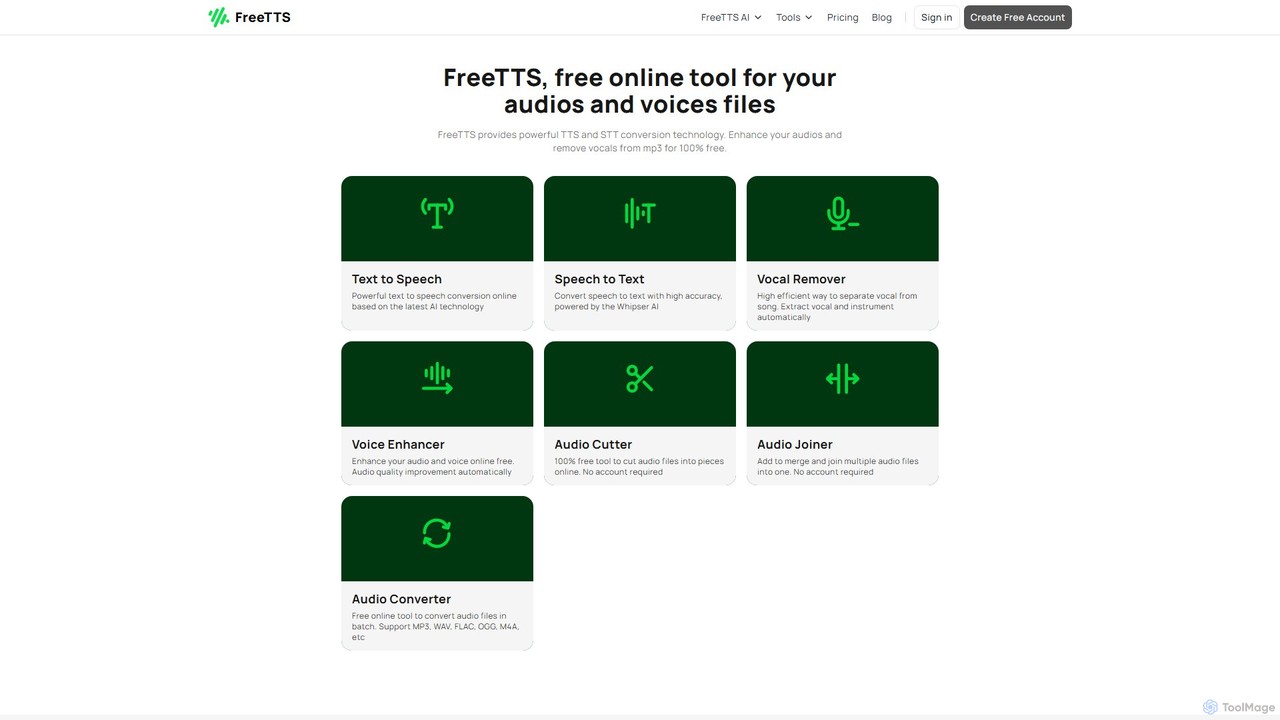
FreeTTS is a versatile AI-powered audio toolkit offering a suite of free and premium services. It excels in converting text to natural-sounding speech with a wide range of human-like voices. Beyond TTS, it provides high-accuracy speech-to-text transcription, an AI vocal remover, a voice enhancer, and various audio editing tools like a converter, cutter, and joiner. It's an all-in-one solution for content creators, musicians, and anyone needing high-quality audio processing.
Audio Editing
Voicv
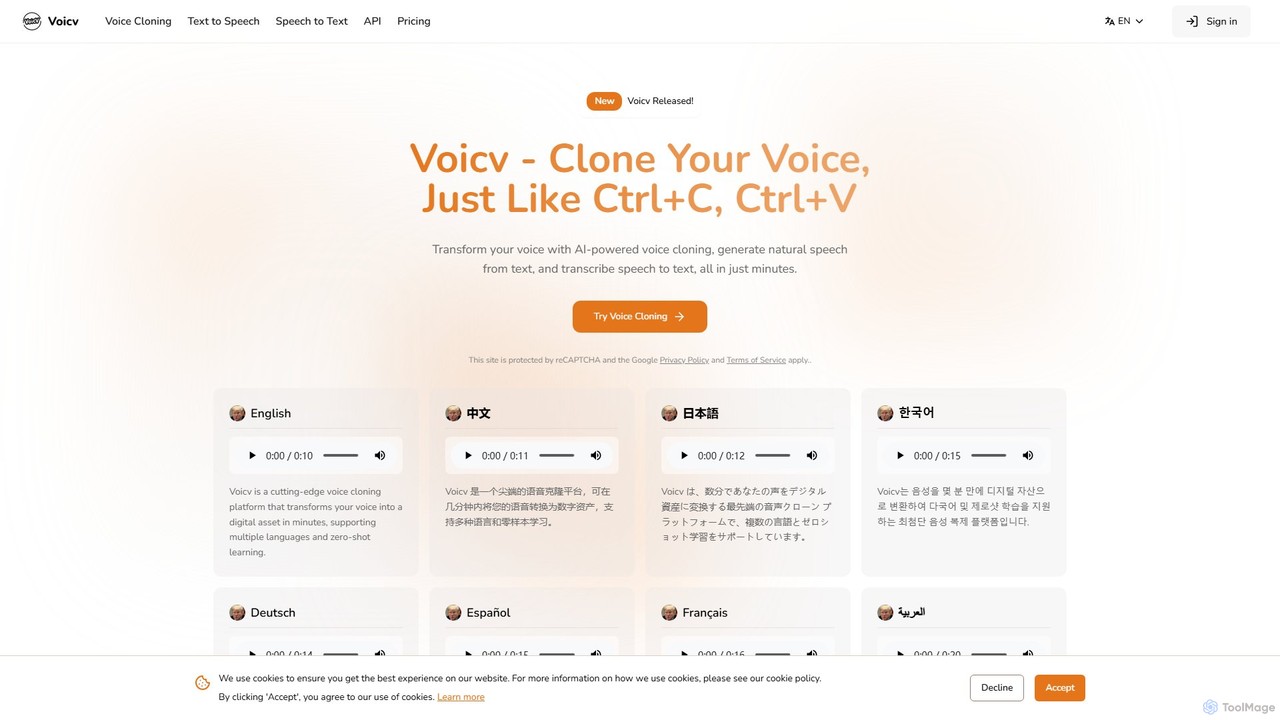
Voicv is an advanced AI platform for voice cloning, text-to-speech (TTS), and speech-to-text (STT). Clone any voice with just a 10-30 second audio sample using zero-shot technology. Generate natural-sounding speech in multiple languages, control emotions, and accurately transcribe audio to text. It's designed for content creators, businesses, and developers seeking high-quality, scalable audio solutions.
Text To Speech