Ai Development Best in category 1 results Data Labeling AI Tool

Popular AI tools in the Data Labeling field of Ai Development include Mercor, etc., helping you quickly improve efficiency.

Mercor

Mercor

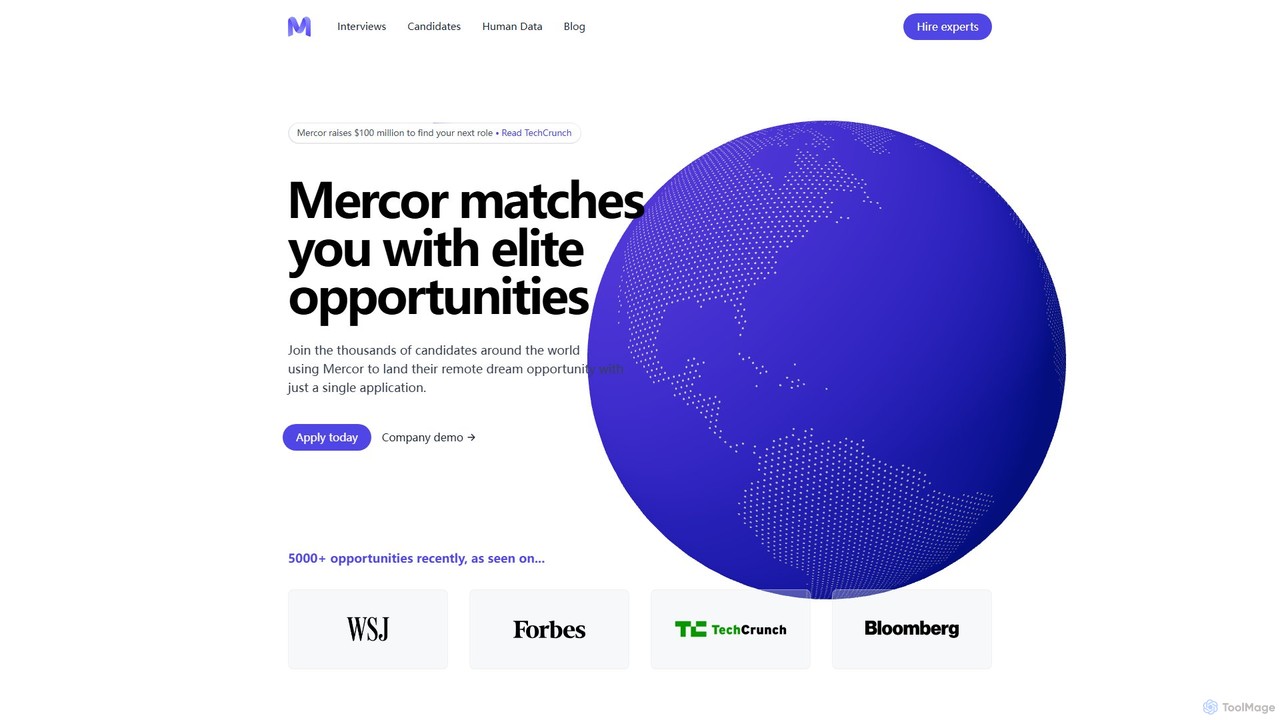
Mercor is an AI-powered platform that connects elite global talent with remote job opportunities. It uses AI to …

7.2M

About Data Labeling

Data Labeling tools are applications designed to annotate raw data, such as images, text, or audio, to create high-quality training datasets for machine learning models. These platforms provide specialized interfaces and automated features, like model-assisted labeling, to accurately assign labels, bounding boxes, or semantic tags to data points. This process is a critical prerequisite in the AI development lifecycle, directly impacting the performance and accuracy of models in fields like computer vision and natural language processing. Advanced tools often incorporate quality control workflows and team collaboration features to ensure consistency and efficiently scale large-scale annotation projects.

Core Features

  • Multi-Format Annotation: Support for various data types including images (bounding boxes, polygons), text (NER, classification), audio, and video.
  • Model-Assisted Labeling: Uses a preliminary AI model to suggest labels, which human annotators then review and correct to accelerate the process.
  • Quality Assurance Workflows: Includes features for review, consensus scoring, and error tracking to maintain high data quality and consistency among annotators.
  • Collaboration & Project Management: Provides tools for assigning tasks, tracking progress, managing annotator performance, and facilitating team communication.

Use Cases

Data Labeling tools are essential for data scientists, machine learning engineers, and dedicated annotation teams. They are widely used in industries like autonomous vehicles for labeling road scenes, healthcare for annotating medical images, e-commerce for categorizing products, and finance for processing documents.

How to Choose

When selecting a Data Labeling tool, consider its support for your specific data types (e.g., DICOM, LiDAR). Evaluate the effectiveness of its automation features and the robustness of its quality control mechanisms. Also, assess its ability to integrate with your existing MLOps pipeline and scale to handle large volumes of data.

Data LabelingUse Cases

1

Training Autonomous Vehicle Perception Models

A machine learning engineer at an automotive company needs to label millions of images and LiDAR point clouds from road tests. Using a data labeling tool, they employ polygon and 3D cuboid annotation to precisely identify pedestrians, vehicles, and traffic signs. The model-assisted labeling feature automatically suggests annotations for common objects, which annotators then verify, significantly reducing manual effort. This process creates a highly accurate dataset that enables the vehicle's perception system to reliably detect and classify objects, directly improving driving safety and model performance.

2

Annotating Medical Images for Disease Detection

A radiologist or medical data annotator is tasked with precisely outlining tumors in MRI scans. Using a specialized data labeling tool, they utilize segmentation tools like brushes and polygons to mark pathological regions with high precision. The platform supports the DICOM format, which is standard in medical imaging, and includes review workflows where senior medical experts can verify the annotations. This meticulous process generates a gold-standard training set for an AI model that can assist doctors in achieving earlier and more accurate diagnoses, potentially improving patient outcomes.

3

Powering E-commerce Product Categorization

A data scientist at an online retail company needs to label thousands of product images with attributes like category, color, and style. They use a data labeling tool with image classification and object detection features to efficiently tag products. Customizable taxonomies and bulk operations allow them to apply consistent labels across a vast inventory quickly. The resulting high-quality dataset is used to train machine learning models that power the website's search engine and recommendation systems, leading to a better user experience and increased sales through more relevant results.

4

Building a Customer Support Chatbot

An NLP specialist is tasked with annotating customer service chat logs to identify user intent and key entities like order numbers. They use a text annotation tool for Named Entity Recognition (NER) and intent classification. The tool helps manage labeling guidelines to ensure a team of annotators consistently tags phrases like "track my order" with the correct "OrderStatus" intent. This creates a robust dataset for training a chatbot that can accurately understand user requests and automate responses, reducing the workload on human support agents by over 40%.

5

Transcribing and Labeling Audio for Voice Assistants

A linguist working on a new voice assistant needs to transcribe and label thousands of hours of audio data. They use an audio labeling tool that provides a waveform visualizer, playback controls, and features for time-stamped transcription. The tool allows them to not only transcribe spoken words but also to label specific sound events like background noise or speaker changes. This detailed annotation process produces a high-quality audio dataset essential for training voice recognition models, significantly improving the accuracy and responsiveness of the voice assistant.

6

Moderating User-Generated Content at Scale

A trust and safety team at a social media platform needs to classify vast amounts of user-generated content. Using a data labeling platform, they set up a streamlined workflow for rapid classification of images and text as 'safe' or 'inappropriate'. The platform's review queues and consensus mechanisms ensure that moderation decisions are consistent and align with platform policies. The labeled data is then used to train an automated content moderation AI, enabling the platform to detect and remove harmful content at scale, protecting the community while reducing manual review time.

Data LabelingFrequently Asked Questions