Infragate
Infragate is an AI infrastructure platform designed to help developers build and run Model-Context-Protocol (MCP) servers rapidly. It …
Infragate is an AI infrastructure platform designed to help developers build and run Model-Context-Protocol (MCP) servers rapidly. It simplifies connecting diverse data sources, deploying AI tools, and managing scalable, secure AI workflows without complex operations.
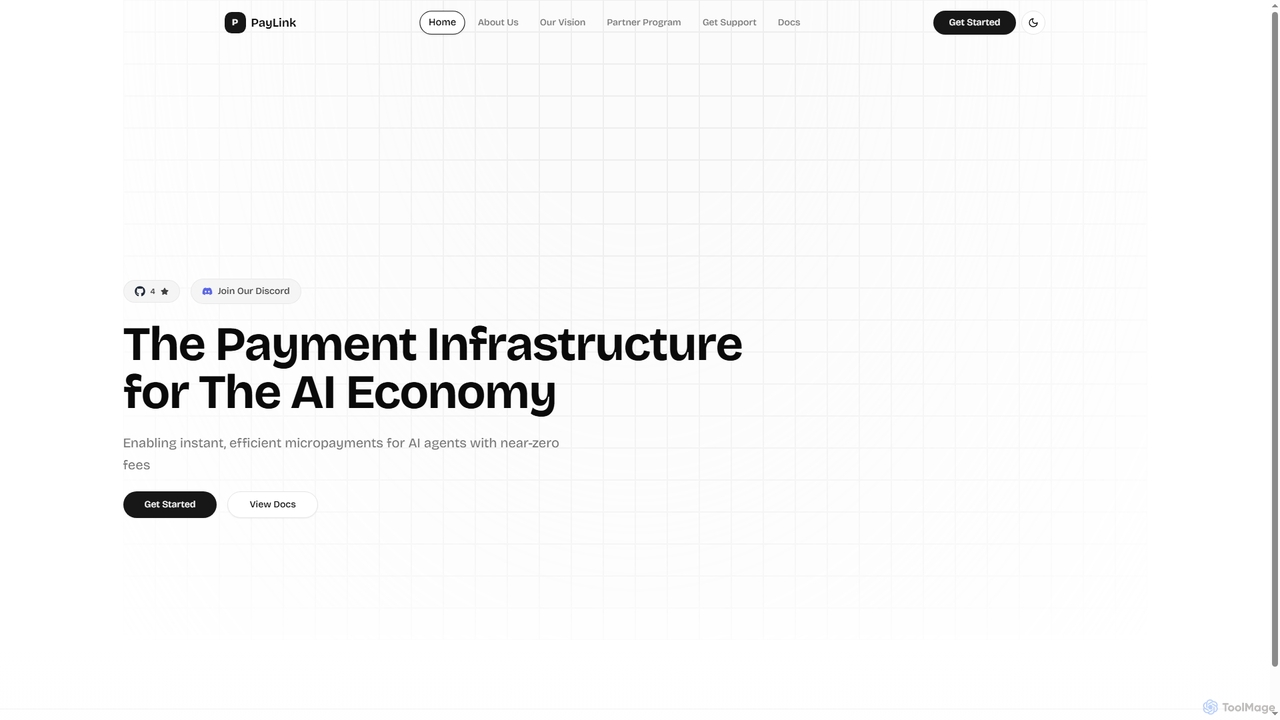
PayLink
PayLink is a specialized payment infrastructure designed for the AI economy, enabling instant and efficient micropayments for AI …
PayLink is a specialized payment infrastructure designed for the AI economy, enabling instant and efficient micropayments for AI agents. It facilitates seamless transactions with near-zero fees, providing a crucial financial backbone for AI-driven applications and services.
About Infrastructure
AI Infrastructure refers to the foundational computing resources, software platforms, and data management systems essential for developing, training, deploying, and managing artificial intelligence models and applications at scale. These tools provide the robust and scalable backbone required to handle the intensive computational demands and vast datasets inherent in modern AI workloads. By offering specialized hardware, optimized software environments, and streamlined MLOps capabilities, AI infrastructure empowers developers and organizations to accelerate their AI initiatives and bring intelligent solutions to production efficiently.
Core Features
- High-Performance Computing: Provides access to powerful GPUs, TPUs, and specialized processors optimized for AI model training and inference.
- Scalable Data Storage & Management: Offers solutions for storing, processing, and governing massive datasets, including data lakes and object storage, crucial for AI.
- MLOps & Deployment Platforms: Facilitates the automated deployment, monitoring, and lifecycle management of AI models in production environments.
- Containerization & Orchestration: Utilizes technologies like Docker and Kubernetes to package and manage AI workloads for consistent and scalable execution.
- Network Optimization: Ensures high-bandwidth, low-latency connectivity vital for distributed training and real-time AI applications.
Use Cases
AI Infrastructure is critical for organizations pushing the boundaries of artificial intelligence. It supports the development of complex deep learning models, enables the deployment of real-time AI services, and provides the necessary environment for managing large-scale data pipelines. From academic research to enterprise-level AI product development, robust infrastructure ensures performance, scalability, and reliability.
How to Choose
Selecting the right AI Infrastructure involves evaluating several key factors. Consider the specific computational requirements of your AI models (e.g., GPU needs), the volume and velocity of your data, and your existing technology stack for seamless integration. Assess the scalability options, cost-effectiveness, security features, and the level of MLOps support offered by different providers to align with your project's lifecycle and budget.

InfrastructureUse Cases
Training Large Language Models (LLMs)
AI researchers and data scientists leverage specialized AI infrastructure to train massive language models. This involves orchestrating thousands of GPUs, managing petabytes of text data, and ensuring fault tolerance for training runs that can last weeks or months. The infrastructure provides the necessary compute power and data throughput to efficiently iterate on model architectures and achieve state-of-the-art performance.
Deploying Real-time Recommendation Engines
E-commerce platforms and content providers utilize AI infrastructure to deploy and scale real-time recommendation engines. These systems require low-latency inference capabilities to process user interactions instantly and deliver personalized suggestions. The infrastructure ensures high availability, rapid model serving, and efficient resource allocation to handle fluctuating user traffic and maintain a seamless user experience.
Managing Large-scale Computer Vision Datasets
Companies developing computer vision applications, such as autonomous driving or medical imaging, rely on robust AI infrastructure for managing vast datasets of images and videos. This includes scalable storage solutions, efficient data labeling pipelines, and high-speed data access for model training. The infrastructure ensures data integrity, versioning, and secure access for distributed teams.
Automating MLOps Pipelines for Production AI
Enterprise AI teams implement MLOps (Machine Learning Operations) pipelines on dedicated AI infrastructure to automate the entire machine learning lifecycle. This encompasses automated data ingestion, model training, versioning, testing, deployment, and continuous monitoring. The infrastructure provides the tools and orchestration capabilities to streamline operations, reduce manual errors, and accelerate time-to-market for AI products.
Scaling AI Research and Development
Academic institutions and R&D departments use flexible AI infrastructure to support diverse research projects and rapid experimentation. This involves providing on-demand access to various compute resources (GPUs, CPUs), different software environments, and collaborative tools. The infrastructure enables researchers to quickly provision resources, run multiple experiments concurrently, and share findings efficiently without managing underlying hardware.
Ensuring Data Security and Compliance for AI Applications
Organizations handling sensitive data for AI applications, such as in finance or healthcare, depend on AI infrastructure with robust security and compliance features. This includes secure data storage, access controls, encryption, audit trails, and adherence to regulatory standards like GDPR or HIPAA. The infrastructure provides the necessary safeguards to protect proprietary models and sensitive user information throughout the AI lifecycle.