Citronetic
Citronetic is a specialized SaaS platform for MCP (Multi-modal Conversational Platform) testing and analytics, ensuring robust tool discovery, …
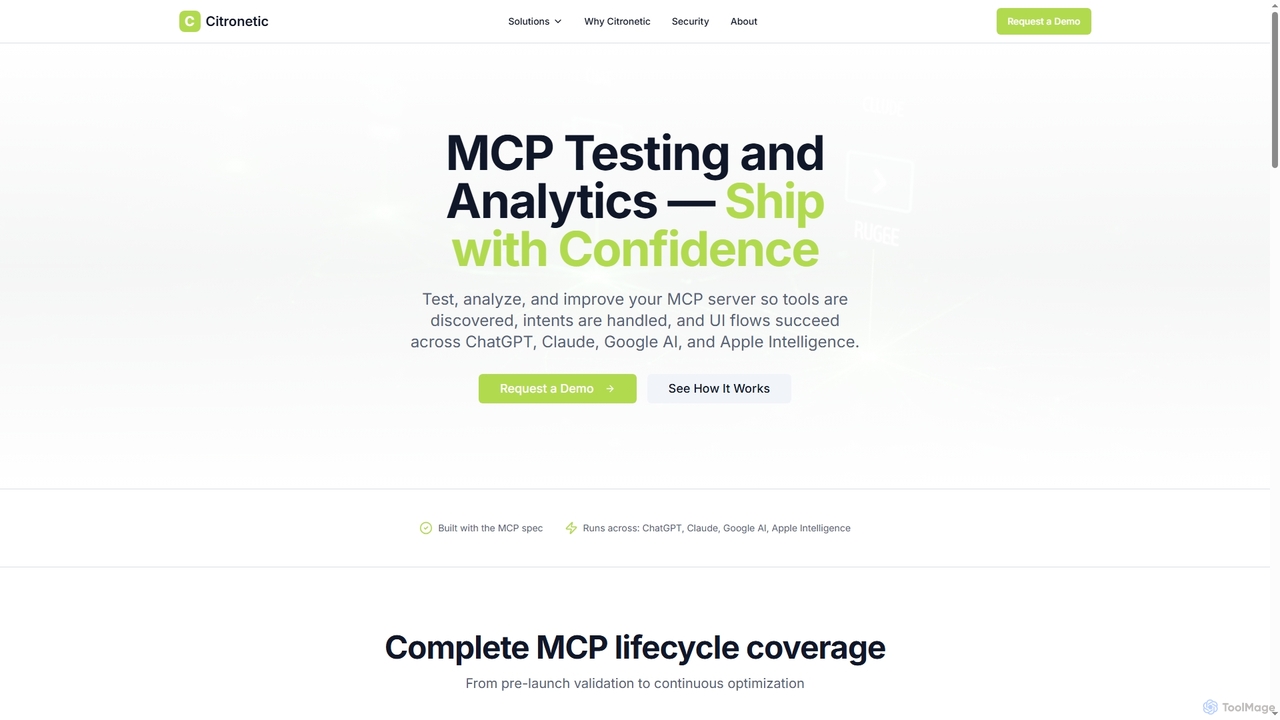
Citronetic is a specialized SaaS platform for MCP (Multi-modal Conversational Platform) testing and analytics, ensuring robust tool discovery, intent handling, and UI flow success across leading LLM platforms like ChatGPT, Claude, Google AI, and Apple Intelligence.
About Llm Optimization
LLM Optimization tools are a specialized category within AI development focused on making Large Language Models more efficient. They employ techniques like quantization, pruning, and knowledge distillation to reduce model size, decrease latency, and lower computational costs. This enables the deployment of powerful LLMs in resource-constrained environments, such as on mobile devices or at a lower operational cost in the cloud. These tools are crucial for scaling AI applications and making them economically viable and performant.
Core Features
- Model Quantization: Reduces the numerical precision of model weights (e.g., from 32-bit to 8-bit) to shrink model size and accelerate inference.
- Network Pruning: Systematically removes less important weights or connections in the neural network to create a smaller, faster model.
- Knowledge Distillation: Trains a smaller "student" model to replicate the performance of a larger "teacher" model, creating a compact and efficient alternative.
- Inference Acceleration: Implements optimized algorithms and kernels, such as FlashAttention, to speed up the process of generating responses.
- Efficient Fine-Tuning: Utilizes methods like LoRA (Low-Rank Adaptation) to adapt models to specific tasks with minimal computational resources.
Use Cases
These tools are essential for MLOps engineers, AI developers, and businesses deploying LLMs at scale. They are used to deploy models on edge devices like smartphones, reduce the inference costs of cloud-hosted AI services, and improve the responsiveness of real-time applications like chatbots and code assistants.
How to Choose
When selecting an LLM Optimization tool, consider the target deployment hardware (GPU, CPU, edge), the specific models you need to optimize, and the desired trade-off between performance and accuracy. Also, evaluate the tool's integration with your existing MLOps toolchain and its ease of use, whether it's a simple library or a comprehensive platform.

Llm OptimizationUse Cases
Reduce LLM Inference Costs for Cloud Services
A SaaS company provides an AI-powered writing assistant to thousands of users, resulting in a substantial monthly GPU cloud bill. By using an LLM optimization tool to apply 8-bit quantization to their deployed model, they reduce the memory requirement by 75%. This allows them to serve the same number of users with fewer or less powerful GPU instances, directly cutting their operational costs by over 50% without a noticeable impact on the quality of generated text.
Deploy Generative AI on Edge Devices
A mobile app developer wants to add an offline-capable smart reply feature to their messaging application. The original LLM is too large to fit on a smartphone. They use a combination of pruning and quantization to drastically reduce the model's size from several gigabytes to under 500 megabytes. This optimized model can now be bundled with the app, enabling fast, private, and reliable AI features that work even without an internet connection.
Accelerate Real-Time AI Application Response
A financial services platform uses an LLM to provide real-time market analysis summaries. Low latency is critical for user experience. Their development team integrates an inference acceleration library that implements techniques like FlashAttention and optimized kernels. This reduces the time-to-first-token by 60%, making the AI-generated insights appear almost instantaneously and significantly improving the perceived performance and usability of the feature.
Efficiently Customize Models for Niche Tasks
A legal tech firm needs to adapt a general-purpose LLM to understand specific legal jargon and document formats. Full fine-tuning is too expensive and time-consuming. They use an efficient fine-tuning technique like LoRA or QLoRA. This allows them to train only a small fraction of the model's parameters, achieving high accuracy on their specialized task in a matter of hours using a single GPU, rather than weeks and multiple GPUs.
Scale High-Throughput LLM APIs
An e-commerce giant uses an LLM for a customer service chatbot that handles thousands of concurrent conversations during peak hours. To manage this load efficiently, their MLOps team uses an optimized serving engine. The engine employs dynamic batching to group incoming requests and maximize GPU utilization, along with a key-value cache to speed up the processing of long conversations, ensuring the service remains stable and responsive under heavy traffic.
Create Compact, Specialized Models via Distillation
A healthcare research institute has access to a large, powerful general model but needs a smaller model for a specific task like summarizing patient records. They use knowledge distillation to train a much smaller, specialized model. The student model learns to mimic the output of the large teacher model on a curated dataset of medical texts, resulting in a compact model that performs exceptionally well on its narrow task while being much cheaper to run and easier to deploy.