
Cols AI
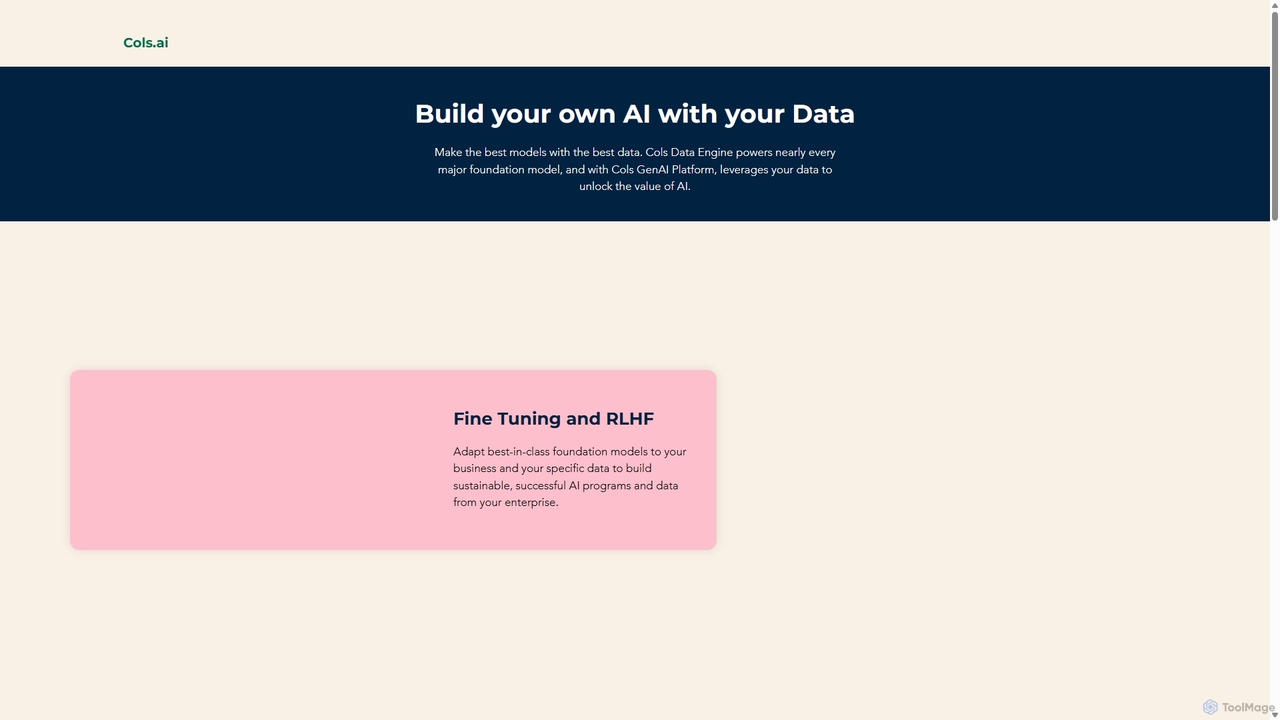
Cols AI is an enterprise-grade GenAI platform for building and deploying custom AI voice agents. It leverages a …
Cols AI is an enterprise-grade GenAI platform for building and deploying custom AI voice agents. It leverages a powerful data engine and fine-tuning capabilities to create highly personalized, context-aware voice bots for customer support, sales, and operational automation, trained on your own business data.
About Model Fine Tuning
Model Fine Tuning is a specialized process within AI development that adapts pre-trained artificial intelligence models to perform specific tasks with higher accuracy and relevance. This technique involves further training a foundational model on a smaller, domain-specific dataset, leveraging its existing knowledge while specializing its capabilities. It significantly reduces the computational resources and time required compared to training a model from scratch, enabling the creation of highly customized AI solutions for niche applications.
Core Features
- Dataset Management: Tools for preparing, cleaning, and managing the specific datasets used for fine-tuning.
- Hyperparameter Optimization: Features to adjust learning rates, epochs, and batch sizes to achieve optimal model performance.
- Transfer Learning Capabilities: Leveraging pre-trained weights from large foundation models to accelerate specialization.
- Performance Evaluation: Metrics and tools to assess the fine-tuned model's accuracy and effectiveness on target tasks.
- Model Deployment & Serving: Options for easily deploying and integrating the specialized model into applications.
Use Cases
Model fine-tuning is crucial for organizations looking to customize general AI models for their unique operational needs. It's widely adopted in sectors like healthcare for specialized diagnostics, finance for nuanced market analysis, and e-commerce for personalized customer interactions, allowing businesses to achieve higher precision and relevance from their AI deployments.
How to Choose
When selecting a model fine-tuning solution, consider its compatibility with your existing pre-trained models and data formats. Evaluate the flexibility of customization options, the ease of hyperparameter tuning, and the robustness of its performance evaluation tools. Additionally, assess the platform's scalability, deployment options, and cost-effectiveness for your specific project requirements.
Model Fine TuningUse Cases
Customizing Large Language Models for Brand Voice
Marketing teams fine-tune a general LLM on their brand's specific content, style guides, and communication history. This enables the AI to generate marketing copy, social media posts, or customer service responses that perfectly align with the brand's unique tone and messaging, ensuring consistency and reducing manual editing time by up to 70%.
Developing Domain-Specific Medical Image Analysis
Healthcare researchers fine-tune a pre-trained vision model on a specialized dataset of medical images (e.g., X-rays for a rare disease). This allows the model to accurately detect subtle anomalies or patterns specific to that condition, assisting clinicians in early diagnosis and improving diagnostic precision by up to 20% beyond general image recognition.
Enhancing Customer Support Chatbots with Product Knowledge
E-commerce companies fine-tune a conversational AI model using their extensive product catalogs, FAQs, and customer interaction logs. The fine-tuned chatbot can then provide highly accurate, detailed, and context-aware answers to product-specific queries, significantly improving customer satisfaction scores by 15-25% and reducing the workload on human agents.
Optimizing Financial Sentiment Analysis for Market Trends
Financial analysts fine-tune a sentiment analysis model on a corpus of financial news, earnings reports, and market commentary. This specialized model can then more accurately interpret the sentiment in financial texts, distinguishing between nuanced positive and negative indicators specific to market dynamics, aiding in investment decisions with up to 10% higher predictive accuracy.
Creating Personalized Educational Content Generation
EdTech platforms fine-tune a text generation model on specific curriculum materials, learning objectives, and student interaction data. This enables the AI to generate personalized quizzes, explanations, or study guides tailored to individual student needs and learning styles, enhancing engagement and learning outcomes by up to 30% compared to generic content.
Improving Industrial Anomaly Detection in Manufacturing
Manufacturers fine-tune a time-series anomaly detection model on sensor data from their specific machinery under normal and faulty operating conditions. The fine-tuned model can then precisely identify unusual patterns indicative of impending equipment failure, allowing for proactive maintenance and minimizing costly downtime by up to 40% in production lines.