ToolMage
Sign in

Best 1 Realtime Ai AI tools for Ai Development

Popular Realtime Ai AI tools in Ai Development include Gabber, helping you work more efficiently.

Gabber
Paid

Gabber

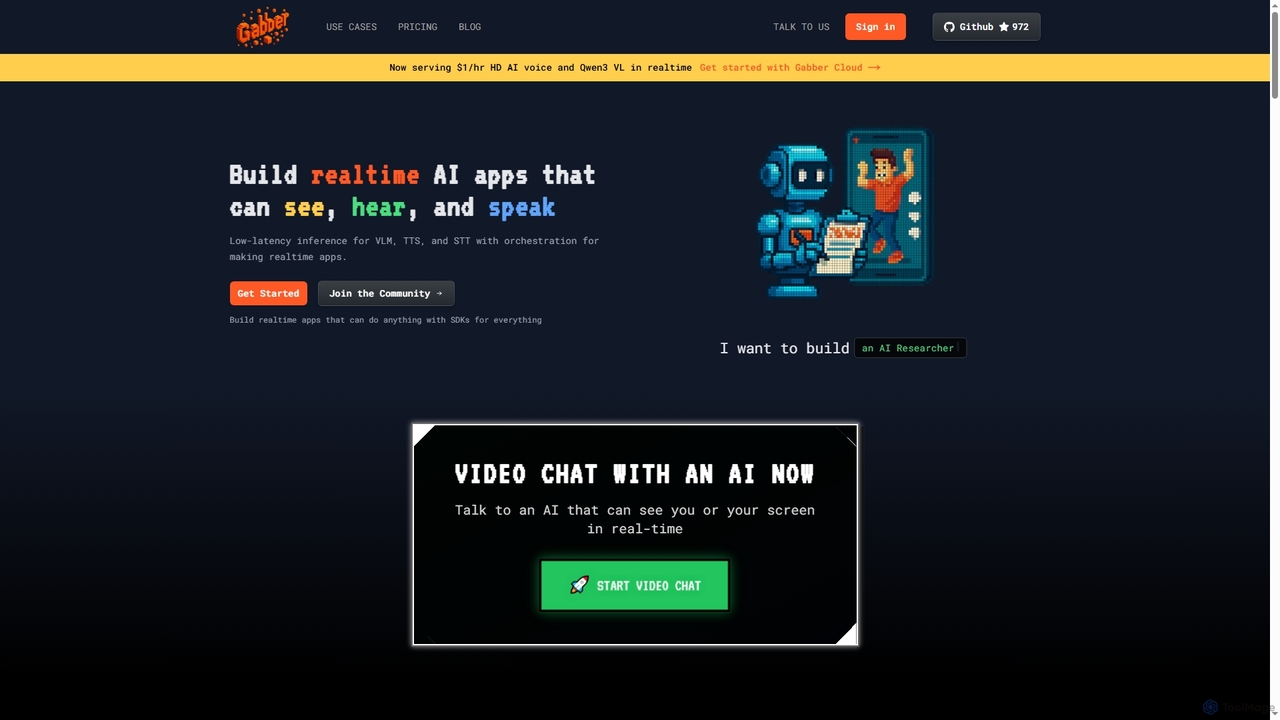
Gabber is a powerful platform for building real-time, multimodal AI applications that can see, hear, and speak. It offers low-latency inference for Vision Language Models (VLM), Text-to-Speech (TTS), and Speech-to-Text (STT), coupled with a graph-based orchestration system for rapid development and deployment.

Conversational Ai
Visits 8.3KFavorites 145Likes 154

About Realtime Ai

Realtime AI refers to artificial intelligence systems specifically engineered to process data and respond instantaneously, often within milliseconds. These advanced systems leverage highly optimized algorithms, specialized hardware, and high-speed data pipelines to perform rapid inference, analysis, and decision-making on continuously streaming information. Realtime AI is paramount for applications demanding immediate interaction and dynamic adaptation, such as the critical decision-making in autonomous vehicles, sophisticated financial fraud detection, and responsive live customer support. This unwavering focus on ultra-low latency and immediate action fundamentally distinguishes Realtime AI within the broader landscape of AI development, enabling critical operations that cannot tolerate delays and require instant feedback loops.

Core Features

  • Ultra-Low Latency Processing: Minimizes the time delay between data input and AI output to mere milliseconds, ensuring immediate and critical responses for time-sensitive applications.
  • Continuous Data Stream Inference: AI models are specifically designed to constantly analyze and act upon live, continuously flowing data streams, enabling always-on monitoring and decision-making.
  • Edge Computing Optimization: Facilitates processing data directly at or near its source (e.g., on a device or sensor), significantly reducing network latency and enhancing system responsiveness and reliability.
  • Dynamic Model Adaptation: Enables AI systems to rapidly adjust their decisions, predictions, or underlying models based on fast-changing real-time environmental data, ensuring relevance and accuracy.
  • High Throughput Capability: Engineered to efficiently handle and process massive volumes of concurrent data streams and events without performance degradation, crucial for large-scale deployments.

Applicable Scenarios

Realtime AI is indispensable in sectors where immediate action and instantaneous decision-making are critical for safety, efficiency, or user experience. It powers the perception and decision-making layers of autonomous driving systems for instant obstacle detection, path planning, and collision avoidance. Financial institutions deploy it to detect and prevent fraudulent transactions in real-time, safeguarding assets and minimizing losses. Furthermore, it enables e-commerce platforms to deliver instantaneous, personalized product recommendations and dynamic pricing, significantly enhancing user engagement and conversion rates by responding to live browsing behavior.

How to Choose

When selecting Realtime AI tools, it is crucial to prioritize solutions based on their demonstrated latency performance and data throughput capabilities, ensuring they precisely match your application's stringent demands for speed and volume. Evaluate their integration flexibility with existing data streams, IoT devices, and infrastructure, considering API availability and ease of deployment. Assess the platform's scalability to accommodate future growth in data volume and user demands, and critically consider its support for various deployment environments, including on-device edge, hybrid cloud, and centralized cloud-based setups, alongside robust security features.

Realtime Ai use cases

1

Real-time Obstacle Detection for Autonomous Vehicles

Automotive engineers utilize Realtime AI to instantly process vast amounts of sensor data (Lidar, camera, radar) from self-driving cars. The AI identifies pedestrians, other vehicles, and road signs in mere milliseconds, enabling the vehicle's control system to make immediate, critical decisions like braking, accelerating, or steering. This ensures optimal safety and responsiveness in highly dynamic and unpredictable traffic conditions, preventing accidents and enabling smooth navigation.

2

Instantaneous Credit Card Fraud Prevention

Financial institutions deploy Realtime AI to monitor credit card transactions as they occur globally. The AI analyzes transaction patterns, location, merchant details, and historical user behavior in real-time to detect suspicious activities (e.g., unusual spending, multiple transactions in different geographies) within seconds. This allows for immediate flagging or blocking of fraudulent transactions before they are completed, significantly minimizing financial losses for both banks and customers.

3

Live Product Recommendations for Online Shoppers

E-commerce platforms leverage Realtime AI to provide highly personalized product recommendations to users as they browse. Based on current viewing history, search queries, cart contents, and even mouse movements, the AI instantly suggests relevant items or complementary products. This dynamic approach improves user engagement, increases average order value, and boosts conversion rates by presenting highly tailored options at the precise moment of interest.

4

Real-time Equipment Malfunction Prediction

Manufacturing plant operators use Realtime AI to continuously monitor sensor data from critical machinery (e.g., temperature, vibration, pressure, current). The AI immediately identifies subtle deviations from normal operating parameters, predicting potential equipment failures or maintenance needs before they cause costly downtime. This enables proactive intervention, optimizes maintenance schedules, and significantly enhances overall production efficiency and safety.

5

Instant AI-Powered Customer Support Responses

Customer service departments implement Realtime AI-powered chatbots to provide immediate answers and support to customer queries across various channels. The AI processes natural language input in real-time, understands user intent, and retrieves relevant information or performs actions (e.g., checking order status, resetting passwords) instantly. This significantly reduces response times, improves first-contact resolution rates, and enhances overall customer satisfaction.

6

Real-time Bid Optimization for Digital Advertising

Digital marketing agencies and ad platforms employ Realtime AI in programmatic advertising to optimize ad placements. The AI evaluates ad impressions in milliseconds, considering user demographics, browsing history, ad placement context, and current market conditions to determine the optimal bid for an ad slot. This instantaneous decision-making maximizes campaign ROI, ensures efficient ad delivery, and targets the most relevant audience at the right time.

Realtime Ai FAQ

What is Realtime AI and why is it important?

Realtime AI refers to artificial intelligence systems that process data and make decisions or predictions with extremely low latency, often within milliseconds. Its importance stems from the need for immediate responsiveness in dynamic environments, enabling instant actions in critical applications like autonomous systems, fraud detection, and live customer interactions where delays are unacceptable.

How does Realtime AI achieve such low latency and rapid responses?

Realtime AI achieves low latency through a combination of optimized, lightweight AI models, efficient data streaming architectures, and the strategic use of edge computing, which processes data closer to its source. Specialized hardware accelerators and highly optimized algorithms also play a crucial role in accelerating inference and decision-making processes to meet stringent time constraints.

What's the key difference between Realtime AI and traditional batch processing AI?

The key difference lies in their operational timing and responsiveness. Traditional batch processing AI typically processes large datasets offline or in scheduled batches for analysis and prediction, with less emphasis on immediate output. Realtime AI, conversely, is specifically engineered for instantaneous processing and response to live, continuously streaming data, making it essential for interactive and time-critical applications requiring immediate action.

What are the main technical challenges in developing and deploying Realtime AI systems?

Developing and deploying Realtime AI systems presents several technical challenges. These include ensuring ultra-low latency and high throughput under varying loads, managing continuous and often massive data streams, optimizing AI models for efficient inference on resource-constrained edge devices, maintaining accuracy with rapidly changing data, and guaranteeing system reliability and fault tolerance in mission-critical applications.

Which industries and applications benefit most from Realtime AI capabilities?

Industries and applications requiring immediate decision-making and instantaneous responsiveness benefit most from Realtime AI. This includes autonomous systems (e.g., self-driving cars, robotics), financial services (e.g., high-frequency trading, real-time fraud detection), manufacturing (e.g., predictive maintenance, quality control), personalized customer experiences (e.g., live recommendations, intelligent chatbots), and cybersecurity (e.g., real-time threat detection and response).