
Ray3
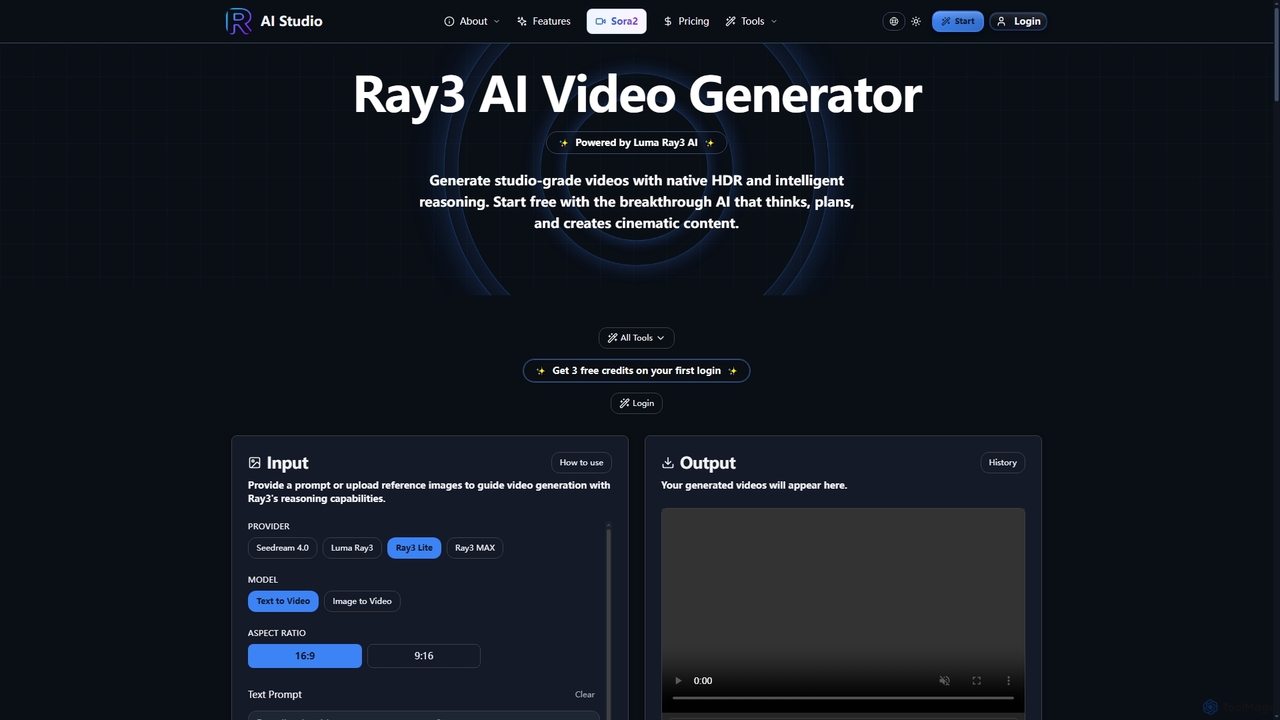
Ray3 is the world's first reasoning AI video model, powered by Luma AI, capable of generating studio-grade videos …
Ray3 is the world's first reasoning AI video model, powered by Luma AI, capable of generating studio-grade videos with native HDR. It understands complex prompts, plans sophisticated sequences, and offers rapid iteration through Draft Mode, making professional video creation accessible and efficient.
About Reasoning Ai
Reasoning AI refers to artificial intelligence systems designed to simulate human-like cognitive processes, enabling them to understand, interpret, and draw logical conclusions from complex information. These advanced models go beyond simple pattern recognition, focusing on causal relationships, problem-solving, and decision-making under uncertainty. They are crucial for tasks requiring deep comprehension and strategic thinking, offering solutions in areas where simple data processing is insufficient.
Core Features
- Logical Inference: Deriving new conclusions from existing premises and rules.
- Causal Reasoning: Identifying cause-and-effect relationships between events or variables.
- Problem Solving: Formulating strategies and executing steps to achieve specific goals.
- Decision Making: Evaluating options and selecting optimal actions based on available data and inferred knowledge.
- Knowledge Representation: Structuring and organizing complex information for efficient processing and retrieval.
Use Cases
Reasoning AI finds applications in expert systems for medical diagnosis, financial fraud detection, and autonomous systems navigation. It helps in understanding complex legal documents and optimizing supply chain logistics by predicting disruptions and inferring optimal strategies.
How to Choose
When selecting a Reasoning AI tool, evaluate its inference capabilities, the complexity of knowledge representation it supports, and its ability to handle uncertainty. Consider integration with existing data sources, scalability for your specific problem domain, and the transparency of its decision-making process to ensure alignment with your operational needs.
Reasoning AiUse Cases
Assisting Medical Professionals with Diagnostic Reasoning
Healthcare providers utilize Reasoning AI to analyze patient symptoms, medical history, lab results, and imaging data. The AI system applies logical inference and causal reasoning to suggest potential diagnoses, identify rare conditions, and recommend treatment pathways, significantly reducing diagnostic errors and improving patient outcomes by providing a second, data-driven opinion.
Enhancing Financial Fraud Detection with Causal Analysis
Financial institutions deploy Reasoning AI to detect sophisticated fraud schemes that evade traditional rule-based systems. By analyzing transaction patterns, user behavior, and external data, the AI identifies unusual causal links and anomalies, predicting potential fraudulent activities before they occur. This proactive approach minimizes financial losses and strengthens security protocols.
Enabling Intelligent Navigation for Autonomous Vehicles
Autonomous vehicles leverage Reasoning AI for real-time decision-making in complex and dynamic environments. The AI processes sensor data, traffic rules, and environmental conditions to infer optimal routes, predict other road users' intentions, and make safe, compliant driving decisions, such as lane changes, braking, or accelerating, ensuring reliable and secure operation.
Streamlining Legal Research and Case Outcome Prediction
Legal professionals use Reasoning AI to analyze vast quantities of legal documents, precedents, and case law. The AI identifies relevant clauses, infers relationships between legal concepts, and predicts potential case outcomes based on logical reasoning, significantly accelerating research, improving argument construction, and enhancing strategic planning for litigation.
Optimizing Supply Chains Through Predictive Reasoning
Businesses employ Reasoning AI to optimize complex supply chain operations. The AI analyzes historical data, market trends, and external factors to predict potential disruptions, infer optimal inventory levels, and suggest efficient logistics routes. This enables proactive risk mitigation and ensures timely delivery, reducing operational costs and improving customer satisfaction.
Accelerating Scientific Research and Hypothesis Generation
Researchers in various scientific fields utilize Reasoning AI to process and interpret large datasets from experiments and observations. The AI identifies novel patterns, infers causal relationships between variables, and generates new hypotheses for further investigation, significantly accelerating the pace of scientific discovery and leading to breakthroughs in complex domains like drug discovery or materials science.