ToolMage
Sign in

Best 1 Vision Ai AI tools for Ai Models

Popular Vision Ai AI tools in Ai Models include Gabber, helping you work more efficiently.

Gabber
Paid

Gabber

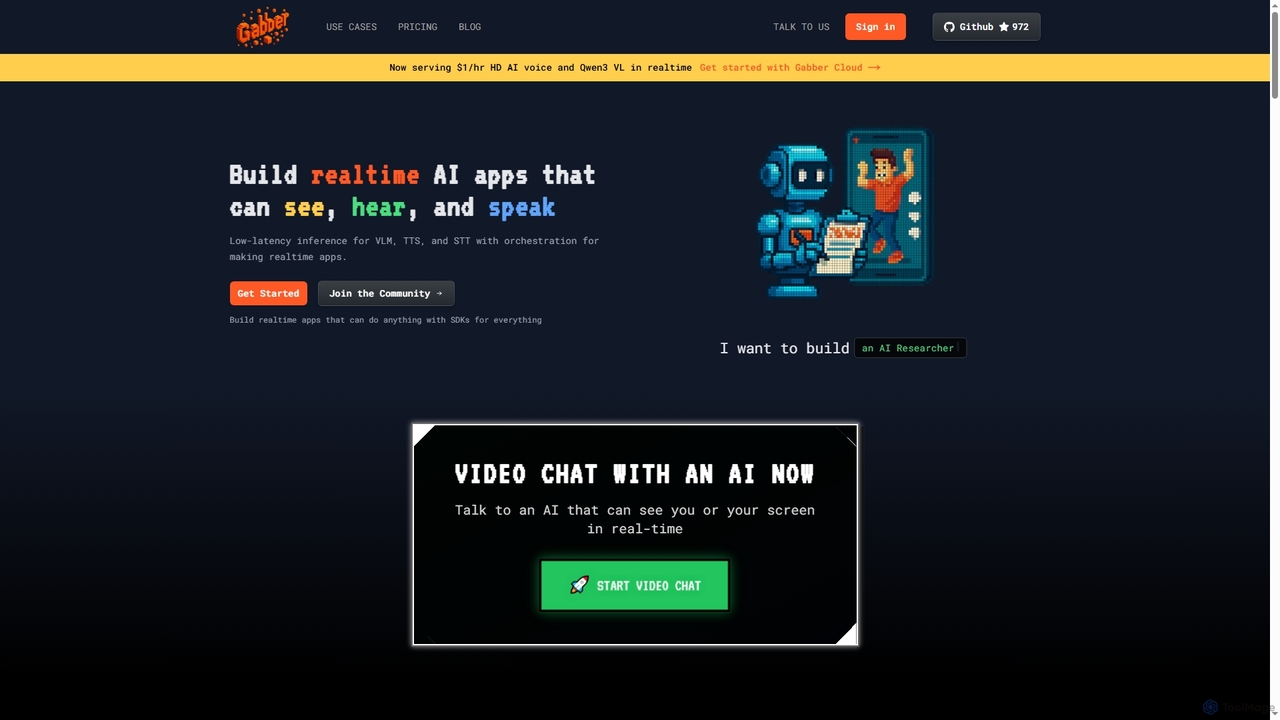
Gabber is a powerful platform for building real-time, multimodal AI applications that can see, hear, and speak. It offers low-latency inference for Vision Language Models (VLM), Text-to-Speech (TTS), and Speech-to-Text (STT), coupled with a graph-based orchestration system for rapid development and deployment.

Conversational Ai
Visits 8.1KFavorites 144Likes 154

About Vision Ai

Vision AI refers to a specialized branch of artificial intelligence that enables computers to "see," interpret, and understand the visual world. These tools utilize advanced machine learning models, particularly deep learning, to process and analyze images, videos, and other visual data. By extracting meaningful information, Vision AI empowers automation, enhances decision-making, and unlocks new insights across various industries, serving as a critical component within the broader field of AI models.

Core Features

  • Object Detection: Identifies and precisely locates specific objects within images or video streams.
  • Image Recognition & Classification: Categorizes visual content, distinguishing between different objects, scenes, or patterns.
  • Facial Recognition: Verifies or identifies individuals by analyzing unique facial features from visual inputs.
  • Optical Character Recognition (OCR): Extracts and converts text from images or scanned documents into machine-readable formats.
  • Anomaly Detection: Automatically identifies unusual or suspicious patterns in visual data, signaling potential issues.

Applicable Scenarios

Vision AI is indispensable in sectors requiring automated visual analysis. In manufacturing, it powers automated quality control, detecting defects on production lines. Retail leverages it for shelf monitoring and customer behavior analytics, while healthcare uses it for assisting in medical image diagnosis and disease detection.

How to Choose

When selecting Vision AI tools, prioritize accuracy and real-time processing capabilities for critical applications. Consider integration ease with existing systems, scalability to handle growing data volumes, and robust data privacy and security features. Evaluate the model's adaptability to specific visual data types and its overall cost-effectiveness.

Vision Ai use cases

1

Automated Manufacturing Quality Control

Manufacturing engineers deploy Vision AI systems to inspect products on assembly lines, automatically identifying defects, misalignments, or missing components with high precision, significantly reducing manual inspection time and improving product quality consistency.

2

Retail Shelf Monitoring & Inventory Management

Retail managers use Vision AI to continuously monitor product placement, stock levels, and planogram compliance on store shelves. This automates inventory checks, identifies out-of-stock items, and optimizes product display, leading to better sales and reduced waste.

3

Medical Image Analysis for Diagnosis

Radiologists and medical professionals utilize Vision AI to analyze X-rays, MRIs, and CT scans, assisting in the early detection of diseases like tumors or anomalies. The AI highlights suspicious areas, providing a second opinion and improving diagnostic accuracy and speed.

4

Autonomous Vehicle Perception & Navigation

Automotive engineers integrate Vision AI into self-driving cars to perceive their surroundings. The AI detects pedestrians, other vehicles, traffic signs, and lane markings in real-time, enabling safe navigation and obstacle avoidance, crucial for autonomous driving systems.

5

Security Surveillance & Anomaly Detection

Security personnel employ Vision AI in surveillance systems to monitor public spaces or restricted areas. The AI automatically flags unusual activities, unauthorized access, or suspicious objects, enhancing security response times and reducing the need for constant human monitoring.

6

Content Moderation and Visual Search

Online platform administrators use Vision AI to automatically moderate user-generated visual content, identifying and filtering out inappropriate or harmful images/videos. It also powers visual search engines, allowing users to find similar products or images based on an uploaded picture.

Vision Ai FAQ

What is Vision AI?

Vision AI, or computer vision, is an AI field that enables machines to interpret and understand visual information from images and videos. It involves training AI models to recognize patterns, objects, and scenes, allowing them to perform tasks like object detection, image classification, and facial recognition, much like human vision.

How does Vision AI work?

Vision AI primarily works by using deep learning models, especially convolutional neural networks (CNNs). These models are trained on vast datasets of labeled images and videos to learn patterns and features. When presented with new visual data, the AI applies its learned knowledge to identify, classify, or segment elements within the input, deriving meaningful insights.

What is the difference between Vision AI and general AI Models?

General AI models encompass a wide range of tasks and data types, including natural language processing, predictive analytics, and recommendation systems. Vision AI specifically focuses on processing and understanding visual data (images, videos). While Vision AI uses general AI model principles, its specialization lies in interpreting the visual world, making it a distinct sub-field.

What are the main applications of Vision AI?

Vision AI has diverse applications across industries. Key uses include automated quality control in manufacturing, retail analytics for customer behavior and inventory, medical imaging for disease diagnosis, autonomous vehicle navigation, security surveillance for anomaly detection, and content moderation for online platforms.

How to choose a Vision AI solution?

When selecting a Vision AI solution, consider its accuracy and robustness for your specific visual data, its processing speed (especially for real-time needs), and its ability to integrate with your existing infrastructure. Evaluate scalability, data privacy compliance, and the level of technical expertise required for deployment and maintenance. Cost-effectiveness and vendor support are also crucial factors.