ToolMage
Sign in

Best 1 Customer Analytics AI tools for Analytics

Popular Customer Analytics AI tools in Analytics include Rosetta.ai, helping you work more efficiently.

Rosetta.ai
Paid

Rosetta.ai

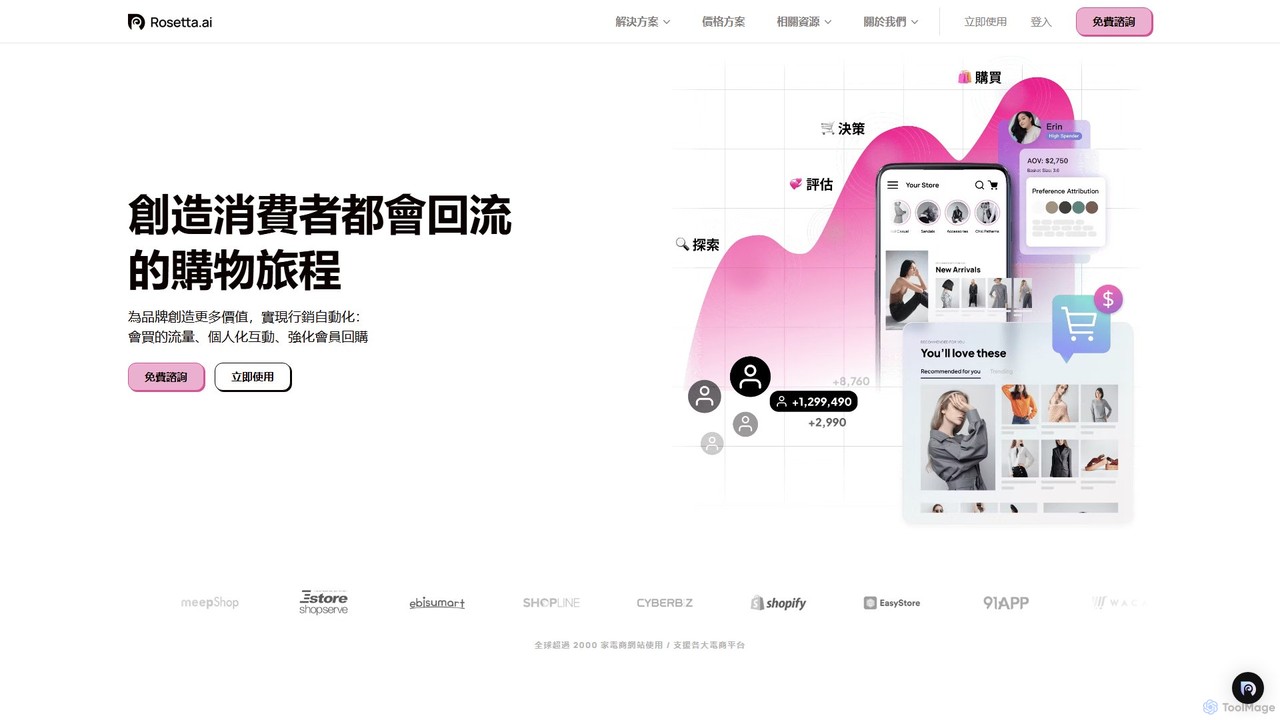
Rosetta.ai is an AI-powered marketing automation platform for e-commerce. It creates personalized shopping journeys to increase customer retention, conversion rates, and average order value. The platform combines traffic acquisition, on-site personalization, and customer analytics to turn visitors into loyal customers.

Customer Analytics
Visits 14.7KFavorites 149Likes 133

About Customer Analytics

Customer Analytics tools are a specialized category of AI-powered software designed to uncover deep insights from customer data. They utilize machine learning algorithms to analyze behavior, predict future actions, and segment audiences across multiple touchpoints. By unifying data from sources like CRMs, websites, and support platforms, these tools help businesses understand the entire customer journey, from acquisition to retention. This enables data-driven decisions to enhance personalization, reduce churn, and maximize customer lifetime value.

Core Features

  • Behavioral Segmentation: Automatically group customers based on actions, purchase history, and engagement levels.
  • Churn Prediction: Identify customers at high risk of leaving by analyzing patterns in their behavior and usage data.
  • Lifetime Value (LTV) Forecasting: Predict the future revenue a customer will generate, enabling smarter marketing spend.
  • Sentiment Analysis: Process customer feedback from reviews and surveys to quantify satisfaction and identify trends.
  • Customer Journey Mapping: Visualize the paths customers take across different channels to pinpoint friction points and opportunities.

Use Cases

These tools are essential for e-commerce, SaaS, and retail businesses. A marketing manager can use them to create highly targeted campaigns for specific customer segments, while a product team can analyze feature adoption to guide their development roadmap. Customer support teams also leverage them to proactively address issues before they lead to churn.

How to Choose

When selecting a Customer Analytics tool, prioritize its integration capabilities with your existing systems (e.g., Shopify, Salesforce). Evaluate the depth of its analytical features—do you need predictive modeling or just descriptive reports? Also, consider the user interface's ease of use for non-technical team members and a pricing model that scales with your data volume and business growth.

Customer Analytics use cases

1

Reduce Customer Churn in SaaS Businesses

A Customer Success Manager at a SaaS company uses an AI Customer Analytics tool to proactively identify at-risk accounts. The tool connects to their CRM and product usage database, automatically flagging users whose engagement has dropped significantly or who haven't used key features. Based on this data, the manager can trigger automated, personalized email sequences or schedule a call to offer support, effectively reducing churn rates by targeting intervention efforts where they are most needed.

2

Personalize E-commerce Marketing Campaigns

An e-commerce marketing team leverages a Customer Analytics platform to move beyond simple demographic targeting. The AI segments customers based on browsing behavior, purchase frequency, and predicted lifetime value. This allows the team to create highly personalized campaigns, such as showing luxury product ads to high-LTV segments or sending re-engagement offers to one-time buyers, significantly improving conversion rates and return on ad spend.

3

Optimize Product Development Roadmap

A Product Manager for a mobile app needs to decide which features to prioritize for the next quarter. By using a Customer Analytics tool, they can analyze which features are most used by their most valuable customer segments. The platform can also correlate feature usage with retention rates, revealing which functionalities are critical for long-term user satisfaction. This data provides a clear, objective basis for roadmap decisions, ensuring development resources are focused on impactful improvements.

4

Enhance Customer Support Efficiency

A Head of Customer Support integrates a Customer Analytics tool with their helpdesk software like Zendesk or Intercom. The AI performs sentiment analysis on thousands of support tickets to identify recurring issues and common points of customer frustration. This allows the team to create better help documentation, train agents on specific problem areas, and provide quantitative feedback to the product team about critical bugs or confusing user interface elements, ultimately reducing ticket volume and improving customer satisfaction.

5

Improve Marketing Channel Attribution

A digital marketing analyst aims to understand the true ROI of different advertising channels. A Customer Analytics tool can map the entire customer journey across multiple touchpoints, from the first ad click on social media to the final purchase on the website. It moves beyond last-click attribution, using AI models to assign proper credit to each channel that influenced the conversion. This provides a more accurate picture of marketing effectiveness, enabling budget reallocation to the most impactful channels.

6

Forecast Inventory for Retail Businesses

A retail operations manager uses a Customer Analytics platform to improve demand forecasting. The tool analyzes historical sales data, customer purchasing patterns, and even external factors like seasonality and promotional events. By segmenting customers and understanding their buying cycles, the AI can predict future demand for specific products with greater accuracy. This helps optimize inventory levels, reducing both stockouts of popular items and overstocking of slow-moving goods, directly impacting the bottom line.

Customer Analytics FAQ

What are AI Customer Analytics tools?

AI Customer Analytics tools are software platforms that use machine learning to analyze customer data from various sources. Their primary goal is to uncover patterns, predict future behavior, and provide actionable insights into the entire customer lifecycle. Unlike traditional analytics, they can automate complex tasks like customer segmentation, churn prediction, and lifetime value forecasting, enabling businesses to make smarter, data-driven decisions.

How do I choose the right Customer Analytics tool?

To choose the right tool, consider four key factors. First, check its integration capabilities with your existing data sources (CRM, e-commerce platform, etc.). Second, evaluate its analytical depth—do you need predictive models or just descriptive dashboards? Third, assess its usability for your team's technical skill level. Finally, analyze the pricing model to ensure it aligns with your budget and can scale as your data grows.

What is the difference between Customer Analytics and Web Analytics?

The main difference lies in their focus. Web Analytics (like Google Analytics) primarily tracks anonymous user behavior on a website, focusing on metrics like page views, sessions, and bounce rates. Customer Analytics focuses on the known customer, unifying data from multiple channels (website, app, email, CRM) to understand the entire person-centric journey. It answers 'who' and 'why' questions about customer behavior, not just 'what' and 'how many'.

What key insights can AI Customer Analytics provide?

These tools provide several critical insights. They can identify your most valuable customer segments, predict which customers are likely to churn and why, forecast the lifetime value (LTV) of different customer cohorts, and reveal friction points in the customer journey. Furthermore, by analyzing customer feedback, they can uncover prevailing sentiment and highlight areas for product or service improvement.

Who benefits most from using Customer Analytics tools?

Various roles and departments benefit significantly. Marketing teams use them to personalize campaigns and improve ROI. Product managers leverage them to prioritize features based on user behavior. Customer success and support teams use them to proactively reduce churn and identify common issues. Executives and business leaders rely on them for strategic planning and understanding long-term customer value.