
ToolMage
Sign in

Best 1 Informational AI tools for Chatbots

Popular Informational AI tools in Chatbots include ChatLegal, helping you work more efficiently.

ChatLegal
Freemium

ChatLegal

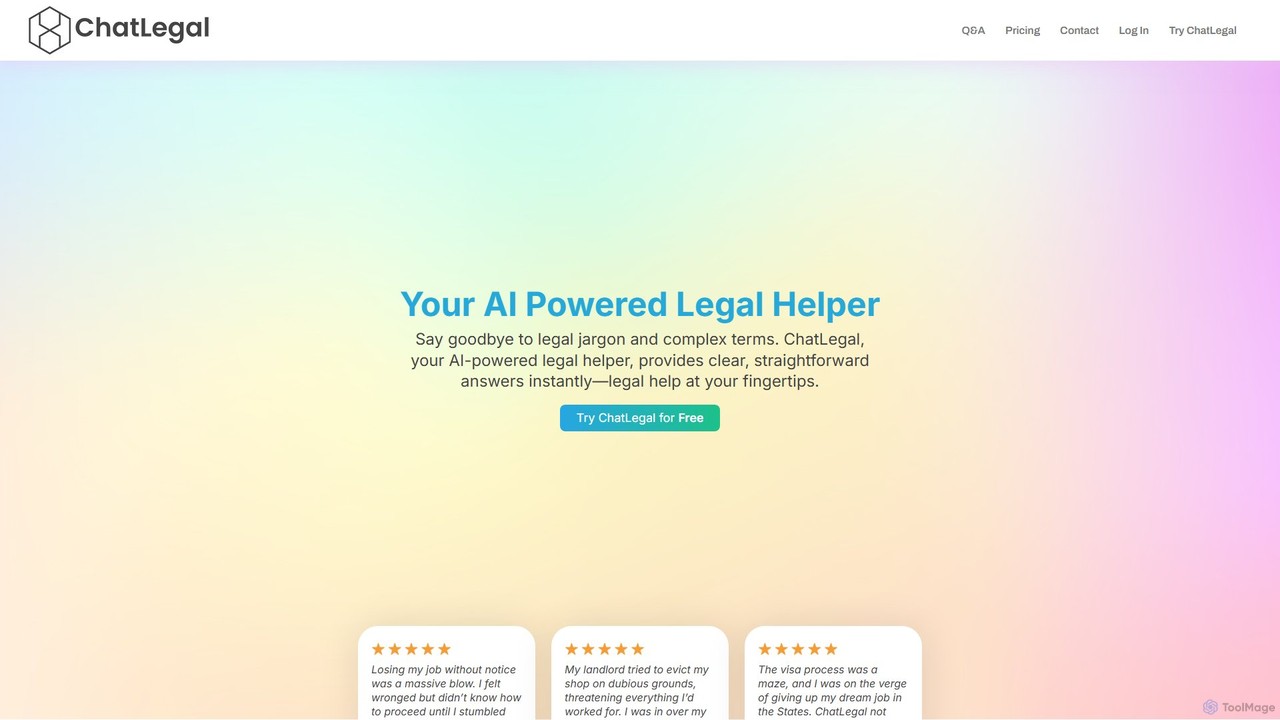
ChatLegal is an AI-powered legal assistant designed to simplify complex legal language and provide instant, clear answers. It offers guidance on various legal matters, assists with document generation like contracts and wills, and supports individuals, business owners, and legal professionals with affordable, 24/7 access to legal information.

Informational
Visits 7.9KFavorites 181Likes 179

About Informational

Informational Chatbots are a specialized type of AI chatbot designed to provide users with specific information by retrieving answers from a structured knowledge base. They utilize Natural Language Processing (NLP) to understand user queries and deliver accurate, pre-approved responses. The primary value of these bots is to offer instant, 24/7 access to information, automating responses to frequently asked questions. Unlike more complex conversational AI, their main goal is efficient information delivery rather than open-ended dialogue.

Core Features

  • Knowledge Base Integration: Directly connects to FAQs, documents, or databases to pull accurate answers.
  • Natural Language Understanding (NLU): Interprets user intent and variations in questions to find the correct information.
  • Pre-defined Responses: Ensures all provided information is consistent, accurate, and approved.
  • Escalation to Human Agent: Can transfer complex queries that are outside its knowledge scope to a live support agent.
  • Analytics and Reporting: Tracks common questions and user interactions to identify knowledge gaps.

Use Cases

Informational Chatbots are widely used across various sectors. In customer service, they act as first-line support on websites to answer common questions about shipping, returns, or product details. Within organizations, they serve as internal helpdesks, providing employees with instant access to HR policies, IT troubleshooting guides, or company information. They are also valuable in education and public services for disseminating information quickly and reliably.

How to Choose

When selecting an Informational Chatbot, first assess its knowledge base compatibility and ease of updating content. Evaluate the accuracy of its Natural Language Understanding (NLU) to ensure it can handle diverse user phrasing. Consider its integration capabilities with your existing platforms (like websites or messaging apps) and its options for escalating conversations to human agents. Finally, review the analytics features to gain insights into user needs and bot performance.

Informational use cases

1

Automating Website FAQ Responses

An e-commerce store manager uses an Informational Chatbot on their website to handle common customer queries. The bot is connected to a knowledge base containing information on shipping policies, return procedures, and product specifications. When a visitor asks, 'How long does shipping take?', the chatbot instantly provides the precise shipping times for different regions. This frees up the customer support team from answering repetitive questions, allowing them to focus on complex issues, and improves the customer experience by providing immediate answers 24/7.

2

Internal HR Policy Information Desk

An HR department implements an Informational Chatbot on the company's intranet to serve as a self-service portal for employees. The bot is trained on all company policies, including leave requests, expense claims, and benefits. An employee can ask, 'What is the company's policy on parental leave?' and receive a direct link to the relevant document along with a summary of key points. This reduces the number of emails and calls to the HR team, ensures consistent information delivery, and empowers employees to find answers independently at any time.

3

Public Service Information for Citizens

A city council's website uses an Informational Chatbot to help citizens find information about local services. The chatbot's knowledge base includes details on waste collection schedules, local tax payments, and community event calendars. A resident can ask, 'When is my recycling collected?' and the bot, after asking for a postcode, provides the specific collection day. This makes public information more accessible, reduces call volume to the council's contact center, and provides a valuable 24/7 service to the community.

4

Event Information and Schedule Assistant

Organizers of a large tech conference deploy an Informational Chatbot on the event's mobile app. Attendees can ask questions like 'What time is the keynote speech?' or 'Where is the session on AI ethics?'. The chatbot, linked to the event schedule and venue map, provides instant answers, helping attendees navigate the conference smoothly. This enhances the attendee experience, reduces the burden on event staff at information booths, and allows for real-time updates to be pushed to the chatbot's knowledge base if schedules change.

5

Product Information Assistant for Shoppers

A large electronics retailer integrates an Informational Chatbot on its product pages. When a customer is viewing a laptop, they can ask the bot specific questions like 'Does this model have a backlit keyboard?' or 'What is the battery life?'. The bot retrieves this data directly from the product's technical specifications sheet. This provides a more interactive and efficient way for customers to get detailed information than searching through long product descriptions, leading to more informed purchasing decisions and potentially higher conversion rates.

6

Educational Content Delivery for Students

An online learning platform uses an Informational Chatbot to help students review course material. The bot's knowledge base is populated with key concepts, definitions, and formulas from a specific course, like 'Introduction to Physics'. A student preparing for an exam can ask, 'Explain Newton's Second Law' or 'What is the formula for kinetic energy?'. The bot provides concise, accurate answers, acting as an on-demand study assistant. This helps reinforce learning and provides students with a quick way to clarify doubts without re-watching entire video lectures.

Informational FAQ

What is an Informational Chatbot?

An Informational Chatbot is a type of AI-powered chatbot focused specifically on retrieving and delivering information from a predefined knowledge source. Unlike general-purpose conversational AI, its primary function is to answer user questions with accurate, consistent data, not to engage in open-ended dialogue. They are commonly used for automating responses to frequently asked questions (FAQs) in customer support, internal HR, and public information services.

How do Informational Chatbots differ from Transactional Chatbots?

The key difference lies in their primary goal. Informational Chatbots are designed to provide answers. They retrieve data from a knowledge base to respond to queries. Transactional Chatbots, on the other hand, are designed to perform actions. They guide users through a process to complete a task, such as booking an appointment, placing an order, or resetting a password. An informational bot tells you the store's hours, while a transactional bot helps you make a reservation.

How do you choose the right Informational Chatbot?

Selecting the right tool involves evaluating several factors. Consider the following:

  • Knowledge Base Management: How easy is it to create, import, and update the information the bot uses? Look for tools with intuitive content management systems.
  • NLP Accuracy: Test how well the bot understands different ways of asking the same question. A strong NLU (Natural Language Understanding) is crucial.
  • Integration: Ensure the chatbot can be easily deployed on your required channels, such as your website, mobile app, or internal messaging platforms.
  • Analytics: The tool should provide insights into what users are asking, whether they find the answers helpful, and where your knowledge base has gaps.
What are the main benefits of using an Informational Chatbot?

The primary benefits include increased efficiency and improved user experience. By automating answers to common questions, they free up human agents to handle more complex issues, reducing operational costs. For users, they provide instant, 24/7 access to information without waiting times. This leads to higher customer satisfaction and empowers employees or the public to find information independently. They also ensure that the information provided is always consistent and accurate, as it comes from a single, controlled source.

Can Informational Chatbots handle complex questions?

Informational Chatbots are best suited for answering factual questions that have clear, predefined answers within their knowledge base. They can handle variations in how a question is asked but struggle with ambiguous, subjective, or multi-part questions that require reasoning or access to external, real-time data. For complex queries that fall outside their scope, a well-designed informational bot should have a clear escalation path, offering to connect the user with a human agent for further assistance.