SWMS AI
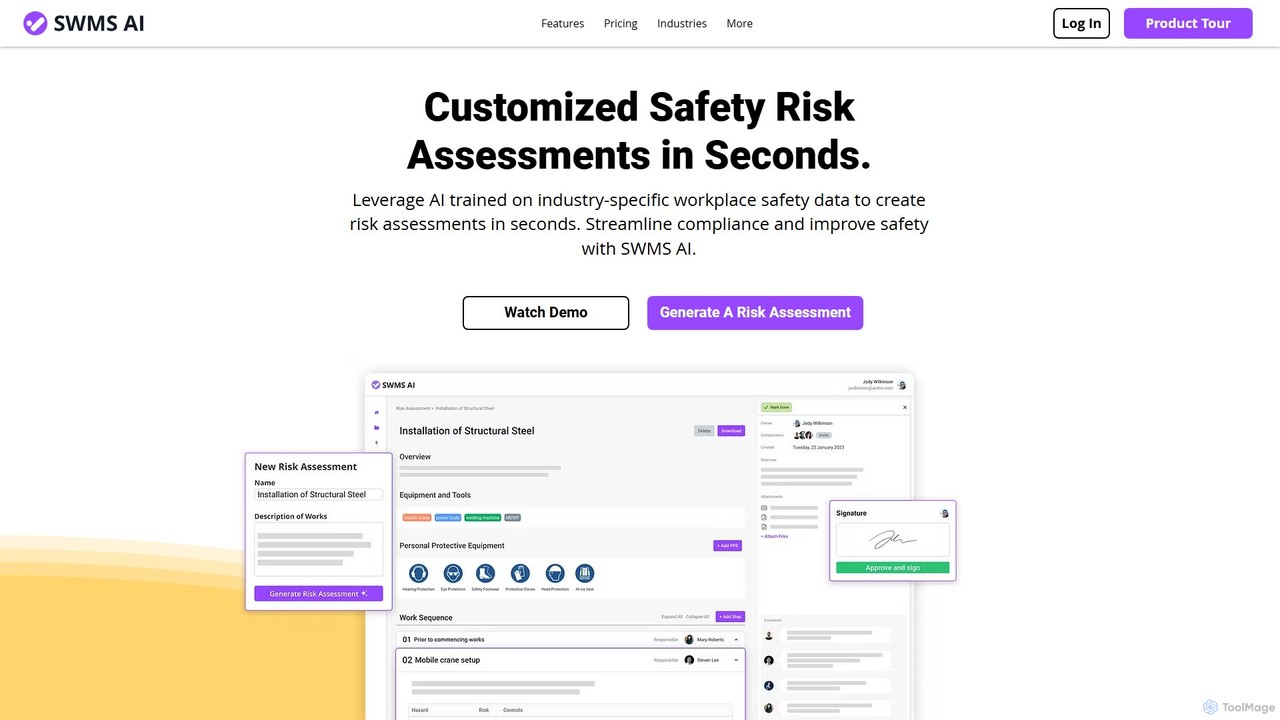
SWMS AI is an advanced platform that leverages artificial intelligence to generate customized safety risk assessments and compliance …
SWMS AI is an advanced platform that leverages artificial intelligence to generate customized safety risk assessments and compliance documents in seconds. Trained on extensive industry-specific data, it helps businesses in sectors like construction, mining, and logistics to streamline safety procedures, automate compliance, and reduce workplace hazards. The platform also features an AI assistant, Oscar, for instant access to critical safety knowledge.
About Safety Management
AI-powered Safety Management tools are designed to proactively identify, assess, and mitigate risks to ensure a safe working environment. These tools leverage advanced analytics, machine learning, and automation to enhance traditional safety protocols. They provide real-time insights and predictive capabilities, significantly improving an organization's ability to prevent incidents and maintain operational integrity. This focus on operational safety directly contributes to an organization's broader compliance with health and safety regulations.
Core Features
- Predictive Risk Assessment: Analyzes historical data and real-time sensor inputs to forecast potential hazards and incidents.
- Automated Incident Reporting: Streamlines the documentation, investigation, and resolution process for workplace incidents.
- Real-time Monitoring & Alerts: Uses AI vision and IoT sensors to detect unsafe conditions or behaviors and trigger immediate notifications.
- Compliance Tracking & Auditing: Monitors adherence to safety regulations and standards, automating audit processes and identifying gaps.
- Safety Training Management: Delivers personalized training modules and tracks employee competency in safety protocols.
Use Cases
These tools are crucial for industries with high operational risks, such as manufacturing, construction, energy, and logistics. They empower safety managers, EHS (Environment, Health, and Safety) officers, and operational leaders to move from reactive incident response to proactive risk prevention. By integrating AI, organizations can create a more robust safety culture, reduce accident rates, and ensure continuous regulatory compliance.
How to Choose
When selecting an AI Safety Management tool, consider its integration capabilities with existing operational systems, the breadth and accuracy of its predictive analytics, and its compliance database for relevant regulations. Evaluate its real-time monitoring features, ease of use for incident reporting, and scalability to accommodate organizational growth. Prioritize solutions that offer customizable dashboards and robust reporting functionalities to support data-driven safety decisions.

Safety ManagementUse Cases
Predictive Maintenance for Industrial Safety
Manufacturing plant managers utilize AI-powered Safety Management tools to analyze sensor data from heavy machinery and production lines. By identifying subtle anomalies and predicting equipment failures before they occur, the system alerts maintenance teams. This proactive approach prevents catastrophic breakdowns, reduces the risk of worker injuries from malfunctioning equipment, and minimizes costly operational downtime, ensuring a safer and more efficient production environment.
Real-time Hazard Detection in Construction Sites
Construction site supervisors deploy AI vision systems to monitor active work zones for potential hazards. These systems can detect if workers are not wearing required PPE (Personal Protective Equipment), if heavy machinery operates too close to personnel, or if unauthorized individuals enter restricted areas. Immediate alerts are sent to supervisors and affected workers, enabling rapid intervention to prevent accidents and ensure compliance with site safety protocols, significantly reducing incident rates.
Automated Incident Reporting and Analysis
EHS managers in large corporations use AI Safety Management platforms to streamline incident reporting. Employees can quickly log incidents via mobile apps, with AI assisting in categorizing the event, identifying contributing factors, and suggesting immediate corrective actions. The system then analyzes aggregated incident data to uncover root causes and recurring patterns, providing actionable insights to prevent future occurrences and improve overall safety performance by 20%.
Optimizing Emergency Response Plans
Emergency response coordinators leverage AI Safety Management tools to simulate various disaster scenarios and optimize evacuation routes and emergency protocols. By analyzing building layouts, occupancy data, and potential hazard zones, AI can identify bottlenecks and suggest improvements to response plans. This ensures faster and safer evacuations, better resource allocation during crises, and a more resilient organization capable of protecting its personnel and assets effectively.
Ensuring Compliance with Safety Regulations
Compliance officers in highly regulated industries use AI Safety Management platforms to continuously monitor adherence to complex safety regulations (e.g., OSHA, EPA). The AI system automatically tracks regulatory updates, cross-references them with internal policies and operational data, and flags potential non-compliance issues. This reduces manual audit efforts by 40%, minimizes the risk of fines and legal penalties, and ensures the organization maintains a strong safety compliance record.
Personalized Safety Training and Competency Tracking
HR and training departments utilize AI Safety Management tools to deliver tailored safety training. Based on an employee's role, past incident involvement, and learning style, the AI platform assigns relevant modules and tracks their progress and comprehension. This personalized approach ensures that all employees receive the most effective training, improving knowledge retention and reducing human error-related incidents by up to 25%, fostering a more competent and safety-conscious workforce.