Construction Best in category 1 results Quantity Takeoff AI Tool

Popular AI tools in the Quantity Takeoff field of Construction include Kreo, etc., helping you quickly improve efficiency.

Kreo

Kreo

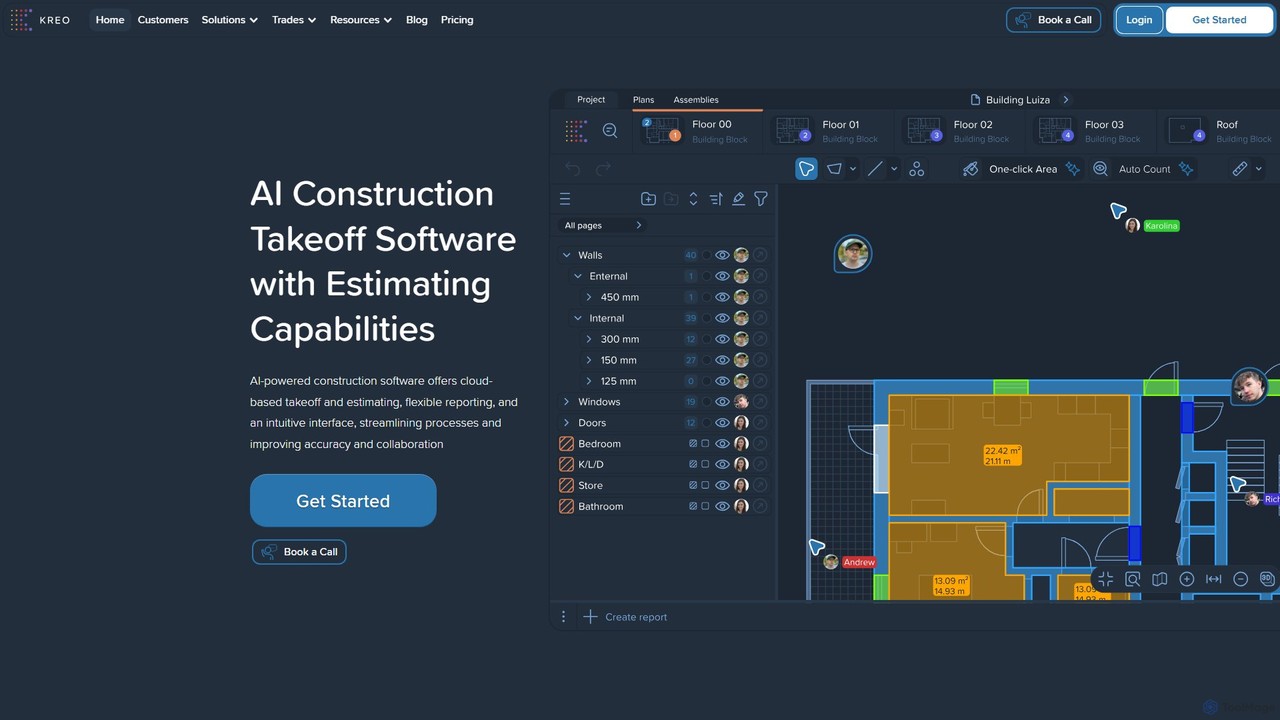
Kreo is an AI-powered cloud platform for the construction industry, designed to automate and streamline quantity takeoffs, cost …

115.5K

About Quantity Takeoff

AI Quantity Takeoff tools are specialized software that automates the measurement and calculation of materials, labor, and costs from construction blueprints and 3D models. These tools leverage computer vision and machine learning to recognize, count, and measure elements like walls, doors, and pipes directly from digital plans. This significantly accelerates the pre-construction phase by providing accurate data for bidding, budgeting, and resource planning. Their primary advantage is the reduction of time-consuming manual work and the minimization of human error in cost estimation.

Core Features

  • Automated Measurement: Automatically detects and measures areas, lengths, volumes, and counts of items from 2D drawings and 3D models.
  • BIM Integration: Directly extracts precise quantity data from Building Information Modeling (BIM) files (e.g., Revit, IFC).
  • Component Recognition: Uses AI to identify specific construction elements such as concrete slabs, steel beams, windows, and MEP fixtures.
  • Cost Database Connectivity: Links quantified materials to up-to-date cost databases to generate instant, detailed cost estimates.
  • Collaborative Review: Provides a cloud-based platform for teams to review, annotate, and validate takeoffs in real-time.

Use Cases

These tools are essential for quantity surveyors, cost estimators, general contractors, and subcontractors during the bidding and planning stages of construction projects. They are used across various disciplines, including structural, architectural, and MEP (Mechanical, Electrical, Plumbing), to create detailed Bills of Quantities (BOQ) and ensure project budgets are based on precise data.

How to Choose

When selecting an AI Quantity Takeoff tool, consider its compatibility with your file formats (PDF, DWG, RVT, IFC). Evaluate its accuracy and specialization for your specific trade (e.g., civil, electrical, finishing). Also, assess its integration capabilities with your existing project management or estimating software and the level of customization available for measurement rules and cost calculations.

Quantity TakeoffUse Cases

1

Automated Concrete & Rebar Estimation for Foundations

A structural estimator working on a bid for a large commercial building uploads the foundation plan drawings (PDF or DWG) to the AI tool. The software automatically identifies and measures all structural elements like footings, slabs, and columns. It calculates the required volume of concrete in cubic meters/yards and estimates the rebar tonnage by recognizing reinforcement specifications. This process reduces the estimation time from several days to just a few hours, significantly improving bid turnaround time and accuracy.

2

Rapid Drywall and Painting Area Calculation

An interior finishing contractor bidding on a multi-family residential project uses an AI takeoff tool to analyze architectural floor plans. The tool automatically calculates the total surface area of walls and ceilings for drywall installation and painting. It intelligently deducts openings for doors and windows from the total area, providing a precise quantity. This allows the contractor to generate a highly accurate material order and labor estimate, leading to more competitive and profitable bids.

3

MEP System Component Counting for Procurement

An MEP (Mechanical, Electrical, Plumbing) contractor preparing for a hospital renovation project uploads the MEP drawings to an AI takeoff platform. The AI uses object recognition to automatically count hundreds or thousands of components, such as light fixtures, electrical outlets, HVAC ducts, pipe fittings, and sprinkler heads. This generates a detailed Bill of Quantities (BOQ) for procurement in minutes, preventing over-ordering or shortages of critical components and ensuring the project stays on schedule.

4

Earthwork Volume Calculation for Site Preparation

A civil contractor planning a new land development project uses an AI tool to process topographical survey data and grading plans. The software calculates the precise cut and fill volumes required to level the site according to the design. It generates 3D visualizations of the earthwork, helping the contractor to optimize machinery planning and accurately estimate the costs associated with excavation and backfilling operations, leading to a more reliable project budget.

5

Facade Material Takeoff from Elevation Drawings

An architect or facade specialist needs to estimate the materials for a high-rise building's exterior. They upload the elevation drawings to an AI takeoff tool. The AI analyzes the drawings to measure the total area of different facade materials, such as glass curtain walls, metal cladding, and stone tiles. It accurately accounts for complex geometries and openings, delivering a precise material list that optimizes procurement and minimizes waste for expensive exterior finishes.

6

Collaborative Takeoff Review for Value Engineering

During the pre-construction phase, a project manager uses the AI tool's cloud platform to share the initial takeoff with the client and design team. Stakeholders can visually inspect the quantified elements directly on the drawings, leave comments, and explore alternatives. For example, they can instantly see the cost impact of switching from one type of flooring to another. This collaborative process facilitates transparent communication and faster decision-making for value engineering, ensuring the project meets budget goals without sacrificing quality.

Quantity TakeoffFrequently Asked Questions