ToolMage
Sign in

Best 1 Prompt Engineering AI tools for Creative Tools

Popular Prompt Engineering AI tools in Creative Tools include Veltos, helping you work more efficiently.

Veltos
Freemium

Veltos

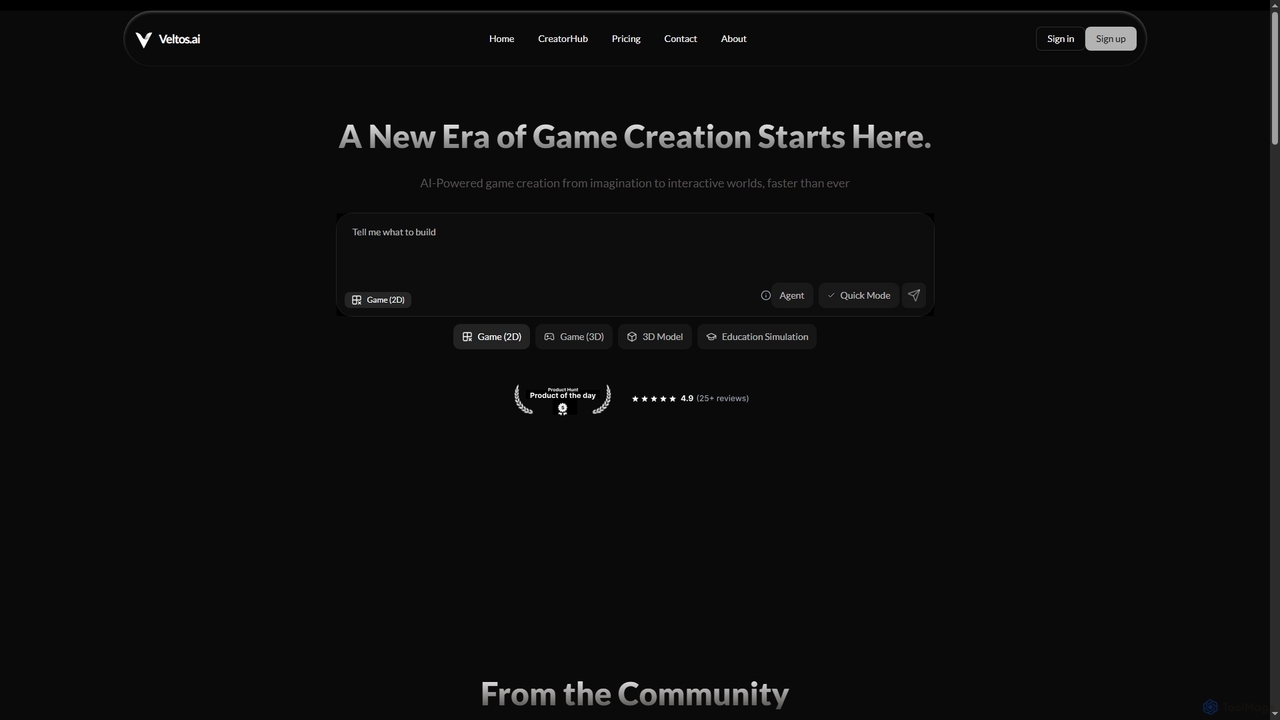
Veltos is an AI-powered platform that transforms simple text prompts into fully playable 2D and 3D games, as well as interactive 3D worlds and simulations. It empowers creators of all skill levels to design and publish games rapidly without writing a single line of code, democratizing game development and fostering a new era of creative play.

Prompt Engineering
Visits 7.7KFavorites 128Likes 145

About Prompt Engineering

Prompt Engineering tools are specialized AI-powered platforms designed to optimize, manage, and refine the input prompts used to interact with large language models (LLMs) and other generative AI systems. These tools enable users to craft more effective, precise, and consistent prompts, significantly enhancing the quality and relevance of AI-generated outputs. By providing structured frameworks and testing environments, Prompt Engineering solutions empower creators, developers, and businesses to unlock the full potential of AI, ensuring predictable and desired results across various applications.

Core Features

  • Prompt Optimization & Refinement: Tools to analyze, test, and iteratively improve prompts for better AI output quality and consistency.
  • Prompt Template Management: Centralized systems for creating, storing, organizing, and sharing reusable prompt templates across teams.
  • Version Control & History: Track changes to prompts, revert to previous versions, and maintain an audit trail for iterative development.
  • Performance Testing & Evaluation: Features to run prompts against various models, compare outputs, and measure effectiveness based on predefined metrics.
  • Context & Constraint Management: Define and manage specific parameters, rules, and contextual information to guide AI generation more precisely.

Applicable Scenarios

Prompt Engineering tools are invaluable for professionals who regularly interact with generative AI. Content creators use them to generate high-quality articles, marketing copy, and social media posts with specific tones and styles. Developers leverage these tools to fine-tune prompts for code generation, API interactions, and chatbot development, ensuring accurate and reliable responses. Businesses implement them to standardize AI interactions across departments, from customer service automation to data analysis, maintaining brand voice and operational efficiency.

How to Choose

When selecting a Prompt Engineering tool, consider its compatibility with your preferred AI models (e.g., OpenAI, Anthropic, Google). Evaluate the prompt management features, such as template libraries, version control, and collaboration capabilities, which are crucial for team environments. Look for robust testing and evaluation functionalities that allow for A/B testing and performance comparison. Finally, assess the ease of integration with existing workflows and the level of support for advanced techniques like few-shot learning or chain-of-thought prompting.

Prompt Engineering use cases

1

Optimizing Marketing Copy for Campaigns

Marketing specialists frequently use Prompt Engineering tools to generate diverse and compelling ad copy, social media posts, and email newsletters. By systematically testing different prompt variations—adjusting tone, keywords, and calls-to-action—they can identify the most effective prompts that yield higher engagement and conversion rates. This iterative refinement process ensures brand consistency and maximizes campaign performance across various platforms, saving significant time compared to manual content creation and testing.

2

Crafting Consistent Chatbot Responses

AI developers and customer service managers employ Prompt Engineering to design and maintain a library of highly effective prompts for conversational AI agents. They refine prompts to ensure chatbots provide accurate, helpful, and on-brand responses to a wide range of customer queries. Through version control and performance testing, they can continuously improve the chatbot's understanding and response quality, leading to enhanced customer satisfaction and reduced support costs.

3

Streamlining AI Art & Design Generation

Digital artists and graphic designers utilize Prompt Engineering tools to explore creative possibilities and achieve specific aesthetic outcomes with AI image generators. By meticulously crafting and iterating on descriptive prompts, they can generate precise visual styles, compositions, and elements. These tools help manage complex prompt structures, experiment with different parameters, and maintain consistency across a series of generated images, accelerating the conceptualization and production phases of design projects.

4

Accelerating Code Generation & Debugging

Software engineers and developers use Prompt Engineering to generate accurate code snippets, functions, or entire scripts using AI coding assistants. They refine prompts to specify programming languages, desired functionalities, and architectural constraints, ensuring the AI produces relevant and error-free code. These tools also aid in debugging by crafting prompts that help the AI analyze existing code and suggest fixes, significantly speeding up development cycles and improving code quality.

5

Developing Educational Content & Quizzes

Educators and instructional designers leverage Prompt Engineering to create engaging and accurate learning materials, summaries, and quiz questions. By carefully structuring prompts, they can guide AI to generate content tailored to specific subjects, grade levels, and learning objectives. The ability to test and refine prompts ensures the generated educational resources are pedagogically sound, factually correct, and aligned with curriculum standards, enhancing the learning experience for students.

6

Standardizing Data Analysis & Reporting Prompts

Data analysts and business intelligence professionals use Prompt Engineering to standardize the way they interact with AI for data interpretation and report generation. They develop and manage prompts that consistently extract specific insights, summarize complex datasets, and format reports according to business requirements. This ensures uniformity in data analysis outputs, reduces manual effort, and allows for rapid generation of actionable intelligence for decision-making across the organization.

Prompt Engineering FAQ

What is Prompt Engineering?

Prompt Engineering is the discipline of designing, refining, and optimizing the input queries (prompts) used to guide generative AI models, such as large language models (LLMs) and text-to-image generators. It involves understanding how AI models interpret instructions and crafting prompts that elicit the most accurate, relevant, and desired outputs. The goal is to maximize the effectiveness of AI tools by providing clear, concise, and contextually rich instructions, transforming vague requests into precise directives for the AI.

How do Prompt Engineering tools help improve AI output?

Prompt Engineering tools enhance AI output by providing structured environments for prompt creation, testing, and iteration. They offer features like prompt templates, version control, and performance metrics, allowing users to systematically experiment with different prompt variations. This process helps identify the most effective prompts that consistently generate high-quality, relevant, and desired results, reducing trial-and-error and ensuring AI models perform optimally for specific tasks.

What should I consider when choosing a Prompt Engineering tool?

When selecting a Prompt Engineering tool, consider its compatibility with the AI models you use (e.g., OpenAI, Google AI). Evaluate its prompt management features, such as template libraries, version control, and collaboration capabilities, which are essential for team workflows. Look for robust testing and evaluation functionalities, including A/B testing and output comparison. Also, assess its integration capabilities with your existing development or content creation pipelines and the level of community support or documentation available.

Who benefits most from using Prompt Engineering tools?

Prompt Engineering tools primarily benefit anyone who regularly interacts with generative AI models and seeks to achieve consistent, high-quality outputs. This includes content creators (writers, marketers, designers) aiming for specific styles or themes, developers building AI-powered applications (chatbots, code generators), researchers exploring AI capabilities, and businesses looking to standardize AI usage across their operations. Essentially, anyone who wants to move beyond basic AI interactions to achieve precise and reliable results will find these tools invaluable.

How does Prompt Engineering differ from general AI content creation?

General AI content creation focuses on generating content using AI, often with basic prompts. Prompt Engineering, however, is the specialized process *behind* that creation, focusing on the *design and optimization* of the prompts themselves. It's about understanding the AI's mechanics to craft superior instructions, rather than just inputting a request. While content creation is the output, prompt engineering is the strategic input refinement that ensures the output is consistently high-quality, targeted, and aligned with specific objectives.