ToolMage
Sign in

Best 44 Business Intelligence AI tools for Data Analysis

Popular Business Intelligence AI tools in Data Analysis include InsightJini, Superads, hellodata, Genie AI, Reflexivity, Hudson Labs, Spatial.ai, Huma.ai, ChartGPT, and MarketAlerts, helping you work more efficiently.

Avanty
Freemium

Avanty

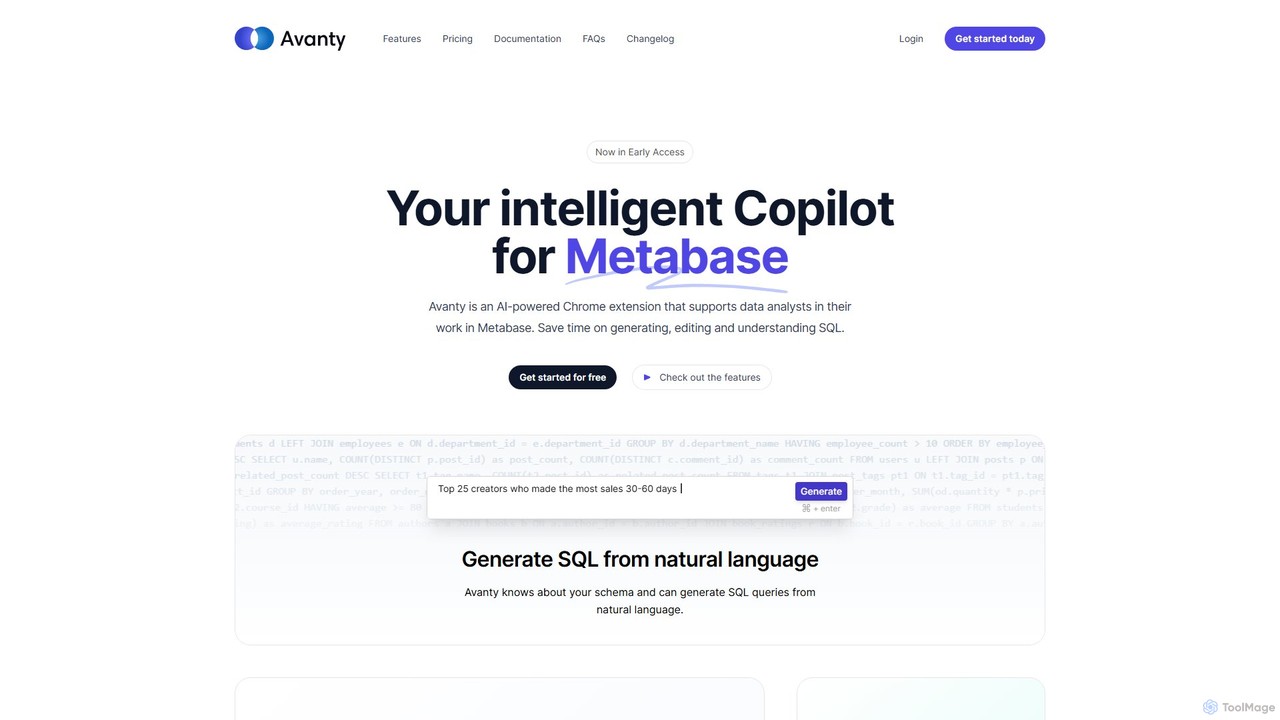
Avanty is an AI-powered Chrome extension designed as an intelligent copilot for data analysts using Metabase. It streamlines workflows by enabling users to generate, edit, explain, and format SQL queries using natural language. This tool significantly saves time, enhances productivity, and helps in understanding complex data queries, making data analysis faster and more intuitive.

Business Intelligence
Visits 7.3KFavorites 142Likes 146

About Business Intelligence

Business Intelligence (BI) tools are AI-powered platforms that transform raw business data into actionable insights for strategic decision-making. These tools leverage advanced algorithms and machine learning to automate data processing, identify complex trends, and provide predictive analytics. Their primary value lies in empowering organizations to understand past performance, monitor current operations, and forecast future outcomes, leading to more informed and agile business strategies.

Core Features

  • Interactive Dashboards: Customizable visual interfaces for real-time monitoring of key performance indicators (KPIs) and metrics.
  • Predictive Analytics: AI-driven models that forecast future trends and potential outcomes based on historical data patterns.
  • Automated Reporting: Generation of scheduled or on-demand reports with deep dives into specific business areas.
  • Natural Language Querying (NLQ): Allows users to ask questions in plain language and receive data-driven answers without complex coding.
  • Data Visualization: Creation of charts, graphs, and maps to present complex data in an easily understandable format.

Applicable Scenarios

Business Intelligence tools are essential for various departments, from executive leadership to operational teams. For instance, sales managers use them to track regional performance and identify top-selling products, while marketing teams analyze campaign effectiveness and customer segmentation. Finance departments leverage BI for budget analysis and financial forecasting, enabling proactive risk management and resource allocation.

How to Choose

When selecting an AI Business Intelligence tool, consider its data integration capabilities with your existing systems (CRM, ERP, databases), the breadth and depth of its visualization options, and the sophistication of its AI-powered analytics (e.g., predictive modeling, anomaly detection). Evaluate its scalability to handle growing data volumes, ease of use for non-technical users, and the availability of robust security features and compliance standards.

Featured tool rankings

Business Intelligence use cases

1

Optimizing Sales Performance

Sales managers utilize AI Business Intelligence tools to analyze sales data across regions, products, and customer segments. By visualizing real-time performance metrics and identifying underperforming areas or emerging opportunities, they can quickly adjust strategies, allocate resources more effectively, and forecast future sales trends with greater accuracy, leading to improved revenue generation.

2

Enhancing Marketing Campaign Effectiveness

Marketing teams leverage BI platforms to track the performance of various campaigns across different channels. These tools help analyze customer engagement, conversion rates, and return on investment (ROI) for each initiative. AI-driven insights can identify which campaigns resonate most with specific demographics, allowing marketers to optimize spending and personalize future outreach efforts.

3

Streamlining Financial Forecasting and Budgeting

Finance departments employ Business Intelligence to gain a comprehensive view of financial health. By integrating data from accounting, payroll, and sales systems, they can generate accurate forecasts, monitor budget adherence, and identify potential financial risks or opportunities. AI capabilities can detect anomalies in spending patterns and predict future cash flows, supporting more robust financial planning.

4

Improving Operational Efficiency and Supply Chain Management

Operations managers use BI tools to monitor key operational metrics, such as production output, inventory levels, and supply chain logistics. Real-time dashboards provide visibility into bottlenecks, delays, or inefficiencies. AI can predict equipment failures or demand fluctuations, enabling proactive adjustments to optimize resource allocation, reduce waste, and ensure smoother operations.

5

Gaining Deeper Customer Behavior Insights

Customer service and product development teams utilize AI Business Intelligence to analyze customer interactions, purchase history, and feedback data. These tools help identify customer segments, predict churn risk, and understand preferences. By visualizing customer journeys and sentiment, businesses can tailor products, services, and support to enhance satisfaction and loyalty.

6

Supporting Strategic Executive Decision-Making

Executive leadership relies on BI dashboards to get a high-level overview of organizational performance across all departments. These tools consolidate complex data into digestible reports and visualizations, highlighting key trends, risks, and opportunities. AI-powered insights provide a data-driven foundation for strategic planning, market entry decisions, and long-term growth initiatives.

Business Intelligence FAQ

What is AI-powered Business Intelligence?

AI-powered Business Intelligence (BI) refers to the use of artificial intelligence and machine learning technologies within BI platforms to automate data analysis, uncover hidden patterns, and generate predictive insights. Unlike traditional BI, which primarily focuses on historical data reporting, AI-powered BI can forecast future trends, detect anomalies, and provide more sophisticated, actionable recommendations, significantly enhancing decision-making capabilities.

How does Business Intelligence differ from Data Analytics?

While closely related, Business Intelligence (BI) focuses on what happened and what is happening by providing dashboards and reports for operational and strategic decision-making. Data Analytics, the broader parent category, involves a deeper dive into why something happened and what could happen, often requiring more technical expertise for data exploration and statistical modeling. AI-powered BI bridges this gap by bringing advanced analytical capabilities to business users in an accessible format.

What are the key benefits of using AI Business Intelligence tools?

AI Business Intelligence tools offer several key benefits, including enhanced decision-making through data-driven insights, improved operational efficiency by identifying bottlenecks and optimizing processes, and a competitive advantage from understanding market trends and customer behavior more deeply. They also enable proactive risk management, faster identification of new opportunities, and significant time savings by automating complex data analysis tasks.

Who can benefit most from AI Business Intelligence tools?

A wide range of professionals can benefit from AI Business Intelligence tools. This includes executive leadership for strategic planning, sales and marketing teams for performance tracking and campaign optimization, finance departments for budgeting and forecasting, and operations managers for supply chain and process efficiency. Essentially, any role requiring data-driven insights to make informed decisions can leverage these tools effectively.

What should I consider when choosing an AI Business Intelligence solution?

When selecting an AI Business Intelligence solution, prioritize its ability to integrate with your existing data sources, the intuitiveness and customizability of its dashboards and reporting features, and the robustness of its AI capabilities like predictive analytics and natural language processing. Also, consider its scalability, security features, pricing model, and the level of technical support and training provided to ensure it aligns with your organizational needs and user skill levels.