ToolMage
Sign in

Best 2 Datasets AI tools for Data Science

Popular Datasets AI tools in Data Science include Allen Institute for AI (AI2) and Project Aria, helping you work more efficiently.

Project Aria

Project Aria

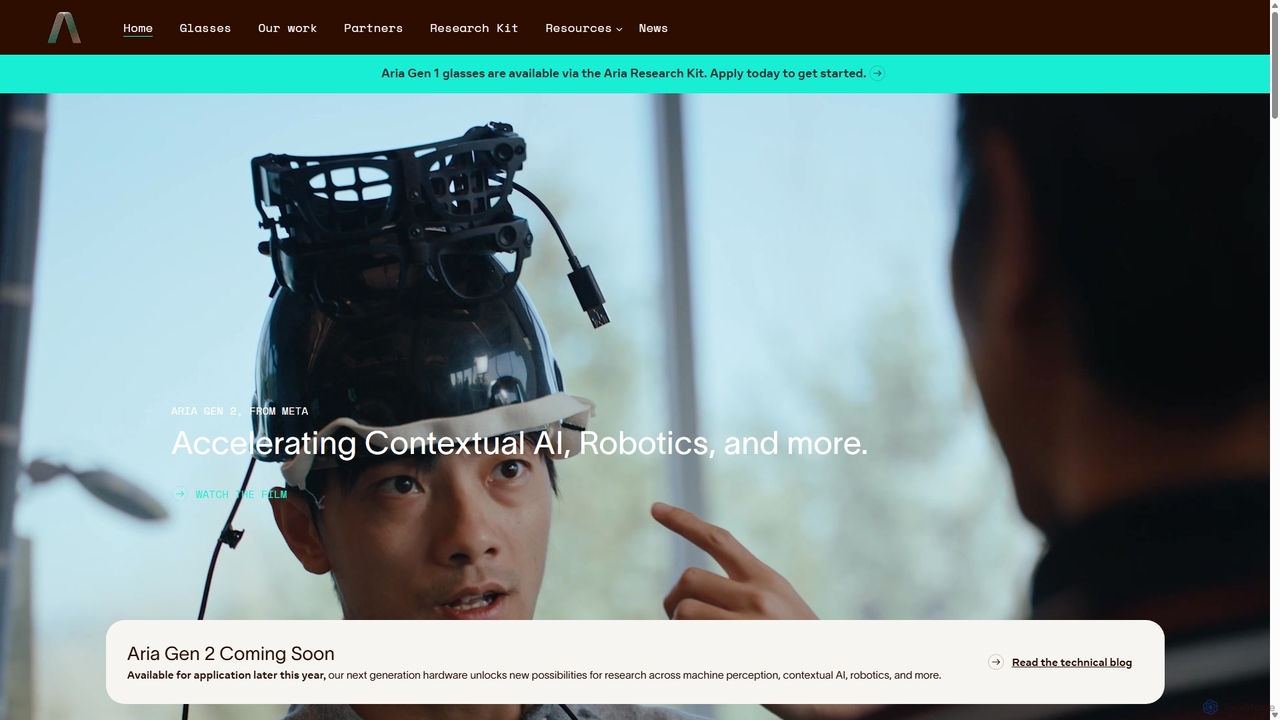
Project Aria is a research initiative by Meta designed to accelerate the development of contextual AI, augmented reality (AR), and robotics. It utilizes advanced research glasses, like the Aria Gen 2, to capture first-person perspective data, providing researchers with a comprehensive platform including hardware, open-source datasets, and development tools to build the future of machine perception.

Datasets
Visits 39.7KFavorites 102Likes 97
Allen Institute for AI (AI2)
Free

Allen Institute for AI (AI2)

The Allen Institute for AI (AI2) is a non-profit research institute dedicated to building breakthrough AI for the common good. It focuses on creating truly open-source large language models like OLMo, comprehensive datasets, and specialized AI tools to advance scientific research and address major global challenges in areas such as climate science, conservation, and medicine.

Datasets
Visits 372.7KFavorites 100Likes 110

About Datasets

Datasets are curated collections of data used to train, validate, and test artificial intelligence models. These collections, which can include images, text, audio, or numerical data, provide the foundational knowledge for machine learning algorithms to learn patterns and make predictions. Accessing high-quality, relevant datasets is a critical first step in developing effective AI applications, from computer vision systems to natural language processors. They serve as the 'textbooks' from which AI learns, directly influencing the final model's accuracy and performance.

Core Features

  • Structured & Labeled Data: Data is often organized and annotated with labels (e.g., 'cat' or 'dog' for images) to facilitate supervised learning.
  • Diverse Data Types: Includes a wide range of formats such as images, text documents, audio clips, and tabular data to support various AI tasks.
  • Data Splitting: Typically pre-divided into training, validation, and testing sets to ensure proper model evaluation and prevent overfitting.
  • Comprehensive Metadata: Accompanied by detailed documentation explaining data sources, collection methods, and licensing information.

Use Cases

Datasets are fundamental in academic research and commercial AI development. They are used by data scientists to train custom machine learning models, by researchers to benchmark algorithm performance against established standards, and by developers to fine-tune pre-trained models for specific tasks like sentiment analysis or object detection.

How to Choose

When selecting a dataset, consider its relevance to your specific problem and its overall quality, including the accuracy of labels and the absence of biases. Also, evaluate the dataset's size—it should be large enough for your model to learn effectively. Finally, check the licensing terms to ensure they permit your intended use, whether for commercial or academic purposes.

Featured tool rankings

Datasets use cases

1

Train a Custom Image Recognition Model

A computer vision engineer needs to build a model to identify specific manufacturing defects. They use a high-quality, labeled dataset of product images, with each image annotated as 'pass' or 'fail' along with the defect type. By training their convolutional neural network (CNN) on this dataset, the model learns to distinguish between flawless products and various defects, automating the quality control process and increasing detection accuracy.

2

Fine-tune a Language Model for Customer Support

A startup wants to create a specialized chatbot for its industry. A machine learning specialist takes a large, pre-trained language model and fine-tunes it using a curated dataset of industry-specific customer inquiries and corresponding expert answers. This process adapts the general model to understand niche terminology and provide relevant, accurate responses, significantly improving the customer support experience.

3

Benchmark a New Recommendation Algorithm

A data science team has developed a new algorithm for a movie recommendation engine. To prove its effectiveness, they test it against a public, industry-standard dataset like MovieLens. They compare their algorithm's prediction accuracy (e.g., how well it predicts user ratings) against established benchmarks. This allows for objective performance evaluation and validation before deploying the new system.

4

Develop a Voice-Controlled Smart Home Device

An IoT developer is creating a device that responds to voice commands. They utilize a large audio dataset containing thousands of hours of spoken commands from diverse speakers with different accents and in various acoustic environments. This dataset is used to train a speech-to-text model, ensuring the device can reliably understand user commands like 'turn on the lights' or 'set a timer' in real-world conditions.

5

Build a Medical Diagnosis AI Assistant

A medical research institution aims to create an AI tool to assist radiologists in detecting tumors from MRI scans. They use a specialized, anonymized dataset of medical images, where each scan is labeled by expert radiologists. Training a model on this dataset helps create a system that can highlight potential areas of concern, serving as a second opinion and potentially improving diagnostic speed and accuracy.

6

Perform Sentiment Analysis for Market Research

A marketing analyst wants to gauge public opinion about a new product launch. They use a dataset of social media posts and product reviews, each labeled with a sentiment (positive, negative, neutral). By training a natural language processing (NLP) model on this data, they can automatically analyze thousands of new comments, providing real-time insights into customer satisfaction and identifying areas for improvement.

Datasets FAQ

What are AI Datasets?

AI datasets are structured collections of information, such as images, text, or sounds, specifically prepared for training and evaluating machine learning models. They act as the source material from which an AI learns to recognize patterns, make decisions, and generate predictions. High-quality datasets are often annotated with labels (e.g., identifying objects in images) to guide the learning process in supervised machine learning tasks.

How do I choose the right dataset for my project?

To choose the right dataset, consider four key factors. First, relevance: ensure the data directly relates to the problem you want to solve. Second, quality: check for accurate labels, minimal noise, and lack of significant bias. Third, size: the dataset must be large enough to train a robust model without causing overfitting. Finally, licensing: verify that the dataset's usage rights align with your project's goals, especially for commercial applications.

What is the difference between a training, validation, and testing dataset?

These are three distinct subsets of a single dataset used for model development. The training set (typically the largest part) is used to teach the model by letting it learn patterns from the data. The validation set is used during training to tune the model's parameters and prevent overfitting. The testing set is used only after the model is fully trained to provide an unbiased evaluation of its final performance on unseen data.

What are some common types of AI datasets?

AI datasets come in many forms depending on the task. Common types include:

  • Image Datasets: Collections of pictures for tasks like object detection or image classification (e.g., ImageNet).
  • Text Datasets: Corpora of text for natural language processing (NLP) tasks like sentiment analysis or translation.
  • Audio Datasets: Recordings of speech or sounds for voice recognition or sound classification.
  • Tabular Datasets: Data organized in rows and columns, common in finance and analytics for predictive modeling.
Why is data quality so important in a dataset?

Data quality is crucial because the performance of an AI model is fundamentally limited by the quality of the data it's trained on—a concept known as 'garbage in, garbage out.' Poor-quality data with inaccurate labels, biases, or insufficient diversity can lead to a model that makes incorrect predictions, behaves unfairly towards certain groups, and performs poorly in real-world scenarios. High-quality data ensures the model learns correct patterns, leading to more accurate and reliable results.