Symphony
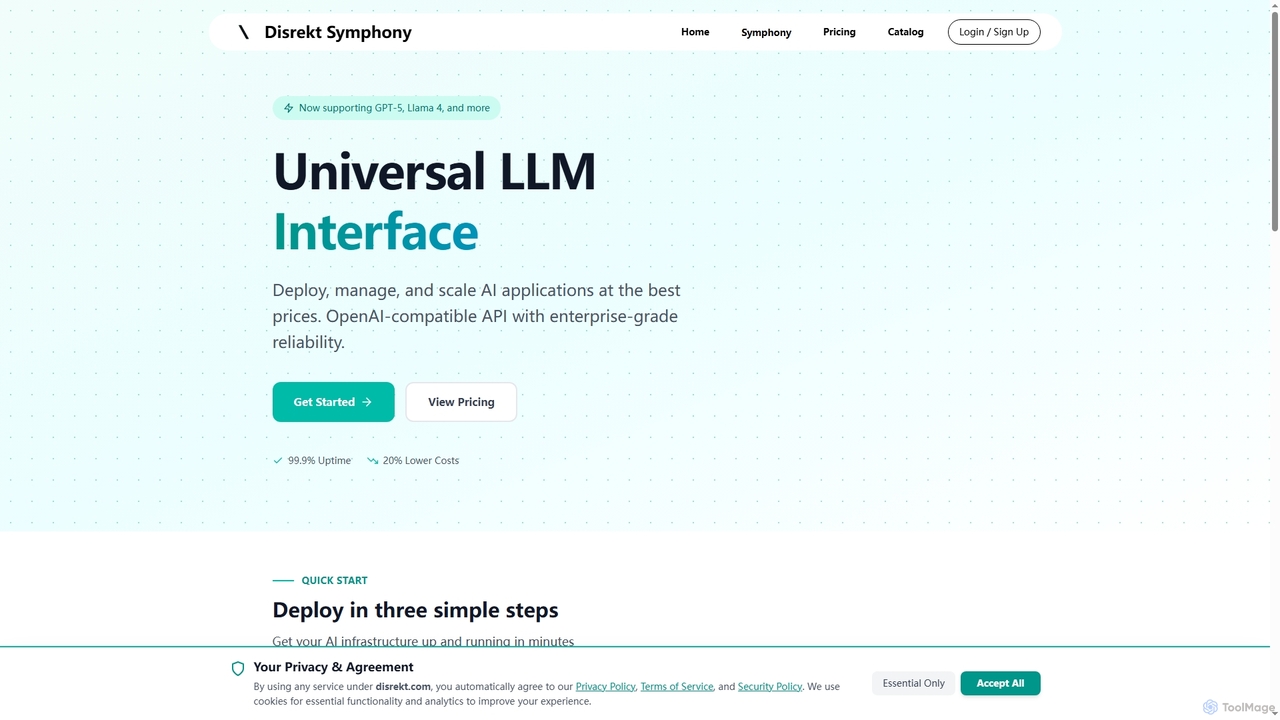
Symphony is a universal LLM interface providing an OpenAI-compatible API for deploying, managing, and scaling AI applications. It …
Symphony is a universal LLM interface providing an OpenAI-compatible API for deploying, managing, and scaling AI applications. It offers enterprise-grade reliability, up to 20% lower costs, and supports over 100 major AI models like GPT-5 and Llama 4, making it an ideal solution for developers and enterprises seeking efficient and robust AI infrastructure.
AgentSystems
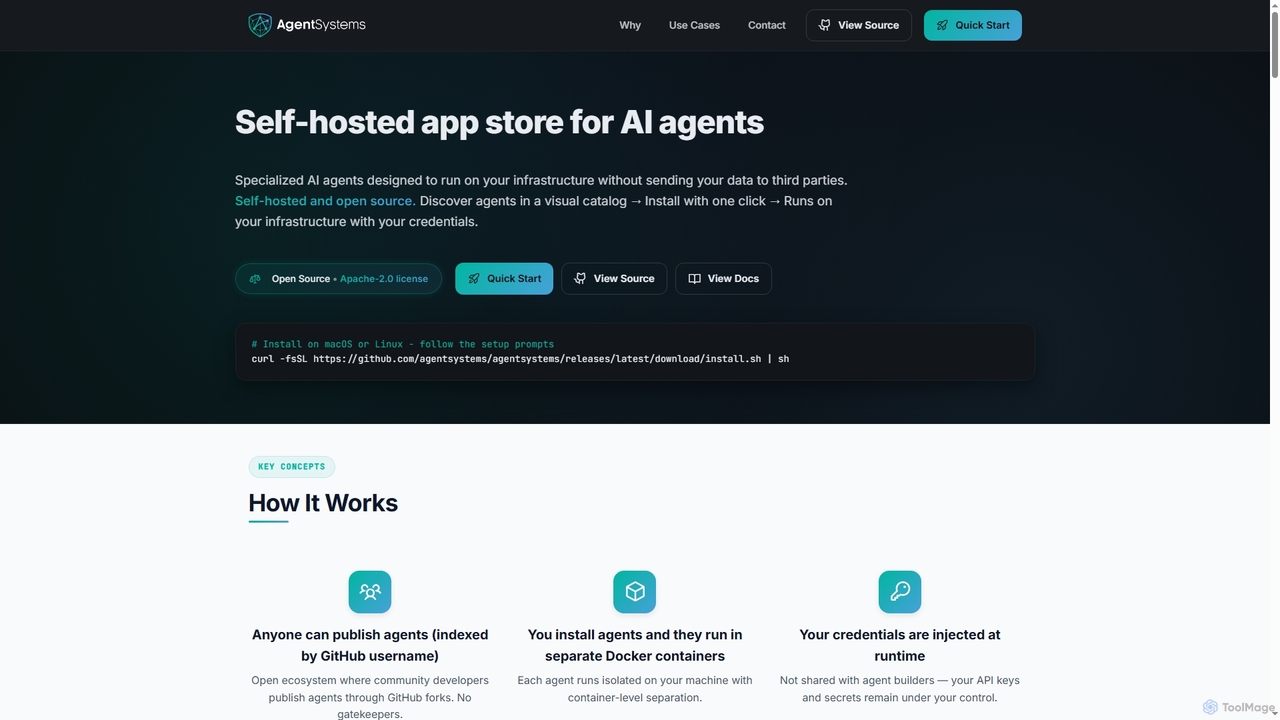
An open-source, self-hosted platform for discovering, deploying, and managing specialized AI agents on your own infrastructure, ensuring complete …
An open-source, self-hosted platform for discovering, deploying, and managing specialized AI agents on your own infrastructure, ensuring complete data privacy and control.
About Ai Infrastructure
AI Infrastructure provides the foundational platforms and services for building, training, deploying, and managing machine learning models at scale. These tools abstract away the complexity of underlying hardware and software, offering managed environments optimized for the entire AI development lifecycle. They enable developers and data scientists to focus on model creation rather than managing complex systems, accelerating the path from experiment to production. This specialized infrastructure is crucial for handling large datasets, intensive computations, and continuous model monitoring.
Core Features
- Managed Compute Resources: Provides on-demand access to optimized hardware like GPUs and TPUs for training and inference without manual setup.
- MLOps & Lifecycle Management: Offers tools for experiment tracking, model versioning, automated retraining, and CI/CD pipelines for machine learning.
- Scalable Model Deployment: Enables easy deployment of trained models as scalable API endpoints, serverless functions, or batch processing jobs.
- Data & Feature Management: Includes solutions for data storage, versioning, labeling, and creating centralized feature stores for model consistency.
- Integrated Development Environments: Offers pre-configured notebooks and environments with popular AI frameworks like TensorFlow and PyTorch.
Use Cases
AI Infrastructure is essential for technology companies, AI startups, and enterprise data science teams building custom AI solutions. It is used for developing large-scale recommendation engines, deploying computer vision models for industrial automation, and managing the lifecycle of fraud detection models in finance. Research institutions also leverage it to accelerate experiments by accessing powerful computing resources on demand.
How to Choose
When selecting an AI Infrastructure tool, evaluate its scalability and performance for your expected workload. Consider its support for your preferred machine learning frameworks and the level of MLOps automation it provides. Assess the balance between ease of use (fully managed platforms) and flexibility (composable components). Finally, analyze the pricing model (e.g., pay-per-use, subscription) and its integration capabilities with your existing data stack.
Ai InfrastructureUse Cases
Deploying a Custom LLM for Customer Service
A SaaS company wants to build a support chatbot powered by a fine-tuned Large Language Model (LLM). Their MLOps team uses an AI Infrastructure platform to manage the entire process. They first use the platform's data management tools to prepare and version their proprietary support tickets. Then, they leverage on-demand GPU instances to fine-tune an open-source model. After tracking experiments to find the best-performing version, they deploy the model as a highly available, auto-scaling API endpoint. This allows their application to handle thousands of concurrent user queries without the team needing to manage servers.
Building a Scalable Image Recognition Service
A startup is developing a mobile app that identifies plant species from photos. Their data scientists use an AI infrastructure platform to train their computer vision model. The platform's integrated environment allows them to easily access and process a large dataset of plant images stored in the cloud. They run dozens of training jobs in parallel on managed GPU clusters, using the experiment tracking feature to compare results. Once the final model is ready, it's deployed as a serverless function, which keeps costs low by only running when a user uploads a photo, and automatically scales to handle viral traffic spikes.
Managing the MLOps Lifecycle for a FinTech App
A financial technology company relies on a machine learning model to detect fraudulent transactions in real-time. To maintain accuracy and adapt to new fraud patterns, the model must be retrained frequently. They use an AI infrastructure platform with strong MLOps capabilities. The platform automates the entire lifecycle: it triggers a retraining pipeline whenever model performance degrades or new labeled data is available. After training, the new model is automatically tested and, if it passes, deployed to production with zero downtime. This ensures their fraud detection system is always up-to-date and reliable, meeting strict regulatory requirements.
Powering Semantic Search with Vector Databases
An e-commerce platform wants to upgrade its product search from keyword matching to semantic search to better understand user intent. Their development team chooses an AI infrastructure provider that offers a managed vector database service. They use this service to store vector embeddings for all their product descriptions and images. When a user searches for 'warm jacket for hiking', the system converts the query into a vector and uses the database to find the most semantically similar products, rather than just matching keywords. The managed service handles the scaling and indexing of the vector database, allowing the team to implement this advanced feature quickly.
Accelerating AI Research and Experimentation
A university research lab is working on a breakthrough in natural language processing that requires training very large models. They lack the on-premise computing power for such tasks. By using a cloud-based AI infrastructure platform, researchers can instantly provision powerful multi-GPU servers for their experiments without a large capital investment. The platform's experiment tracking tools automatically log all hyperparameters, code versions, and results, ensuring reproducibility. This allows the team to run hundreds of experiments, collaborate effectively, and accelerate their research timeline significantly compared to managing their own hardware.
Developing and Hosting a Generative AI Application
An indie developer builds a SaaS product that generates marketing copy using a generative AI model. They choose an AI infrastructure platform that simplifies deployment and hosting. After training their model, they upload it to the platform and expose it via a simple API. The platform handles user authentication, rate limiting, and billing integration. It also provides dashboards to monitor API usage, latency, and costs. This allows the developer to launch their product quickly and focus on improving the model and user experience, rather than building and maintaining complex backend infrastructure from scratch.