Eyer
Eyer is a headless AIOps and observability platform that uses AI to analyze time-series data from IT, OT, …
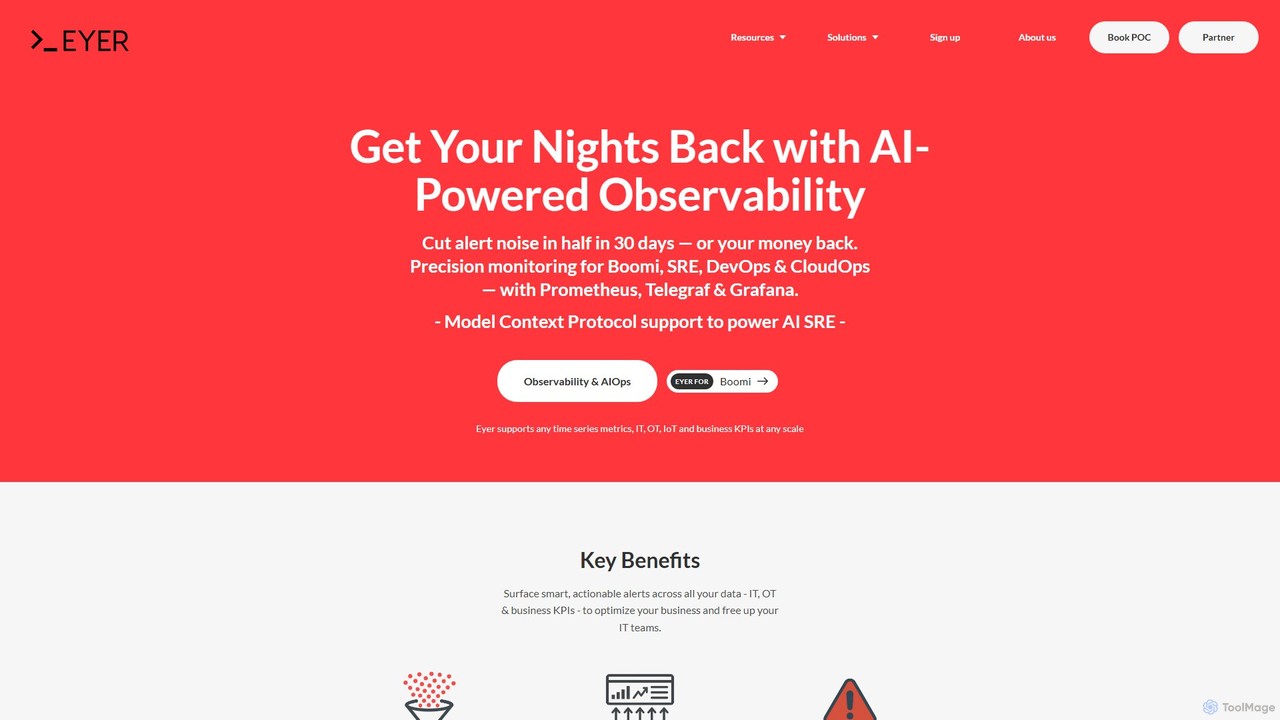
Eyer is a headless AIOps and observability platform that uses AI to analyze time-series data from IT, OT, and business systems. It delivers smart, actionable alerts to reduce noise by up to 80%, enabling teams to proactively identify and resolve issues. It integrates seamlessly with existing tools like Grafana and Boomi.
About Aiops
AIOps (Artificial Intelligence for IT Operations) are AI-powered tools that apply artificial intelligence and machine learning to IT operations data. They analyze vast amounts of operational data, such as logs, metrics, and events, to automatically identify patterns, detect anomalies, and predict potential issues. AIOps aims to enhance IT system visibility, automate response capabilities, and optimize resource management, thereby improving operational efficiency and system stability. As a crucial component within developer tools, AIOps helps DevOps teams intelligently manage complex cloud-native and hybrid IT environments.
Core Features
- Intelligent Monitoring & Anomaly Detection: Real-time data analysis to automatically identify behaviors deviating from normal baselines.
- Root Cause Analysis & Fault Prediction: Quickly pinpoint the source of problems and predict potential system failures.
- Automated Response & Remediation: Automatically execute corrective actions based on predefined rules or AI decisions.
- Performance Optimization & Capacity Planning: Optimize resource allocation and plan capacity based on historical data and forecasts.
Use Cases
AIOps tools are vital for large enterprise IT departments monitoring distributed systems, enabling rapid fault response. Cloud service providers leverage them to optimize resource allocation and predict service interruptions. DevOps teams integrate AIOps for automated monitoring and problem diagnosis within CI/CD pipelines, streamlining development and operations workflows.
How to Choose
When selecting an AIOps platform, consider its data integration capabilities to ensure seamless connectivity with existing monitoring and logging systems. Evaluate the maturity and explainability of its AI models for accurate anomaly detection and root cause analysis. Assess its automation and orchestration features for automated responses and integration with other IT tools. Finally, consider scalability, deployment flexibility (cloud or on-premise), and overall cost-effectiveness.

AiopsUse Cases
Real-time Fault Diagnosis & Root Cause Analysis
IT operations engineers in complex microservices architectures often struggle to quickly pinpoint issues when service outages occur. AIOps tools automatically aggregate data from logs, metrics, and traces, using machine learning to identify anomalous patterns and correlate events, rapidly pointing to the root cause of a fault, such as a memory leak in a specific service instance. This reduces Mean Time To Recovery (MTTR) from hours to minutes, significantly minimizing business disruption.
Predictive Maintenance & Capacity Planning
Infrastructure architects and cloud resource administrators aim to prevent system downtime due to resource exhaustion or performance bottlenecks, while optimizing cloud costs. AIOps platforms analyze historical resource usage trends and business growth forecasts, intelligently predicting future resource needs. For example, it might warn that a database cluster's storage or CPU will reach a bottleneck next month, issuing an alert or suggesting automatic scaling. This ensures high system availability and cost-effective resource utilization.
Automated Alert Noise Reduction & Event Correlation
Network Operations Center (NOC) operators often face an overwhelming volume of repetitive, low-priority, or correlated alerts from numerous monitoring systems, making it difficult to distinguish truly critical issues. AIOps tools use AI algorithms to deduplicate, cluster, and correlate alerts, consolidating hundreds of scattered alerts into a few core incidents and prioritizing them based on impact. This drastically reduces alert fatigue, allowing operators to focus on critical problems and improve response efficiency.
Performance Bottleneck Identification & Optimization Suggestions
Software development and DevOps engineers frequently encounter performance degradation after application deployment, struggling to determine if the issue lies in code, database, or infrastructure. An AIOps platform continuously monitors application performance metrics (APM), combining log and infrastructure data to automatically identify code modules, slow queries, or resource contention causing bottlenecks. It then provides specific optimization recommendations, helping teams quickly resolve performance issues and enhance user experience.
Security Incident Detection & Automated Response
Security Operations Center (SOC) analysts often deal with numerous false positives from traditional Security Information and Event Management (SIEM) systems and struggle with new, complex cyberattacks. AIOps integrates security data, using machine learning models to identify anomalous user behavior, network traffic patterns, or system configuration changes. It automatically detects potential security threats (e.g., DDoS attacks, insider threats) and triggers automated response processes, such as isolating infected hosts, enhancing security posture and accelerating incident response.
Intelligent Change Management & Risk Assessment
Release managers and change management teams find it challenging to predict the impact of software releases or infrastructure changes on system stability and performance. AIOps tools continuously monitor key metrics before and after change deployment, comparing them against historical baselines. They automatically assess the risks introduced by changes and can trigger immediate rollbacks or alerts if anomalies occur. This reduces change failure rates, ensures stable system operation, and accelerates the rollout of new features.