Developer Tools Best in category 1 results Api & Backend AI Tool

Popular AI tools in the Api & Backend field of Developer Tools include ChatDB, etc., helping you quickly improve efficiency.

ChatDB

ChatDB

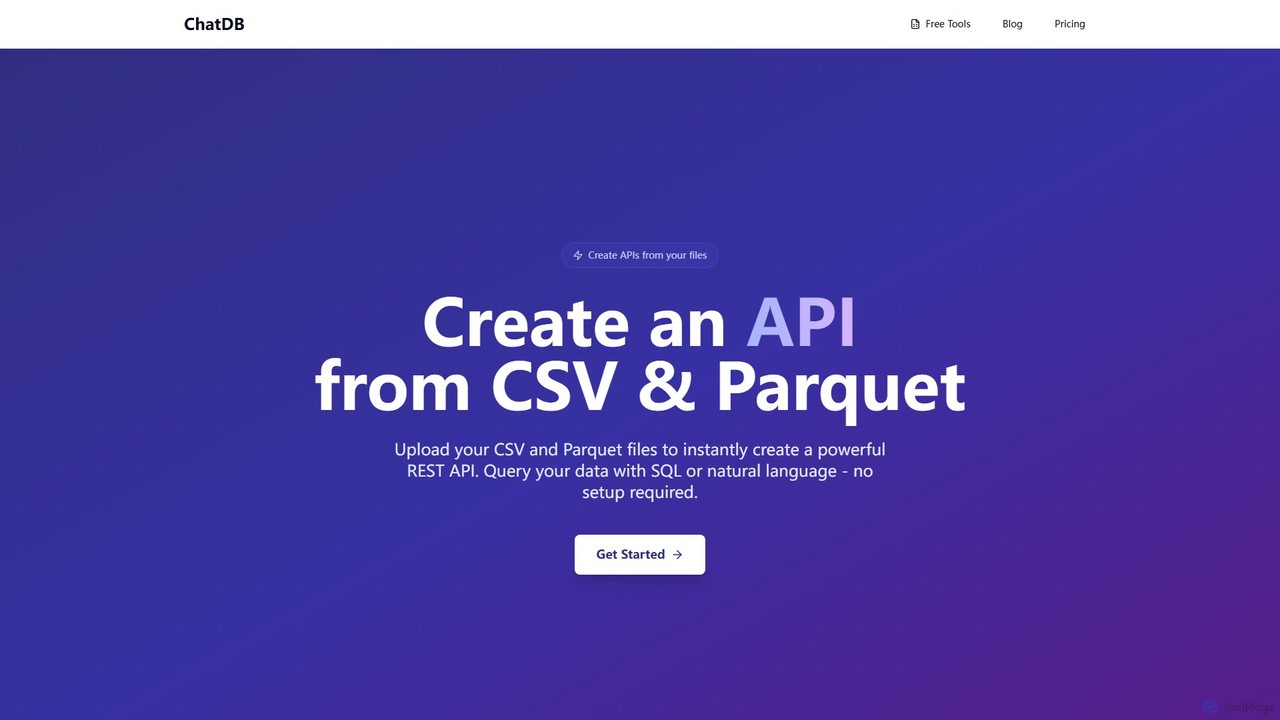
ChatDB is a powerful platform that instantly converts CSV and Parquet files into a fully functional REST API. …

61.5K

About Api & Backend

API & Backend tools are a category of AI-powered solutions designed to automate and optimize the development, deployment, and management of application programming interfaces (APIs) and server-side infrastructure. These tools leverage artificial intelligence to streamline complex backend processes, from code generation and data integration to intelligent API orchestration and robust security. They empower developers to build scalable, efficient, and secure applications with unprecedented speed and precision, forming the foundational logic and data handling for modern digital services.

Core Features

  • AI-driven API Generation: Automatically design and generate API endpoints, schemas, and documentation from natural language descriptions or data models.
  • Intelligent Backend Code Generation: Produce optimized, boilerplate-free server-side code in various languages and frameworks, reducing manual coding effort.
  • Automated Data Integration & Orchestration: Seamlessly connect diverse data sources and services, intelligently mapping and transforming data flows for complex workflows.
  • Predictive Performance Optimization: Analyze backend traffic and resource usage to suggest or automatically implement optimizations for scalability and efficiency.
  • Enhanced API Security & Monitoring: Proactively identify vulnerabilities, detect anomalies, and enforce security policies across API endpoints using AI.

Applicable Scenarios

These tools are vital for organizations building microservices architectures, integrating disparate enterprise systems, or developing real-time data processing pipelines. They enable rapid prototyping of new services, efficient management of complex API ecosystems, and ensure the underlying infrastructure can scale to meet demand.

How to Choose

When selecting an AI-powered API & Backend tool, consider its integration capabilities with existing tech stacks, the range of supported programming languages and frameworks, and its scalability features. Evaluate the level of automation offered for code generation, data handling, and security, as well as the clarity of its documentation and community support. Cost-effectiveness and compliance with industry standards are also crucial factors.

Api & BackendUse Cases

1

Automated Microservice API Generation

For software architects and development teams, AI-powered API & Backend tools can automatically generate robust API endpoints and data models for new microservices. By inputting high-level business requirements or data schemas, the AI can produce ready-to-use API code, complete with documentation and test cases. This drastically accelerates the initial development phase, allowing teams to focus on core business logic rather than boilerplate API creation, reducing development time by up to 50%.

2

Intelligent Backend Code Optimization

Developers can leverage these tools to analyze existing backend codebases for performance bottlenecks, security vulnerabilities, and inefficient patterns. The AI provides intelligent suggestions for refactoring, automatically generates optimized code snippets, or even rewrites entire modules to improve execution speed, reduce resource consumption, and enhance scalability. This ensures applications remain performant under heavy load, extending their lifespan and reducing operational costs.

3

Streamline Serverless Function Deployment and Monitoring

Cloud engineers and DevOps teams utilize AI & Backend tools to simplify the deployment and management of serverless functions (e.g., AWS Lambda, Azure Functions). The tools can automatically containerize code, configure deployment settings, and monitor function performance and costs in real-time. AI-driven anomaly detection helps identify issues before they impact users, ensuring highly available and cost-efficient serverless operations.

4

Orchestrate Real-time Data Flows Across Disparate Systems

Data engineers and system integrators use these tools to build complex, real-time data pipelines that connect various enterprise applications, databases, and external services. The AI intelligently maps data transformations, handles schema variations, and orchestrates the flow of information, ensuring data consistency and availability across the entire ecosystem. This enables immediate insights and powers dynamic, data-driven applications.

5

Proactive API Security & Threat Detection

Security engineers and API administrators deploy AI-powered backend tools to continuously monitor API traffic for suspicious activities and potential threats. The AI learns normal API usage patterns and can instantly detect anomalies like injection attempts, DDoS attacks, or unauthorized access. This proactive approach helps prevent data breaches, ensures compliance, and maintains the integrity and trustworthiness of critical APIs.

6

Power Personalized Content Delivery and User Experiences

For marketing platforms and e-commerce sites, these tools can build intelligent backend systems that deliver highly personalized content and recommendations. The AI analyzes user behavior, preferences, and historical data to dynamically generate and serve tailored content via APIs. This enhances user engagement, increases conversion rates, and provides a seamless, individualized experience for each customer.

Api & BackendFrequently Asked Questions