Developer Tools Best in category 2 results Api Platforms AI Tool

Popular AI tools in the Api Platforms field of Developer Tools include maslo、Atlancer.ai, etc., helping you quickly improve efficiency.

maslo

maslo

Maslo was a pioneering AI platform dedicated to creating empathetic and emotionally aware AI companions. Although the project …

5.7K
Atlancer.ai

Atlancer.ai

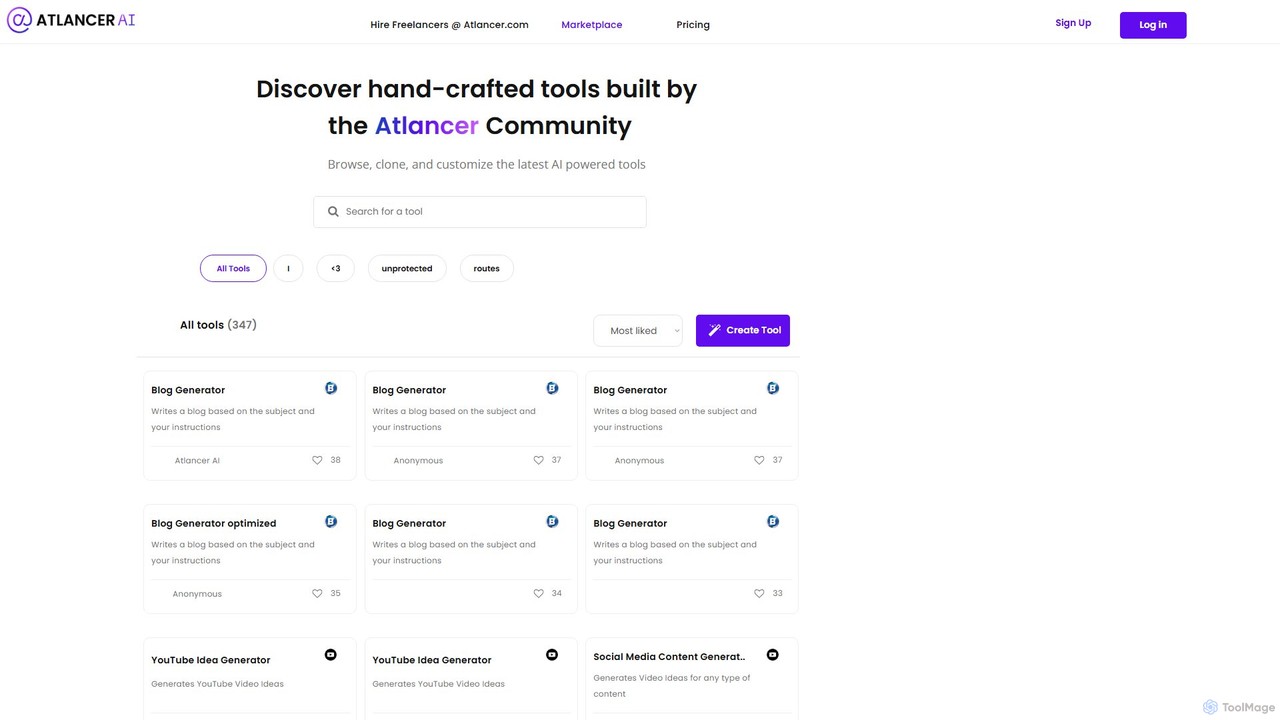
Atlancer.ai is a community-driven platform offering a marketplace of customizable AI tools. Users can browse, use, and even …

4.2K

About Api Platforms

API Platforms are services that provide a single, unified interface to access multiple AI models from different providers. As a specialized type of developer tool, they act as a universal adapter, allowing developers to switch between models like GPT-4, Claude, or Llama with minimal code changes. This approach simplifies development, enhances application reliability through model fallbacks, and provides centralized cost management. These platforms are essential for building resilient, scalable, and model-agnostic AI applications.

Core Features

  • Unified API Endpoint: Access diverse AI models from providers like OpenAI, Anthropic, and Google through a single, consistent API.
  • Model Routing & Fallback: Automatically direct requests to the best-performing or most cost-effective model, with options to reroute if a primary model fails.
  • Centralized Cost Management: Track spending, set budgets, and analyze usage across all integrated models from a single dashboard.
  • Standardized I/O: Normalize input and output formats, making it seamless to swap models without rewriting data handling logic.
  • Performance Analytics: Monitor key metrics like latency, throughput, and error rates for different models to optimize application performance.

Use Cases

These platforms are widely used by startups and enterprises building AI-powered applications. They are ideal for developers who need to A/B test different models for performance or cost, product managers who want to avoid vendor lock-in, and organizations that require high availability for their AI services by implementing automatic model failover.

How to Choose

When selecting an API Platform, consider the range of supported models and providers. Evaluate its performance, latency, and reliability features like automatic retries and fallbacks. Examine the pricing structure—whether it's a subscription, a per-call fee, or a markup on the underlying model's cost. Finally, assess the quality of its analytics, logging, and cost management tools to ensure it meets your operational needs.

Api PlatformsUse Cases

1

Build Model-Agnostic AI Applications

A software development team is building a new AI-powered customer support chatbot. To avoid dependency on a single AI provider and to optimize costs, they use an API Platform. Instead of writing separate integrations for OpenAI's GPT-4 and Anthropic's Claude, they integrate with the platform's single API. This allows them to programmatically route simple queries to a cheaper model and complex ones to a more powerful model. If their primary model provider experiences an outage, the platform automatically fails over to a secondary model, ensuring the chatbot remains online and functional without any service interruption.

2

A/B Test AI Models for Optimal Performance

A marketing technology company wants to determine which AI model generates the most effective advertising copy. Using an API Platform, their system can send the same prompt to both Google's Gemini and a fine-tuned open-source model simultaneously. The platform routes 50% of the traffic to each model. The generated ad copies are then deployed, and their performance (e.g., click-through rates) is tracked. The platform's analytics dashboard provides a clear comparison of cost and performance, enabling the marketing team to make a data-driven decision and select the model that delivers the best return on investment.

3

Ensure High Availability with Automatic Failover

An enterprise application provides a critical AI-driven feature for its customers that must be available 24/7. To guarantee uptime, the developers configure an API Platform with a primary and a secondary AI model. The platform continuously monitors the health and latency of the primary model provider. If it detects an outage or significant performance degradation, it automatically and instantly reroutes all incoming API traffic to the secondary model. This failover process is seamless to the end-users, preventing service disruptions and maintaining a high level of reliability and customer trust without requiring manual intervention from the operations team.

4

Manage and Control AI Spending Across Teams

A large corporation provides AI model access to multiple internal teams for R&D and product development. Instead of managing separate subscriptions and billing with each AI provider, the IT department uses a central API Platform. This platform allows them to create unique API keys for each team, set monthly spending limits, and monitor usage in real-time. The finance department can access a unified dashboard to see a clear breakdown of costs by project or department, simplifying budget allocation and identifying areas of high expenditure. This centralized control prevents unexpected costs and streamlines financial oversight of AI resource consumption.

5

Rapid Prototyping for Hackathons and MVPs

A developer participating in a 48-hour hackathon needs to quickly build a prototype that uses text generation, image analysis, and code completion. Learning and integrating three separate APIs would be too time-consuming. By using an API Platform, the developer only needs to learn one SDK and API structure. They can make calls to different models for different tasks through the same endpoint, simply by changing a parameter in their request. This dramatically accelerates the development process, allowing them to build a feature-rich minimum viable product (MVP) within the tight deadline and focus on the application's logic rather than on API integration complexities.

6

Simplify Access to Open-Source Models

A research lab wants to experiment with various open-source LLMs like Llama and Mistral without the operational overhead of hosting and managing these models themselves. They subscribe to an API Platform that offers managed access to a wide range of open-source models. Through a simple API call, researchers can instantly access and compare different models for their natural language processing tasks. The platform handles all the infrastructure, scaling, and maintenance, allowing the lab to focus purely on research and experimentation, saving significant time and resources that would otherwise be spent on DevOps and server management.

Api PlatformsFrequently Asked Questions