
Freemium
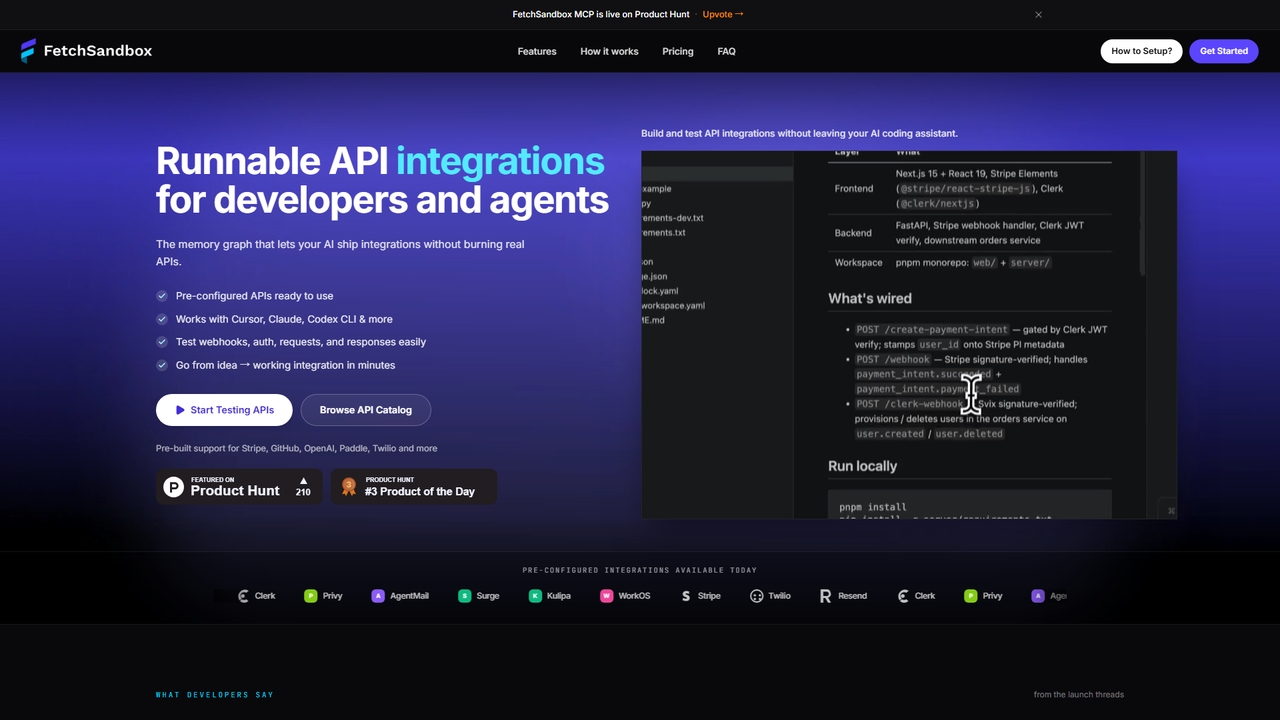
FetchSandbox
Test API integrations, webhooks, and workflows via MCP in your IDE without real API keys or quota.
API DevelopmentVisits 1.9KFavorites 23Likes 23
Popular Api & Testing AI tools in Developer Tools include AI Placeholder and FetchSandbox, helping you work more efficiently.
Test API integrations, webhooks, and workflows via MCP in your IDE without real API keys or quota.
API Development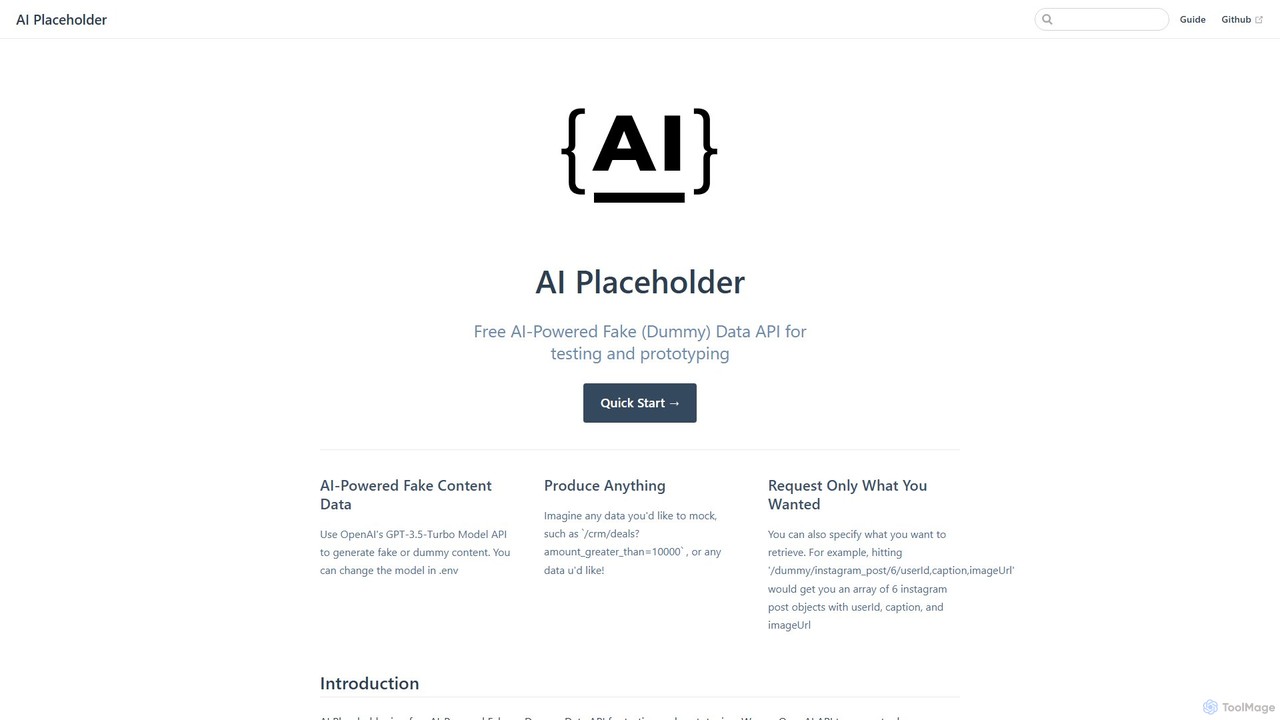
AI Placeholder is a free, open-source API that leverages OpenAI's GPT-3.5-Turbo to generate realistic fake or dummy data for testing and prototyping. Developers can create highly customized datasets on-the-fly, from simple user lists to complex CRM deal data, simply by structuring an API request. It offers both a hosted version for immediate use and the option to self-host for greater control.
Api & TestingAPI & Testing tools are specialized AI-powered solutions designed to streamline the entire Application Programming Interface (API) lifecycle, from development and documentation to rigorous testing and ongoing monitoring. These tools leverage artificial intelligence to automate complex tasks, enhance accuracy, and accelerate the delivery of robust and reliable APIs. They enable developers and QA teams to build, validate, and maintain high-quality APIs efficiently, ensuring seamless integration and optimal performance across various applications and services.
These tools are essential for software development teams building microservices architectures, companies integrating third-party services, and organizations requiring robust and scalable API ecosystems. They are widely adopted by developers, QA engineers, and DevOps professionals to ensure API reliability, security, and performance in continuous integration/continuous deployment (CI/CD) pipelines.
When selecting API & Testing tools, consider the breadth of AI capabilities for automation and insights, integration with your existing development and CI/CD workflows, support for various API protocols (REST, GraphQL, SOAP), and the comprehensiveness of reporting and analytics. Evaluate scalability to handle growing API complexity and traffic, as well as robust security features to protect your data and services.
For development teams managing numerous microservices, AI-powered API testing tools automatically generate and execute regression tests whenever code changes occur. This ensures that new deployments do not introduce breaking changes to existing API functionalities, significantly reducing manual testing effort and accelerating release cycles.
DevOps engineers use these tools to continuously monitor API response times, throughput, and error rates. AI algorithms analyze performance data to identify patterns, predict potential bottlenecks before they impact users, and suggest optimizations, ensuring APIs remain highly responsive and scalable under varying loads.
Security teams leverage AI-driven API testing to scan for common vulnerabilities like injection flaws, broken authentication, and insecure configurations. The tools simulate malicious attacks and analyze API behavior, providing actionable insights to developers for patching security gaps early in the development lifecycle.
Frontend developers often face delays waiting for backend APIs to be fully implemented. API & Testing tools can generate realistic mock APIs based on specifications, allowing frontend teams to develop and test their applications in parallel, significantly speeding up the overall development process and reducing dependencies.
Technical writers and developers use these tools to automatically create and maintain up-to-date API documentation. By analyzing API code and traffic, the tools generate accurate specifications, examples, and usage guides, ensuring that internal and external consumers can easily understand and integrate with the APIs.
QA engineers need to ensure APIs function correctly across different operating systems, browsers, and device types. AI-powered tools can simulate diverse client environments and execute compatibility tests, identifying inconsistencies or errors that might arise from varying platform interactions, thus guaranteeing broad API usability.
API & Testing tools are software solutions designed to manage the entire lifecycle of Application Programming Interfaces (APIs), from design and development to rigorous testing and ongoing monitoring. They often incorporate AI to automate tasks like test case generation, performance analysis, and security scanning, ensuring APIs are reliable, secure, and performant.
Traditional API testing relies heavily on manual scripting and predefined test cases, which can be time-consuming and prone to human error. AI-powered tools, conversely, can automatically generate test cases, identify complex patterns, predict issues, and adapt to API changes dynamically. This leads to faster, more comprehensive testing and proactive issue detection.
Developers, QA engineers, and DevOps teams are the primary beneficiaries. Developers use them for rapid prototyping and integration, QA engineers for comprehensive validation and bug detection, and DevOps for continuous monitoring and performance optimization. Any organization building or consuming APIs, especially in microservices architectures, gains significant value.
Look for robust test automation capabilities, support for various API protocols (REST, GraphQL, SOAP), comprehensive reporting and analytics, and strong integration with CI/CD pipelines. AI-driven features like intelligent test generation, performance anomaly detection, and security scanning are crucial for modern API development. Also, consider ease of use and scalability.
These tools enhance API security by integrating automated vulnerability scanning and penetration testing. They can identify common security flaws such as broken authentication, injection vulnerabilities, and misconfigurations. By simulating attacks and analyzing responses, they help developers proactively secure APIs against potential threats before deployment.