
Freemium
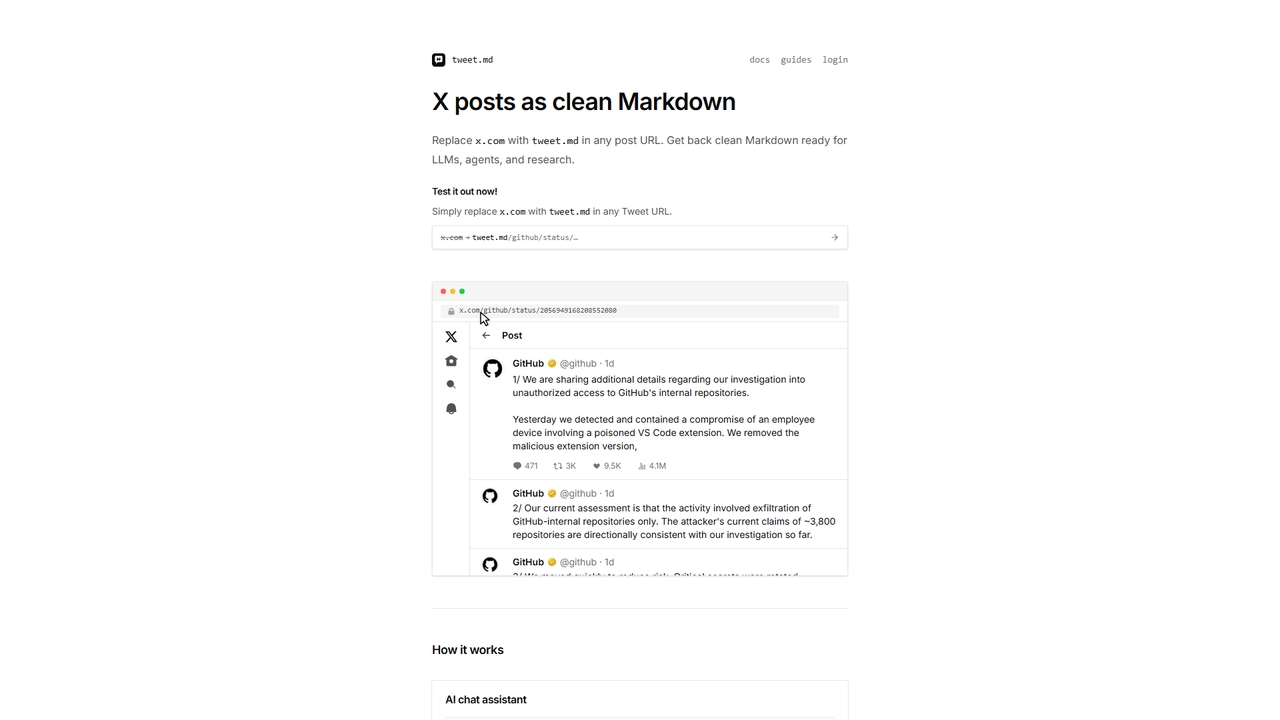
Popular Api Tools in Developer Tools include Tweet and Dialektai, helping you work more efficiently.
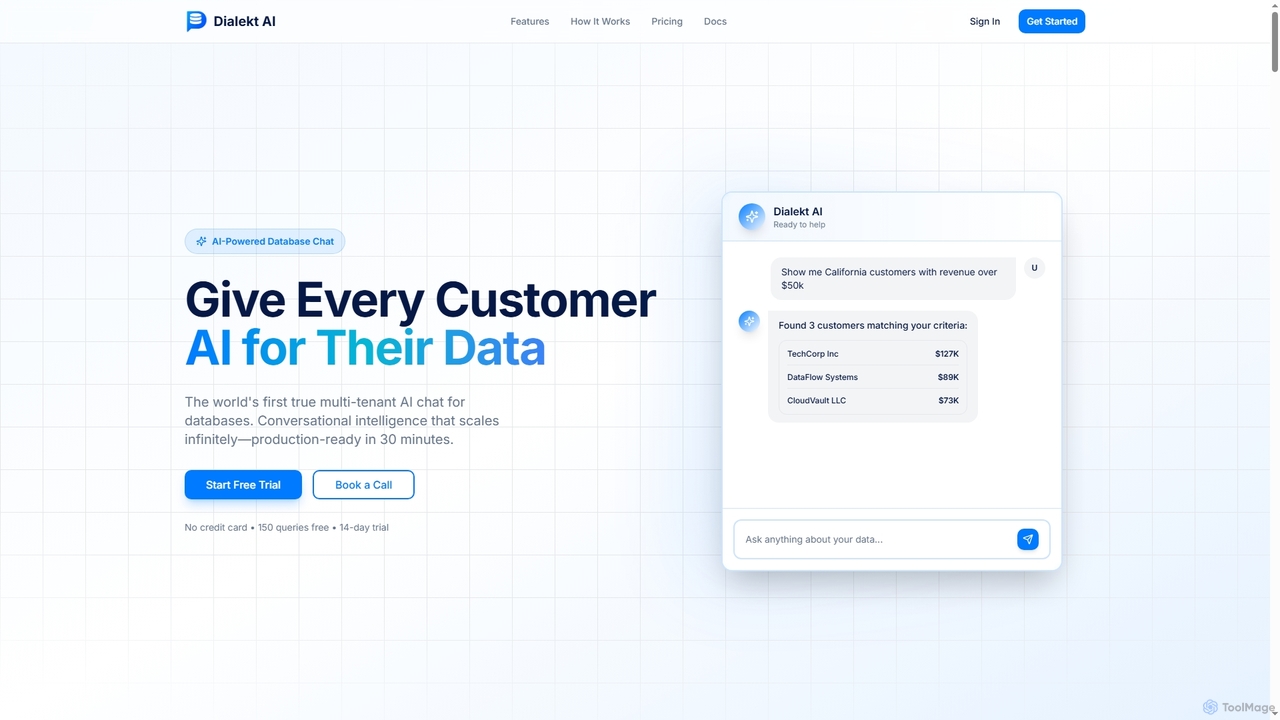
Dialektai is the world's first true multi-tenant AI chat for databases, enabling users to query complex data in plain English. It provides secure, scalable conversational intelligence, making critical business data accessible to everyone without technical expertise, and can be production-ready in under 30 minutes.
Natural Language ProcessingAPI Tools are specialized AI-powered solutions designed to facilitate the interaction, integration, and management of various Artificial Intelligence services and models through their Application Programming Interfaces (APIs). These tools act as a bridge, enabling developers and businesses to seamlessly incorporate advanced AI capabilities—such as large language models (LLMs), image generation, or speech recognition—into their own applications and workflows without needing deep AI expertise or extensive infrastructure. They streamline the development process, accelerate innovation, and unlock the potential of AI for custom solutions.
API Tools are indispensable for software developers building AI-driven applications, data scientists integrating AI models into analytical pipelines, and businesses seeking to embed intelligent features into their products. They are crucial for creating custom chatbots, automating content generation, enhancing customer service platforms, and developing innovative AI-powered services across various industries.
When selecting API Tools, consider the range of AI services supported (e.g., LLMs, vision, speech), ease of integration with existing systems, scalability to handle varying workloads, and the robustness of security features. Evaluate the documentation quality, community support, and pricing models to ensure alignment with project requirements and budget constraints.
A software developer needs to build a custom customer service chatbot that can understand complex queries and provide nuanced responses. Using API Tools, they can easily connect to a large language model (LLM) API, manage conversation flows, and integrate the chatbot into their existing web application, significantly reducing development time and leveraging state-of-the-art natural language understanding.
A marketing team requires a high volume of unique product descriptions and social media posts. With API Tools, they can set up automated workflows to send product data to a text generation AI API, receive diverse content variations, and integrate these directly into their content management system, boosting content output by over 70%.
A photo editing software company wants to add advanced AI features like background removal or style transfer. Instead of building these models from scratch, their developers use API Tools to integrate with specialized AI image APIs, allowing users to access powerful editing capabilities directly within their application, enhancing user experience and product value.
A business needs to transcribe meeting recordings into text for documentation and analysis. An API Tool can be used to send audio files to a speech-to-text AI API, receive accurate transcriptions in real-time or batch, and then integrate these transcripts into a knowledge base or project management system, saving hours of manual transcription work.
An e-commerce platform aims to offer highly personalized product recommendations. Developers leverage API Tools to connect with AI recommendation APIs, feeding them user behavior data. The tools help manage the data flow, process API responses, and display tailored product suggestions to users, leading to increased engagement and conversion rates.
An enterprise uses multiple AI services from different providers. An API Tool provides a centralized dashboard to monitor API call volumes, latency, costs, and error rates across all integrated AI APIs. This enables IT teams to identify performance bottlenecks, optimize resource allocation, and ensure cost-effective utilization of AI services.
AI API Tools are software solutions that simplify the process of accessing, integrating, and managing Artificial Intelligence services and models through their Application Programming Interfaces (APIs). They abstract away much of the complexity involved in direct API calls, allowing developers to easily incorporate advanced AI functionalities like natural language processing, computer vision, or machine learning into their own applications without needing to build or maintain the underlying AI models themselves.
While API Tools fall under the broader category of Developer Tools, their distinction lies in their specific focus on AI services. General Developer Tools encompass a wide range of utilities for coding, debugging, and deployment across various technologies. API Tools, however, are specifically tailored to handle the unique requirements of AI APIs, such as managing model versions, handling specific data formats for AI inputs/outputs, monitoring AI-specific metrics, and orchestrating complex AI workflows, making AI integration more efficient.
The primary benefits include accelerated development cycles by providing ready-to-use AI functionalities, reduced operational costs by leveraging cloud-based AI services, and enhanced application capabilities through advanced intelligence. They also lower the technical barrier for integrating AI, improve scalability by managing API calls efficiently, and allow developers to focus on core application logic rather than AI model development and maintenance.
API Tools can access a vast array of AI services. This includes Large Language Models (LLMs) for text generation, summarization, and translation; computer vision APIs for image recognition, object detection, and facial analysis; speech APIs for transcription and synthesis; machine learning APIs for predictive analytics and recommendation engines; and specialized AI services for data extraction, sentiment analysis, and more. Essentially, any AI model exposed via an API can be managed by these tools.
Security is paramount. Key considerations include robust API key management, ensuring secure authentication and authorization mechanisms (e.g., OAuth), and encrypting data both in transit and at rest. It's also crucial to understand the data privacy policies of the AI service providers, implement rate limiting to prevent abuse, and regularly audit API access logs. Choosing tools that offer strong security features and compliance certifications is highly recommended.