
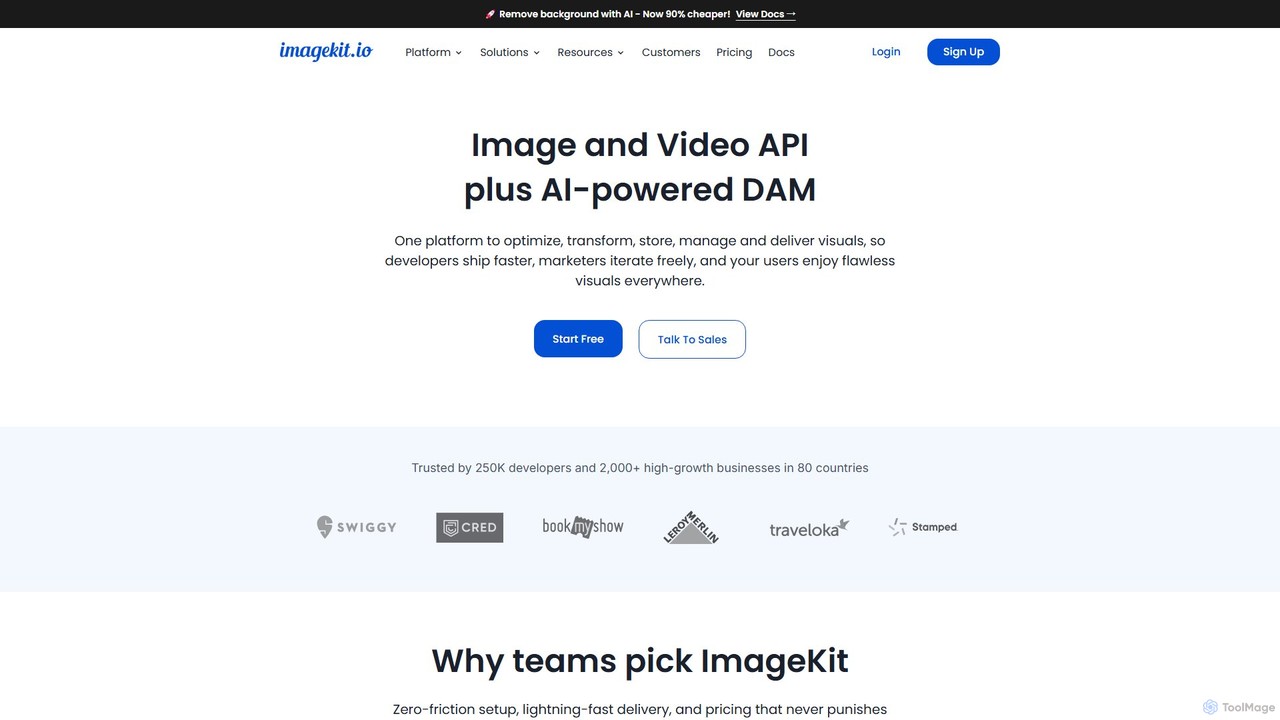
Developer Tools Best in category 1 results Apis & Integrations AI Tool

Popular AI tools in the Apis & Integrations field of Developer Tools include ImageKit.io, etc., helping you quickly improve efficiency.

ImageKit.io

ImageKit.io

ImageKit.io is a comprehensive platform for image and video management, offering an API and AI-powered Digital Asset Management …

884.5K

About Apis & Integrations

AI APIs & Integrations are services that provide developers with programmatic access to pre-trained artificial intelligence models. These tools function as a bridge, allowing any application to leverage complex AI capabilities like natural language processing or computer vision through simple API calls, typically over HTTP. The primary value is enabling the rapid integration of advanced AI features without the need for deep machine learning expertise or managing complex infrastructure. This approach significantly accelerates development cycles and lowers the barrier to entry for creating intelligent applications.

Core Features

  • Pre-trained Model Access: Provides access to sophisticated, ready-to-use AI models for tasks like text analysis, image recognition, and speech synthesis.
  • Scalable Infrastructure: The API provider manages all backend computing resources, ensuring high availability and performance that scales with usage.
  • Standardized Protocols: Utilizes common web standards like REST or GraphQL, making them easy to integrate with any programming language or platform.
  • Comprehensive Documentation & SDKs: Offers detailed guides, code samples, and software development kits (SDKs) to streamline the integration process for developers.

Use Cases

These tools are widely used across various industries. For example, e-commerce platforms integrate vision APIs to automatically tag products and power visual search. SaaS companies use NLP APIs to build intelligent chatbots for customer support. Media companies might use speech-to-text APIs to automatically generate transcripts for video and audio content.

How to Choose

When selecting an AI API, consider the model's accuracy and specialization for your specific task. Evaluate the pricing structure—whether it's pay-per-use, subscription-based, or offers a free tier. Assess the quality of the documentation and developer support. Finally, check performance metrics like latency and uptime to ensure they meet your application's requirements.

Apis & IntegrationsUse Cases

1

Automating Customer Support with a Chatbot API

A SaaS company's support team is overwhelmed with repetitive customer queries. By integrating a conversational AI API, their developers can build and deploy an intelligent chatbot on their website and in-app messenger. This bot uses natural language understanding to interpret user questions, provide instant answers from a knowledge base, and create support tickets for complex issues. The result is a 60% reduction in response times for common questions and freeing up human agents to focus on high-priority cases, improving overall customer satisfaction.

2

Enhancing E-commerce with Image Recognition API

An online fashion retailer needs to improve product discovery on their site. Manually tagging thousands of product images with attributes like color, pattern, and style is time-consuming and inconsistent. By integrating a computer vision API, their system can automatically analyze new product photos upon upload. The API identifies and returns a list of relevant tags (e.g., 'red', 'floral print', 'v-neck dress'). These tags are used to populate product details and power faceted search filters, leading to a more accurate and user-friendly shopping experience and a 15% increase in conversion for filtered searches.

3

Automating Document Data Extraction

An accounting firm processes thousands of invoices and receipts monthly. Manual data entry is slow and prone to errors. They integrate a document intelligence API into their workflow. Employees now scan or upload documents, and the API automatically extracts key information like vendor name, invoice number, date, and total amount. The extracted data is structured in JSON format and fed directly into their accounting software. This automation reduces data entry time by over 80% and significantly improves accuracy, allowing accountants to focus on analysis rather than manual transcription.

4

Generating Transcripts for Media Content

A podcast production company wants to make its content more accessible and discoverable. They use a speech-to-text API to automatically transcribe audio files from their episodes. The API processes the audio and returns a time-stamped text transcript. This transcript is then used to create blog posts, generate subtitles for video versions, and improve the podcast's SEO by making the full content indexable by search engines. This process saves hundreds of hours of manual transcription work per month and broadens their audience reach.

5

Personalizing Marketing Campaigns at Scale

A digital marketing agency needs to create highly targeted ad copy for dozens of client segments. Writing unique copy for each segment is not scalable. They use a generative AI API to automate this process. By providing the API with a base product description and a profile of the target audience (e.g., 'young professionals', 'eco-conscious families'), it generates multiple variations of compelling ad headlines and body text tailored to each group's interests. This allows the agency to run hyper-personalized campaigns, resulting in a 25% higher click-through rate compared to generic ads.

6

Implementing Content Moderation Systems

A social media platform is struggling with the volume of user-generated content that needs moderation for safety and policy compliance. Their human moderation team cannot keep up. They integrate a content moderation API that analyzes text and images in real-time. The API flags potentially harmful content, such as hate speech or graphic imagery, and assigns it a severity score. Low-risk content is automatically removed, while high-risk or ambiguous cases are routed to human moderators for review. This tiered approach increases moderation efficiency by 5x and helps create a safer online environment for users.

Apis & IntegrationsFrequently Asked Questions