ToolMage
Sign in

Best 1 Authorization AI tools for Developer Tools

Popular Authorization AI tools in Developer Tools include D2, helping you work more efficiently.

D2
Freemium

D2

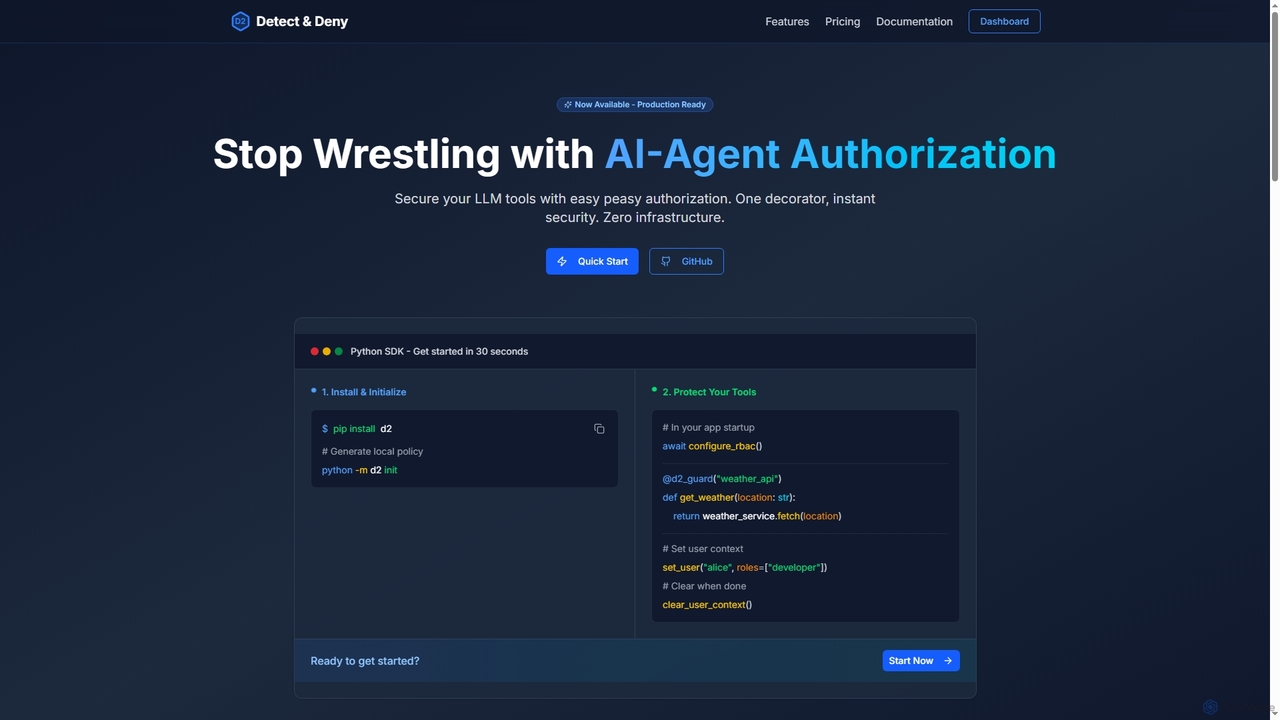
D2 is a Python SDK designed to simplify authorization for AI agents and LLM tools. It provides robust, code-level security by adding a single decorator to your functions, replacing complex authorization logic with an easy-to-manage, policy-based system.

Development
Visits 7.4KFavorites 152Likes 145

About Authorization

Authorization tools are a critical component within developer tools, designed to define and enforce what authenticated users or systems are permitted to do within an application or system. These tools establish access policies and manage permissions, ensuring that only authorized entities can perform specific actions or access particular resources. They provide the granular control necessary for building secure, compliant, and multi-tenant applications.

Core Features

  • Role-Based Access Control (RBAC): Assigns permissions to roles, which are then assigned to users, simplifying permission management at scale.
  • Attribute-Based Access Control (ABAC): Defines access policies based on attributes of the user, resource, and environment, offering highly flexible and dynamic authorization.
  • Policy Enforcement Points (PEPs): Integrates directly into application code or API gateways to intercept access requests and query authorization decisions.
  • Fine-Grained Permissions: Allows for precise control over individual actions (e.g., read, write, delete) on specific resources, down to the field level.

Use Cases

Authorization tools are essential for developers building secure applications. They are used to manage user access levels in SaaS platforms, control which microservices can communicate with each other, and restrict data access based on user roles or departmental affiliations. This ensures data privacy and operational security across complex systems.

How to Choose

When selecting authorization tools, consider the granularity of control required (e.g., RBAC vs. ABAC), ease of integration with existing tech stacks (SDKs, APIs), scalability to handle growing user bases, and the flexibility of policy definition languages. Evaluate compliance features, performance impact, and the total cost of ownership, including deployment and maintenance.

Authorization use cases

1

Managing User Permissions in SaaS Applications

SaaS platform developers use authorization tools to define and enforce complex user roles (e.g., admin, editor, viewer) and their corresponding permissions across various features and data. This ensures that each user can only access and modify what they are explicitly allowed to, maintaining data integrity and security for multi-tenant environments.

2

Securing Microservices Communication

In a microservices architecture, developers implement authorization policies to control which services can call specific endpoints or access data from other services. This prevents unauthorized internal access and limits the blast radius of potential security breaches, ensuring secure inter-service communication.

3

Controlling Access to Sensitive Data

Data engineers and developers utilize authorization tools to restrict access to sensitive customer or financial data within databases or data lakes. Policies can be set based on user roles, department, or even data attributes, ensuring compliance with regulations like GDPR or HIPAA by preventing unauthorized data exposure.

4

Implementing Multi-Tenant Access Control

For applications serving multiple organizations (tenants), authorization tools enable strict isolation of data and features between tenants. Developers configure policies to ensure that users from one organization cannot view or interact with data belonging to another, providing a secure and segregated user experience.

5

Securing APIs for Third-Party Integrations

API developers employ authorization tools to protect their APIs, ensuring that only legitimate third-party applications or partners can access specific API endpoints and data. This involves defining scopes, tokens, and policies that grant precise permissions, safeguarding the API infrastructure and underlying data.

6

Ensuring Compliance with Regulatory Requirements

Organizations in regulated industries (e.g., finance, healthcare) leverage authorization tools to enforce strict access control policies that meet compliance standards. Developers implement rules that dictate who can access, modify, or audit specific information, providing auditable logs of access decisions to demonstrate regulatory adherence.

Authorization FAQ

What are Authorization tools?

Authorization tools are specialized developer tools that manage and enforce access permissions for users and systems within an application or digital environment. They determine "what" an authenticated entity is allowed to do, access, or see, based on predefined policies and rules, ensuring secure and controlled interactions with resources.

How do Authorization tools differ from Authentication tools?

Authentication tools verify "who" a user is (e.g., via username/password, biometrics), confirming their identity. Authorization tools, on the other hand, determine "what" that authenticated user is allowed to do or access. Authentication is about identity verification, while authorization is about permission management. They are complementary processes in securing an application.

What are the key benefits of using Authorization tools?

Using authorization tools offers several key benefits: enhanced security by preventing unauthorized access, improved compliance with data protection regulations (like GDPR, HIPAA), simplified management of complex user permissions, and greater flexibility in defining granular access policies. They also reduce development effort by centralizing access control logic.

What is Role-Based Access Control (RBAC) in Authorization?

Role-Based Access Control (RBAC) is a popular authorization model where permissions are associated with specific roles (e.g., "Administrator," "Editor," "Guest"). Users are then assigned one or more roles, inheriting all permissions associated with those roles. RBAC simplifies permission management, especially in large organizations, by abstracting individual user permissions into manageable roles.

Can Authorization tools integrate with existing identity providers?

Yes, most modern authorization tools are designed to integrate seamlessly with existing identity providers (IdPs) like Okta, Auth0, Azure AD, or Google Identity Platform. This allows applications to leverage existing user directories and authentication mechanisms, while the authorization tool handles the permission enforcement layer, creating a unified security architecture.