
D2
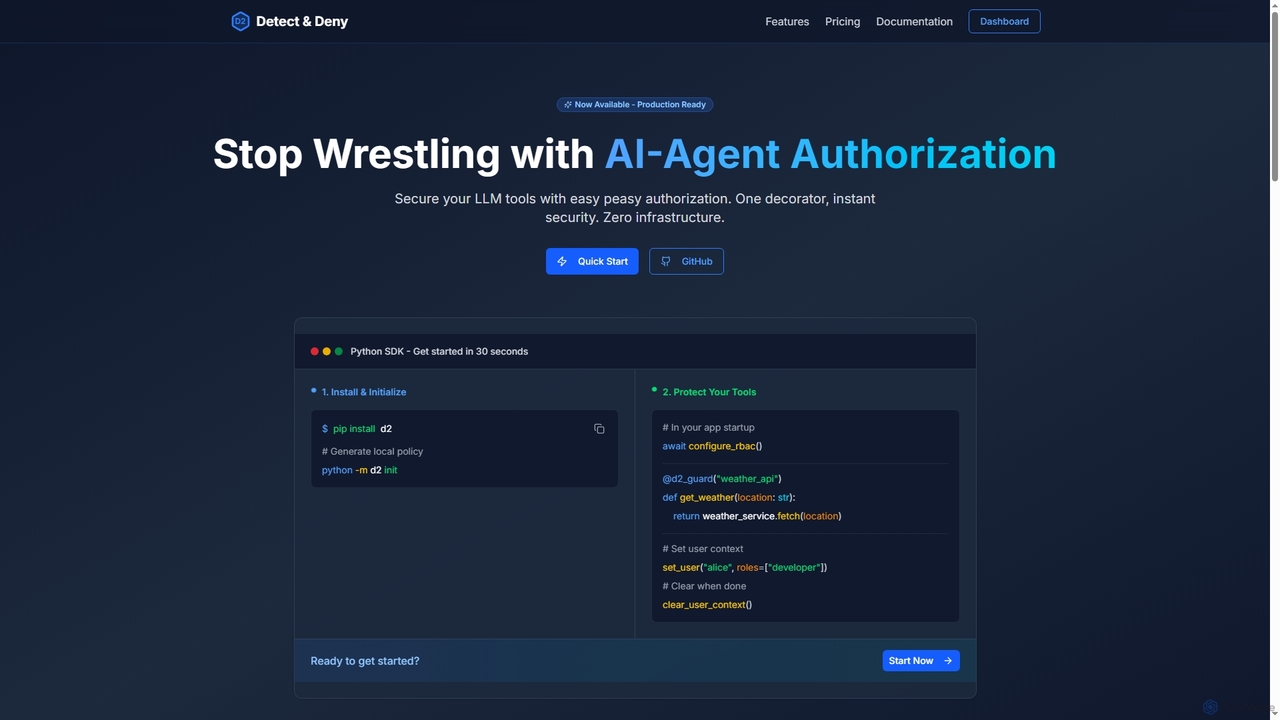
D2 is a Python SDK designed to simplify authorization for AI agents and LLM tools. It provides robust, …
D2 is a Python SDK designed to simplify authorization for AI agents and LLM tools. It provides robust, code-level security by adding a single decorator to your functions, replacing complex authorization logic with an easy-to-manage, policy-based system.
About Development
AI Development tools are a specialized suite of software for building, training, and debugging machine learning models. These platforms provide integrated environments, frameworks, and libraries that streamline the entire model creation lifecycle. They empower developers and data scientists to experiment with algorithms, manage complex datasets, and accelerate the journey from a conceptual idea to a functional AI application. This focus on the core creation process distinguishes them within the broader AI infrastructure landscape.
Core Features
- Integrated Development Environments (IDEs): Offer code editors, debuggers, and project management tools tailored for ML, such as Jupyter Notebook support.
- Framework & Library Support: Provide pre-configured access to popular libraries like TensorFlow, PyTorch, and scikit-learn.
- Experiment Tracking: Allow logging of parameters, metrics, and artifacts for different training runs to ensure reproducibility.
- Compute Resource Management: Simplify the allocation and management of CPU/GPU resources for model training.
- Version Control Integration: Seamlessly connect with systems like Git for collaborative code and model versioning.
Use Cases
These tools are essential for technology companies, research institutions, and any organization building custom AI solutions. Data scientists use them for rapid prototyping of predictive models, while machine learning engineers rely on them to train large-scale neural networks for computer vision or natural language processing. They are also foundational for academic researchers exploring new AI architectures.
How to Choose
When selecting an AI Development tool, consider the specific frameworks you use (e.g., PyTorch vs. TensorFlow). Evaluate its integration capabilities with your existing data storage and MLOps pipeline. Assess the scalability for handling large datasets and complex models. Finally, consider the user interface and collaboration features to match your team's workflow and technical expertise, from code-first environments to low-code platforms.
DevelopmentUse Cases
Accelerating ML Model Prototyping
A data scientist at a fintech startup needs to quickly build and test a new credit risk model. Using an AI development platform, they can leverage a pre-configured Jupyter Notebook environment with scikit-learn and XGBoost already installed. They can rapidly load data, experiment with different feature engineering techniques, and train multiple model versions in parallel. The platform's experiment tracking feature automatically logs the performance metrics of each run, allowing them to easily compare results and identify the most promising model architecture in hours instead of days.
Training Large-Scale Deep Learning Models
A research team is developing a complex computer vision model for medical image analysis. The model requires training on a massive dataset using powerful GPUs. An AI development tool simplifies this process by managing distributed training across multiple GPU instances. The ML engineer can define the training job, specify the required compute resources, and monitor progress through a centralized dashboard. The platform handles the complexities of data parallelism and resource allocation, allowing the team to focus on improving the model's architecture and accuracy rather than on infrastructure management.
Collaborative AI Research and Development
A university research lab with members in different locations is collaborating on a new natural language processing (NLP) model. They use a cloud-based AI development platform that provides a shared workspace. Each researcher can access the same datasets, code repositories, and computing environments. The platform's integration with Git allows for seamless code versioning and merging. They can share interactive notebooks to review each other's work and reproduce experiments, fostering efficient collaboration and accelerating the pace of their research despite being geographically distributed.
Fine-Tuning Foundation Models for Specific Tasks
A marketing team wants to use a large language model (LLM) for generating product descriptions but needs it to adopt the company's specific brand voice. A developer uses an AI development platform to fine-tune a pre-trained foundation model like GPT or Llama. The platform provides tools to easily upload a custom dataset of existing marketing copy. The developer then runs a fine-tuning job on a managed GPU instance, adjusting hyperparameters through a simple UI. The result is a specialized model that generates on-brand content, a task that would be computationally prohibitive without such a development environment.
Integrating Custom AI into Existing Applications
A software developer is tasked with adding a recommendation feature to an e-commerce mobile app. They use an AI development platform to build and train a collaborative filtering model. After achieving satisfactory performance, they use the platform's features to package the model and expose it as a REST API endpoint. This managed endpoint can then be easily called from the mobile app's backend. The development platform handles model hosting, scaling, and monitoring, allowing the developer to focus on the application logic rather than the complexities of deploying and maintaining an ML model in production.
Automating Model Building with AutoML
A business analyst with limited coding experience needs to create a sales forecasting model. They use an AI development platform that includes an AutoML (Automated Machine Learning) feature. The analyst simply uploads a CSV file with historical sales data and specifies the target variable ('sales'). The AutoML tool automatically performs data preprocessing, feature engineering, model selection, and hyperparameter tuning. It presents a leaderboard of the best-performing models, allowing the analyst to choose and deploy the most accurate one without writing a single line of code, democratizing access to machine learning capabilities.