
ToolMage
Sign in

Best 1 Backend Development AI tools for Developer Tools

Popular Backend Development AI tools in Developer Tools include Shuttle, helping you work more efficiently.

Shuttle
Freemium

Shuttle

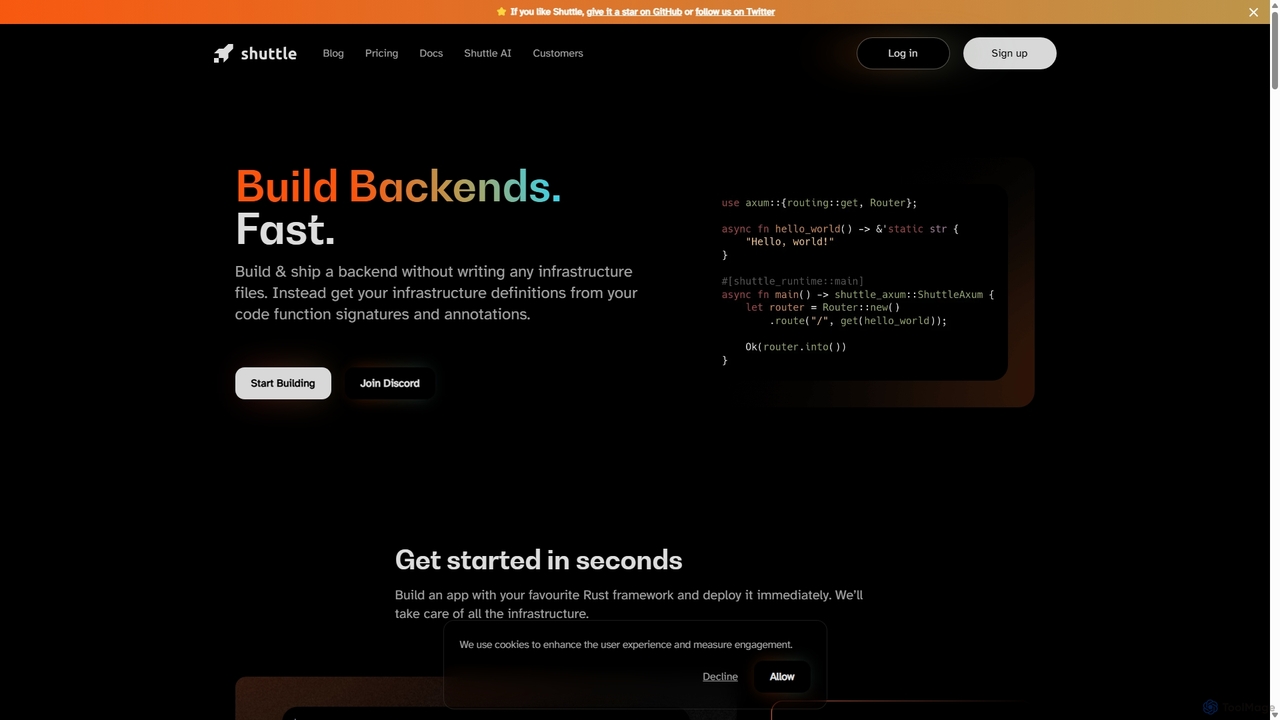
Shuttle is an open-source cloud platform designed to accelerate backend development in Rust. It eliminates infrastructure management by allowing developers to provision resources like databases and secrets directly within their code using simple annotations. Focus on building your application, and let Shuttle handle the deployment and scaling.

Backend Development
Visits 41.4KFavorites 168Likes 176

About Backend Development

AI Backend Development tools are a specialized category of developer utilities that use artificial intelligence to automate and accelerate the creation of server-side applications. These tools leverage machine learning models to generate code, design databases, and build APIs based on natural language prompts or high-level specifications. Their primary value lies in significantly reducing manual coding, minimizing human error, and enabling developers to build complex, scalable backends more efficiently. This allows teams to focus on core business logic rather than repetitive infrastructure setup.

Core Features

  • AI-Powered Code Generation: Automatically writes functions, classes, and boilerplate code in various languages like Python, Node.js, or Go.
  • Automated API Creation: Generates RESTful or GraphQL API endpoints, including documentation and data validation schemas.
  • Intelligent Database Schema Design: Suggests optimal database structures, relationships, and queries based on application requirements.
  • Predictive Performance Optimization: Analyzes code and infrastructure to identify potential bottlenecks and suggest performance improvements.
  • Automated Test Generation: Creates unit and integration tests to ensure code quality and reliability.

Use Cases

These tools are widely used for rapid application prototyping, where a functional backend is needed quickly to validate an idea. They are also invaluable for building microservices, as AI can quickly generate independent, well-defined services. Enterprises use them to modernize legacy systems by automatically refactoring old code into modern architectures and languages.

How to Choose

When selecting an AI Backend Development tool, consider its compatibility with your preferred programming languages and frameworks. Evaluate the quality and customizability of the generated code. Assess its integration capabilities with existing CI/CD pipelines, cloud providers, and databases. Finally, review the tool's security features and data privacy policies, especially if handling sensitive information.

Backend Development use cases

1

Automated Generation of RESTful APIs

A backend developer is tasked with creating a new set of APIs for a mobile application's user management system. Instead of manually writing each endpoint for user creation, login, profile updates, and deletion, they use an AI backend tool. By providing a simple specification like 'Create a user model with email, password, and name fields, and generate CRUD APIs for it,' the tool automatically generates the entire API structure, including request validation, database interactions, and response formatting in Node.js. This reduces development time from several days to just a few hours.

2

Optimizing Database Queries with AI

A database administrator (DBA) for an e-commerce platform notices that the product search page is loading slowly during peak hours. They use an AI-powered backend tool that analyzes database performance logs. The tool identifies an inefficient SQL query with multiple complex joins as the root cause. It then automatically suggests an optimized version of the query and recommends adding a specific index to the products table. After implementing the AI's suggestions, the query execution time is reduced by 90%, significantly improving the page load speed and user experience.

3

Rapid Prototyping for a Startup MVP

A startup founder with a great idea for a social networking app needs to build a Minimum Viable Product (MVP) quickly to present to investors. Lacking a large development team, they use an AI backend generator. They describe the core features in plain English: 'user profiles, a post feed, and a direct messaging system.' The AI tool interprets these requirements, designs a suitable database schema, and generates the entire backend logic and API endpoints in Python with Django. This allows the founder to have a working prototype in a week, a process that would typically take over a month with traditional development.

4

Automated Unit and Integration Test Generation

A quality assurance (QA) team is struggling to increase test coverage for a complex microservices architecture. They integrate an AI backend tool into their CI/CD pipeline. The tool analyzes the Go codebase for a specific service, understands its functions and API endpoints, and automatically generates a comprehensive suite of unit tests that cover various edge cases. It also creates integration tests that simulate API calls between different services to verify their interactions. This automated process helps the team achieve 95% test coverage, significantly improving the application's stability and reducing bugs in production.

5

Legacy System Modernization and Refactoring

An enterprise is running a critical business application on a monolithic backend written in an outdated version of Java. A development team is tasked with migrating it to a modern, microservices-based architecture using Go. They use an AI backend tool that can analyze the legacy Java code. The tool maps out dependencies, identifies distinct business domains within the monolith, and automatically generates boilerplate Go code for new microservices corresponding to those domains. This AI-assisted refactoring accelerates the migration project, reduces the risk of introducing errors, and allows developers to focus on implementing new features rather than just translating old code.

6

Real-time Security Threat Detection

A DevOps engineer for a financial services app needs to ensure the backend is secure against emerging threats. They deploy an AI-powered security module within their backend infrastructure. This tool continuously monitors API traffic and server logs in real-time. It uses machine learning to establish a baseline of normal activity and instantly detects anomalies, such as unusual data access patterns or potential SQL injection attempts. When a threat is detected, it automatically blocks the malicious IP address and alerts the security team with a detailed report, providing proactive protection rather than reactive fixes.

Backend Development FAQ

What are AI Backend Development tools?

AI Backend Development tools are software applications that use artificial intelligence to automate server-side coding tasks. Unlike traditional IDEs that offer simple code completion, these tools can generate entire code blocks, APIs, and database schemas from natural language descriptions. Their main purpose is to accelerate the development lifecycle, reduce repetitive work for developers, and improve code quality by automating tasks like testing and optimization.

How to choose the right AI Backend Development tool?

Choosing the right tool depends on your specific project needs. Consider the following factors:

  • Language & Framework Support: Ensure the tool supports your tech stack (e.g., Python/Django, Node.js/Express, Go).
  • Code Quality: Evaluate the readability, efficiency, and maintainability of the code it generates. Some tools offer more customization than others.
  • Integration: Check if it integrates smoothly with your existing tools, such as Git, Docker, and CI/CD pipelines.
  • Scope of Automation: Determine if you need a tool just for code generation or one that also handles database design, testing, and deployment.
What's the difference between AI backend tools and traditional IDEs?

The primary difference lies in the level of automation and intelligence. Traditional IDEs (Integrated Development Environments) like VS Code or IntelliJ provide features like syntax highlighting, debugging, and basic code completion (e.g., suggesting variable names). AI backend tools go a step further by understanding intent. They can generate complex logic, entire functions, or even full applications from a high-level prompt, acting more like a development partner than a simple editor.

Can AI completely replace backend developers?

Currently, AI tools are designed to augment, not replace, backend developers. They excel at automating repetitive and predictable tasks, such as writing boilerplate code, generating APIs from schemas, or creating standard unit tests. However, they still require human oversight for complex architectural decisions, creative problem-solving, and understanding nuanced business requirements. Developers can leverage these tools to become more productive and focus on higher-level strategic tasks.

What programming languages are commonly supported by AI backend tools?

Support varies widely between tools, but most focus on popular backend languages. Commonly supported languages include:

  • Python: Often with support for frameworks like Django and Flask.
  • JavaScript/TypeScript: Primarily for the Node.js runtime environment with frameworks like Express.js.
  • Go (Golang): Valued for its performance and concurrency in microservices.
  • Java: With support for frameworks like Spring Boot.
  • C: For development within the .NET ecosystem.

It's crucial to check the specific tool's documentation for the most up-to-date list of supported languages and frameworks.