Developer Tools Best in category 2 results Calculation AI Tool

Popular AI tools in the Calculation field of Developer Tools include Wolfram|Alpha、MathSolver, etc., helping you quickly improve efficiency.

Wolfram|Alpha

Wolfram|Alpha

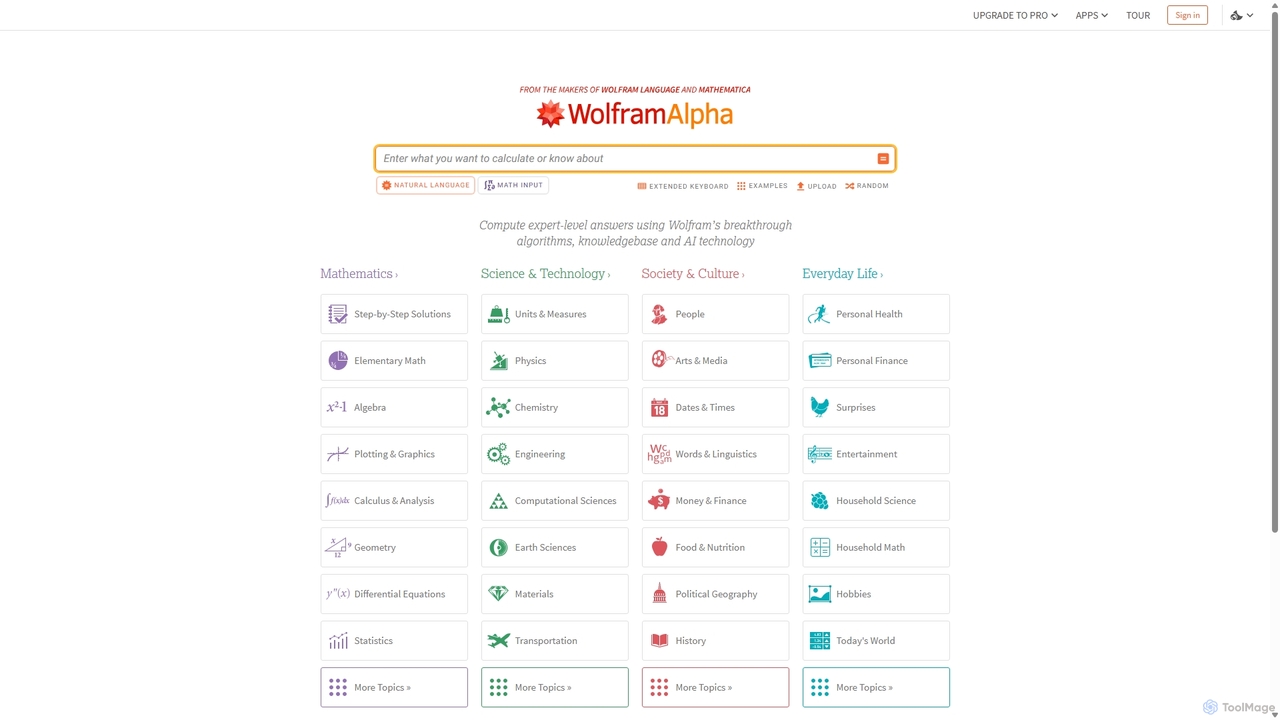
Wolfram|Alpha is a unique computational knowledge engine that provides expert-level answers by computing them dynamically from its vast …

3.6M
MathSolver

MathSolver

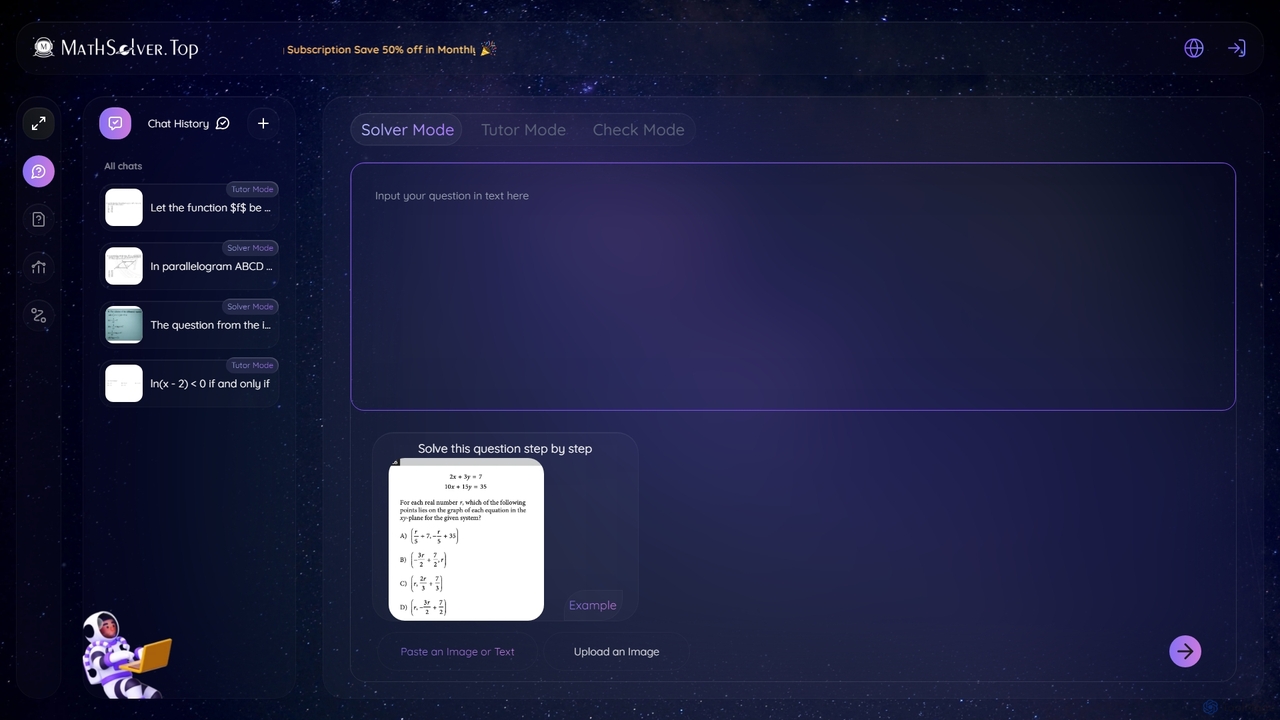
MathSolver is an AI-powered math assistant offering multiple modes to solve problems and learn concepts. Use Solver Mode …

2.3K

About Calculation

AI Calculation tools are a specialized category of developer utilities designed to perform complex mathematical, statistical, and symbolic computations. Leveraging machine learning and advanced algorithms, they interpret natural language queries, solve intricate equations, and process large datasets for analytical tasks. These tools empower developers, researchers, and analysts to accelerate problem-solving in fields from financial modeling to scientific research, often without writing extensive custom code. As a key component of the Developer Tools ecosystem, they bridge the gap between high-level problem statements and low-level computational execution.

Core Features

  • Natural Language Querying: Understands and processes mathematical problems stated in plain English, converting them into executable expressions.
  • Symbolic Mathematics: Performs algebraic manipulations, calculus operations (derivatives, integrals), and solves equations conceptually, not just numerically.
  • Statistical Analysis & Modeling: Executes complex statistical tests, regression analysis, and can suggest or build predictive models from data.
  • API Integration: Provides robust APIs for developers to embed advanced computational capabilities directly into their applications and workflows.
  • Step-by-Step Solutions: Generates detailed, human-readable explanations for how a solution was derived, which is valuable for learning and verification.

Use Cases

These tools are primarily used by software developers, data scientists, engineers, financial analysts, and academic researchers. They are applied in scenarios requiring rapid prototyping of complex algorithms, validating scientific models, performing quantitative financial analysis, or embedding sophisticated calculation logic into software products.

How to Choose

When selecting an AI Calculation tool, consider the specific mathematical domains it covers (e.g., linear algebra, calculus, statistics). Evaluate its API availability and documentation for integration with your existing tech stack. Assess its performance on large-scale computations and the accuracy of its results. Finally, consider the user interface and whether it supports natural language, code-based input, or both.

CalculationUse Cases

1

Financial Modeling and Risk Analysis

A financial analyst needs to assess the risk of a new investment portfolio. Instead of spending hours writing complex scripts in Python or R, they use an AI Calculation tool. They input queries in natural language, such as 'Calculate the Value at Risk (VaR) for this portfolio with a 99% confidence level using historical simulation.' The tool instantly processes historical market data, performs the calculation, and returns the VaR value along with visualizations, enabling rapid risk assessment and decision-making.

2

Scientific Research and Simulation

A physicist is studying fluid dynamics and needs to solve a set of complex partial differential equations. Manually solving them is impractical, and coding a solver is time-consuming. Using an AI Calculation tool, the researcher inputs the equations in standard mathematical notation. The tool's symbolic engine solves the equations where possible or sets up a numerical simulation, providing results and plots that help the researcher understand the system's behavior, significantly accelerating the research cycle.

3

Embedding Logic in Software Applications

A developer is building a logistics application that needs to calculate the most optimal delivery routes in real-time. Developing this optimization algorithm from scratch is a major undertaking. Instead, the developer integrates an AI Calculation tool's API. The application sends location data and constraints to the API, which then solves the Traveling Salesperson Problem (TSP) variant and returns the optimal route. This allows the developer to incorporate sophisticated functionality quickly and reliably.

4

Data Science Prototyping

A data scientist receives a new dataset and wants to quickly explore relationships within the data. Instead of writing boilerplate code for visualizations and statistical tests, they upload the data to an AI Calculation platform. They can then ask questions like, 'Perform a linear regression of revenue against marketing spend' or 'Show me the distribution of customer age.' The tool generates plots and statistical summaries on the fly, allowing for rapid hypothesis testing and feature engineering before committing to a full model build.

5

Educational Support for STEM Students

A university student struggling with an advanced calculus problem uses an AI Calculation tool as a tutor. They input the problem, such as 'Find the derivative of f(x) = sin(x^2) * e^(3x)'. The tool not only provides the correct answer but also generates a detailed, step-by-step derivation using the product rule and chain rule. This interactive process helps the student understand the methodology, reinforcing their learning in a way that a simple calculator cannot.

6

Engineering Design and Optimization

A mechanical engineer is designing a bridge truss and needs to calculate the forces in each member under various load conditions. This involves solving a large system of linear equations. By using an AI Calculation tool, the engineer can define the geometry and loads, and the tool solves the system of equations instantly. They can then ask follow-up questions like, 'What happens to the force in member A if we increase the load by 15%?' to rapidly iterate on the design and ensure structural integrity.

CalculationFrequently Asked Questions