
Developer Tools Best in category 1 results Calculators AI Tool

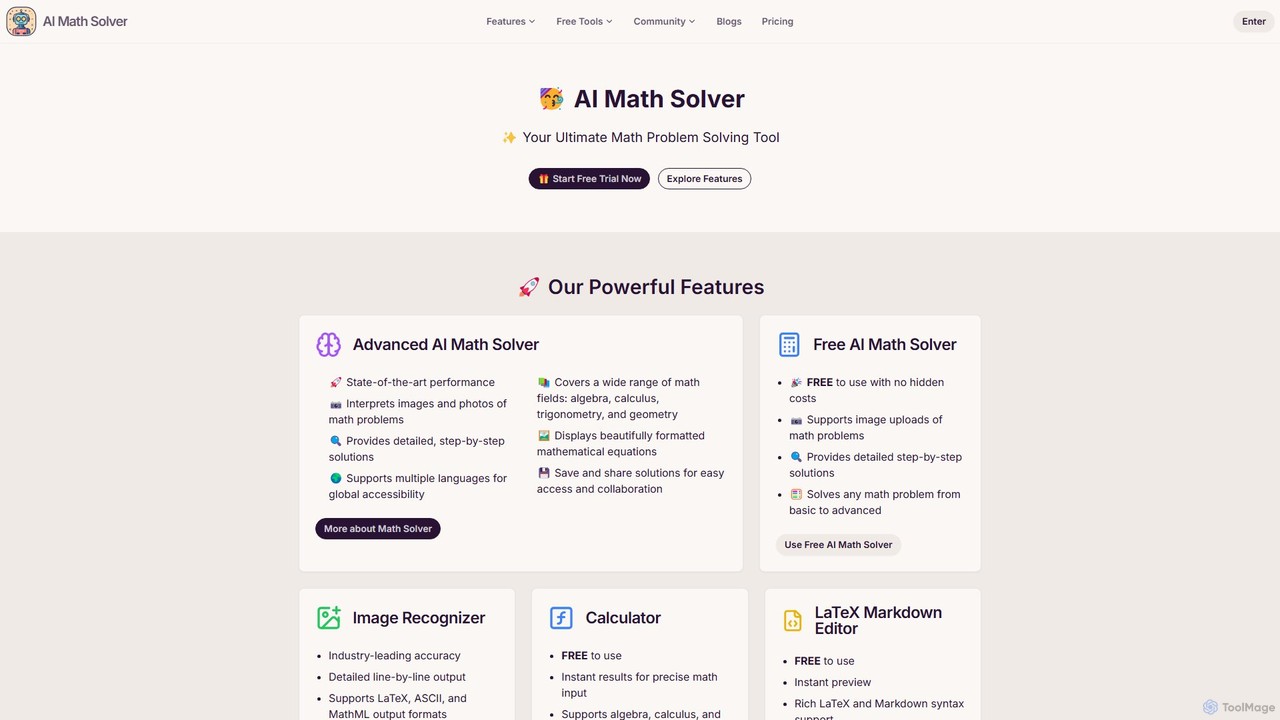
Popular AI tools in the Calculators field of Developer Tools include aimathsolve, etc., helping you quickly improve efficiency.

aimathsolve

aimathsolve

aimathsolve is an AI-powered math problem solver that provides detailed, step-by-step solutions. It supports various input methods, including …

49.1K

About Calculators

AI Calculators are a category of AI-powered tools that leverage artificial intelligence to perform complex computations, data analysis, and predictive modeling. These tools often integrate machine learning algorithms and natural language processing to interpret diverse inputs and provide intelligent insights beyond traditional arithmetic. They are invaluable for developers, data scientists, and engineers needing advanced estimation, optimization, or scenario planning capabilities within the broader developer tools ecosystem.

Core Features

  • Intelligent Input Processing: Understands natural language queries or complex data structures for computation.
  • Advanced Algorithmic Computation: Executes sophisticated mathematical, statistical, or logical operations.
  • Predictive Modeling & Simulation: Forecasts outcomes or simulates scenarios based on input data and learned patterns.
  • Data Analysis & Visualization: Processes large datasets, identifies trends, and presents results clearly.
  • Optimization & Recommendation: Suggests optimal solutions or parameters for complex problems.

Applicable Scenarios

AI Calculators are widely used in fields requiring precise estimations and data-driven decisions. Developers utilize them for optimizing code performance, predicting project timelines, and managing cloud resource allocation. Data scientists apply them for complex statistical analysis and model performance prediction, while financial analysts use them for risk assessment and portfolio optimization.

How to Choose

When selecting an AI Calculator, consider its computational scope to ensure it covers your specific mathematical or statistical models. Evaluate its data integration capabilities with your existing systems and APIs. Assess the level of customization and extensibility it offers for defining custom functions. Finally, prioritize tools with high accuracy and explainability, allowing you to understand the AI's reasoning behind its results.

CalculatorsUse Cases

1

Financial Risk Assessment for Fintech Developers

A Fintech developer needs to evaluate the risk profile of new investment algorithms before deployment. By inputting market data and algorithm parameters into an AI Calculator, they can predict potential losses or gains under various simulated market conditions. This allows for quick identification of high-risk areas and optimization of algorithm parameters, potentially saving weeks of manual backtesting and improving investment strategy reliability.

2

Cloud Resource Allocation Optimization

A Cloud Engineer or DevOps specialist aims to determine the most cost-effective and performant allocation of cloud resources (CPU, RAM, storage) for microservices. By feeding current usage metrics and projected load into an AI Calculator, they receive recommendations for optimal scaling configurations and potential cost savings. This can lead to a reduction in cloud spending by 15-20% while maintaining critical service level agreements and application performance.

3

Predictive Project Timeline Estimation

A Project Manager or Software Lead needs to estimate realistic timelines for complex software development projects with numerous dependencies. By inputting project scope, team velocity, historical data, and known risks into an AI Calculator, they can generate probabilistic timeline forecasts. This provides more accurate delivery dates to stakeholders and helps proactively identify potential delays, improving project planning and execution.

4

Code Complexity and Maintainability Scoring

A Software Architect or Senior Developer needs to assess the maintainability and technical debt of a large codebase. By uploading code metrics (lines of code, cyclomatic complexity, coupling) to an AI Calculator, they can receive a score for modules and suggestions for refactoring priorities. This helps prioritize refactoring efforts, improving overall code quality and significantly reducing future maintenance costs and development bottlenecks.

5

API Rate Limit Optimization

A Backend Developer needs to calculate optimal API request rates to avoid hitting limits while maximizing data throughput. By inputting API documentation limits, application usage patterns, and error rates into an AI Calculator, they can receive suggestions for dynamic rate limiting strategies. This helps prevent service interruptions due to rate limits and ensures smooth, efficient data exchange across integrated systems, enhancing application reliability.

6

Data Model Performance Prediction

A Data Scientist or ML Engineer needs to predict the performance (e.g., inference time, memory usage) of a machine learning model on different hardware configurations. By inputting model architecture, dataset size, and target hardware specifications into an AI Calculator, they can estimate resource consumption and latency. This enables them to select the most suitable deployment environment and optimize the model for production, avoiding costly trial-and-error cycles.

CalculatorsFrequently Asked Questions