ToolMage
Sign in

Best 1 Chatbot AI tools for Developer Tools

Popular Chatbot AI tools in Developer Tools include llmchat.co, helping you work more efficiently.

Free

llmchat.co

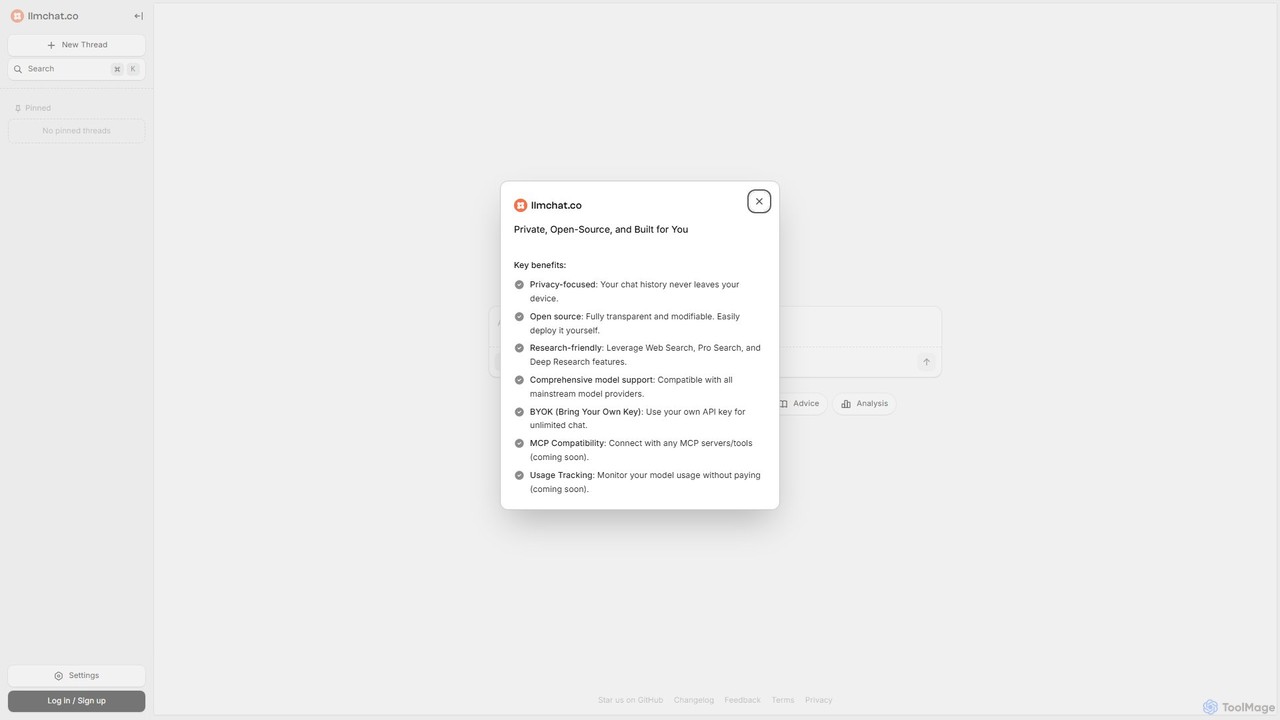
llmchat.co is a private, open-source AI research assistant designed for deep analysis and agentic workflows. It prioritizes user privacy by keeping all chat history on your device. With support for multiple LLM providers via your own API key (BYOK), it offers powerful features like Web Search and Deep Research, making it an ideal tool for researchers, developers, and power users seeking control and flexibility.

Chatbot
Visits 5.1KFavorites 116Likes 101

About Chatbot

Chatbots are AI-powered tools designed to simulate human conversation through text or voice interfaces, providing automated responses and performing tasks. Leveraging advanced natural language processing (NLP) and machine learning, these intelligent agents can understand user queries, extract intent, and deliver relevant information or actions. As a vital part of developer tools, chatbots enable the creation of interactive and intelligent applications, enhancing user engagement and operational efficiency across websites, mobile apps, and various messaging platforms.

Core Features

  • Natural Language Understanding (NLU): Accurately interprets user intent, sentiment, and extracts key entities from diverse linguistic inputs, allowing for more natural interactions.
  • Context Management: Maintains the flow of conversation by remembering previous interactions, user preferences, and session-specific data, enabling more personalized and coherent dialogues.
  • Integration Capabilities: Seamlessly connects with CRM, ERP, knowledge bases, payment gateways, and other critical business systems to retrieve data, update records, and execute complex workflows.
  • Multi-channel Deployment: Offers flexibility to deploy across a wide range of platforms, including company websites, mobile applications, popular messaging apps (e.g., WhatsApp, Facebook Messenger, Slack), and voice-activated assistants.
  • Personalization: Adapts responses, recommendations, and conversational paths based on individual user profiles, historical data, and real-time behavior, creating a more tailored experience.

Applicable Scenarios

Chatbots are extensively utilized across various sectors, from enhancing customer support to streamlining internal operations. For example, in e-commerce, a chatbot can proactively assist customers with product discovery, answer FAQs about shipping or returns, and guide them through the checkout process, significantly reducing cart abandonment. In corporate environments, an HR chatbot can automate responses to common employee queries regarding policies, benefits, or leave requests, freeing up HR staff for more strategic tasks.

How to Choose

When selecting a chatbot solution, prioritize its natural language understanding (NLU) accuracy and comprehensive language support to ensure effective communication with your target audience. Evaluate its integration capabilities with your existing CRM, helpdesk, and other business systems for seamless data flow. Consider the platform's scalability to handle fluctuating user loads, the ease of customization for specific business logic, and the availability of robust analytics to monitor performance and continuously improve conversational flows.

Featured tool rankings

Chatbot use cases

1

Automating Customer Service Inquiries

For businesses with high volumes of repetitive customer questions, chatbots can provide instant 24/7 support. They handle common FAQs, track order statuses, and troubleshoot basic issues, significantly reducing response times and allowing human agents to focus on complex or sensitive customer interactions, thereby improving overall customer satisfaction and operational efficiency.

2

Streamlining Sales Lead Qualification

Sales teams can deploy chatbots on websites or landing pages to engage visitors, ask qualifying questions (e.g., budget, needs, timeline), and gather essential contact information. This automates the initial lead qualification process, ensuring that sales representatives only receive warm leads that are more likely to convert, thereby optimizing sales pipeline management and increasing conversion rates.

3

Providing Instant IT Support for Employees

Internal IT departments can leverage chatbots to offer immediate assistance to employees for common technical problems. Chatbots can guide users through password resets, software installation steps, network troubleshooting, or direct them to relevant knowledge base articles, reducing the workload on IT staff and minimizing employee downtime due to technical issues.

4

Enhancing E-commerce Shopping Experience

E-commerce retailers use chatbots to personalize the shopping journey. These bots can recommend products based on user preferences, answer detailed product questions, compare items, and even assist with the checkout process. This interactive guidance helps customers find what they need faster, leading to higher engagement, reduced cart abandonment, and increased sales.

5

Facilitating Internal HR & Employee Support

HR departments can utilize chatbots to automate responses to employee queries regarding company policies, benefits, payroll, or leave requests. Employees get immediate access to information without waiting for HR staff, improving employee experience and allowing HR professionals to dedicate more time to strategic initiatives and complex employee relations matters.

6

Delivering Personalized Educational Content

Educational platforms and e-learning providers can use chatbots to deliver tailored learning experiences. Chatbots can answer student questions about course material, provide supplementary resources, offer practice quizzes, and guide learners through complex topics, making education more accessible and engaging, and supporting self-paced learning.

Chatbot FAQ

What is an AI Chatbot?

An AI chatbot is a computer program designed to simulate human conversation, primarily through text or voice, using artificial intelligence. Unlike rule-based bots, AI chatbots leverage natural language processing (NLP) and machine learning to understand user intent, context, and sentiment, enabling them to provide more intelligent, flexible, and human-like responses. They are used for automating customer service, providing information, and performing various tasks.

How do AI Chatbots work?

AI chatbots work by combining several technologies. First, Natural Language Processing (NLP) allows them to understand human language. This involves tokenization, parsing, and named entity recognition to extract meaning and user intent. Second, machine learning models are trained on vast datasets of conversations to predict appropriate responses. Third, context management systems track the conversation history to maintain coherence. Finally, integration with backend systems enables them to retrieve information or perform actions.

What are the key benefits of using Chatbots for businesses?

Businesses benefit significantly from chatbots by achieving 24/7 customer support availability, reducing operational costs associated with human agents, and improving response times. Chatbots can handle a large volume of inquiries simultaneously, ensuring consistent service quality. They also enhance customer satisfaction through instant assistance and can gather valuable data on customer interactions, which helps in refining services and products.

How do I choose the right Chatbot platform for my needs?

To choose the right chatbot platform, first assess your specific business needs and target audience. Look for platforms with strong Natural Language Understanding (NLU) capabilities in the languages you require. Consider its integration potential with your existing CRM, helpdesk, and other essential systems. Evaluate the ease of bot training, customization options, scalability, and the availability of analytics tools to monitor performance and user engagement. Finally, compare pricing models and support services.

What is the difference between an AI Chatbot and a virtual assistant?

While often used interchangeably, an AI chatbot typically refers to a conversational interface designed for specific tasks or domains, like customer support on a website. A virtual assistant (e.g., Siri, Alexa, Google Assistant) is generally broader in scope, designed to assist users with a wider range of personal and productivity tasks across multiple applications and devices, often with voice interaction as a primary mode. Virtual assistants are essentially highly advanced, multi-functional chatbots with deeper system integration.