Dagger.io
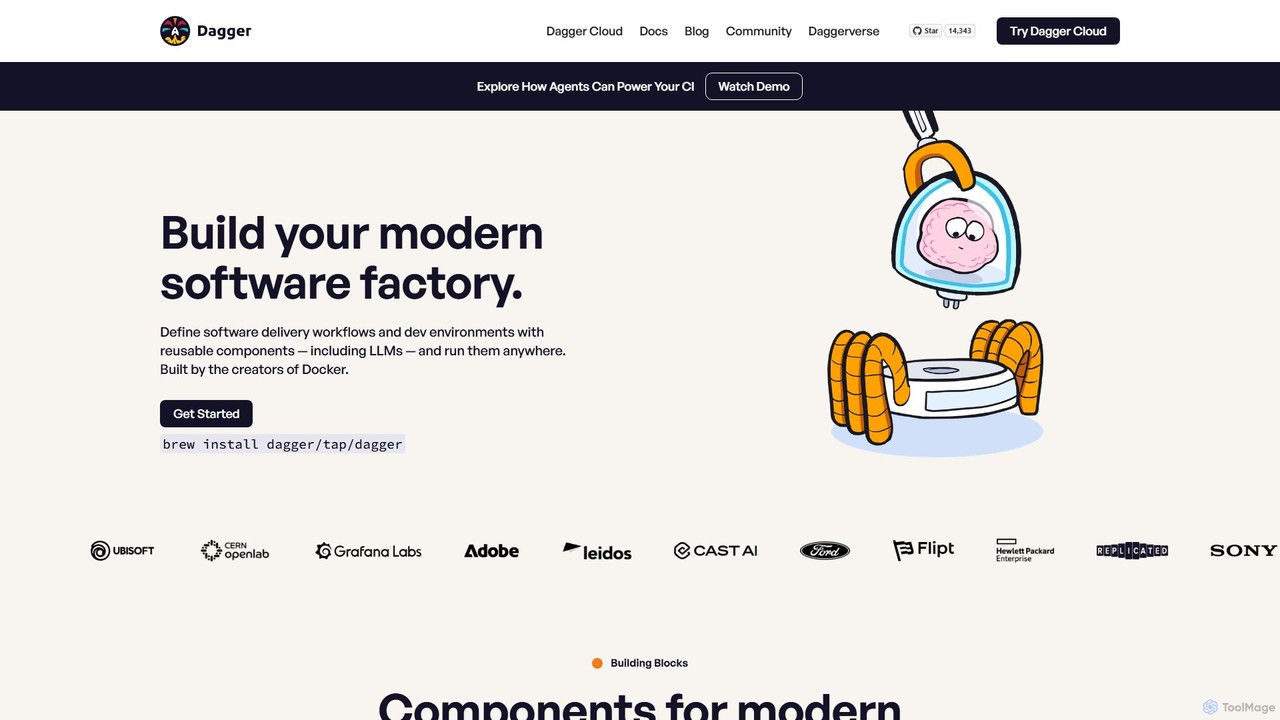
Dagger.io is a programmable CI/CD engine that allows developers to build powerful automation pipelines as code in languages …
Dagger.io is a programmable CI/CD engine that allows developers to build powerful automation pipelines as code in languages like Go, Python, and TypeScript. It leverages containers to ensure workflows are portable, reproducible, and run consistently everywhere. Dagger also provides a secure environment for integrating LLMs and AI agents into your software development lifecycle.
About Ci Cd
CI/CD (Continuous Integration/Continuous Delivery) tools are essential developer tools that automate the software development lifecycle from code commit to deployment. These platforms integrate automated testing, building, and deployment pipelines, ensuring rapid and reliable software releases. They empower development teams to deliver high-quality software faster, reduce manual errors, and maintain a consistent deployment process.
Core Features
- Automated Builds: Automatically compile code and create executable artifacts upon every code change.
- Continuous Testing: Integrate and run various tests (unit, integration, end-to-end) automatically to detect issues early.
- Deployment Automation: Orchestrate and automate the deployment of applications to various environments (staging, production).
- Version Control Integration: Seamlessly connect with Git repositories to trigger pipelines on code commits or pull requests.
- Pipeline Orchestration: Define, visualize, and manage complex workflows for building, testing, and deploying software.
Applicable Scenarios
CI/CD tools are indispensable for modern software development teams, DevOps engineers, and SREs. They are used in agile environments to support frequent code changes, ensuring that new features and bug fixes are delivered to users quickly and reliably. From small startups to large enterprises, any organization aiming for efficient, high-quality software delivery benefits from robust CI/CD pipelines.
How to Choose
When selecting a CI/CD tool, consider its integration capabilities with your existing tech stack (VCS, cloud providers, testing frameworks), scalability to handle growing projects, ease of pipeline configuration (YAML vs. GUI), security features for code and deployment, and pricing model. Evaluate community support and available plugins to ensure it meets your specific development workflow needs.

Ci CdUse Cases
Automating Web Application Deployment
A web development team uses CI/CD to automatically build, test, and deploy new features or bug fixes for their SaaS application. Upon a code commit to the main branch, the CI/CD pipeline triggers, runs unit and integration tests, builds the Docker image, and deploys it to a staging environment for QA, then to production after approval, significantly reducing manual deployment time and errors.
Continuous Delivery for Microservices
An enterprise with a microservices architecture leverages CI/CD to manage independent deployments of numerous services. Each microservice has its own pipeline, allowing teams to develop and deploy updates without affecting other services. This ensures agility and reduces the risk associated with large, monolithic deployments, enabling faster iteration cycles for individual components.
Mobile App Release Automation
Mobile app developers utilize CI/CD to automate the build, testing, and distribution of iOS and Android applications. The pipeline compiles the app for different platforms, runs UI tests, signs the builds, and distributes them to internal testers via platforms like TestFlight or directly to app stores, streamlining the release process and ensuring consistent quality across versions.
Infrastructure as Code (IaC) Deployment
DevOps engineers employ CI/CD to automate the provisioning and management of infrastructure using tools like Terraform or Ansible. Changes to infrastructure code are committed to version control, triggering a CI/CD pipeline that validates the code, plans infrastructure changes, and applies them to cloud environments, ensuring consistent and reproducible infrastructure deployments.
Security Scanning in Development Pipeline
A security-conscious organization integrates static application security testing (SAST) and dynamic application security testing (DAST) into their CI/CD pipelines. Before deployment, the pipeline automatically scans code for vulnerabilities and performs runtime checks on the staging environment, providing immediate feedback to developers and preventing insecure code from reaching production.
Database Schema Migration Automation
Development teams working with relational databases use CI/CD to automate database schema migrations. When schema changes are committed, the pipeline validates the migration scripts, applies them to development and staging databases, and ensures compatibility with existing data, reducing the risk of data corruption and ensuring smooth application updates.