Movestax
Movestax is an AI-powered, serverless-first cloud platform designed for modern developers. It simplifies infrastructure management by unifying app …
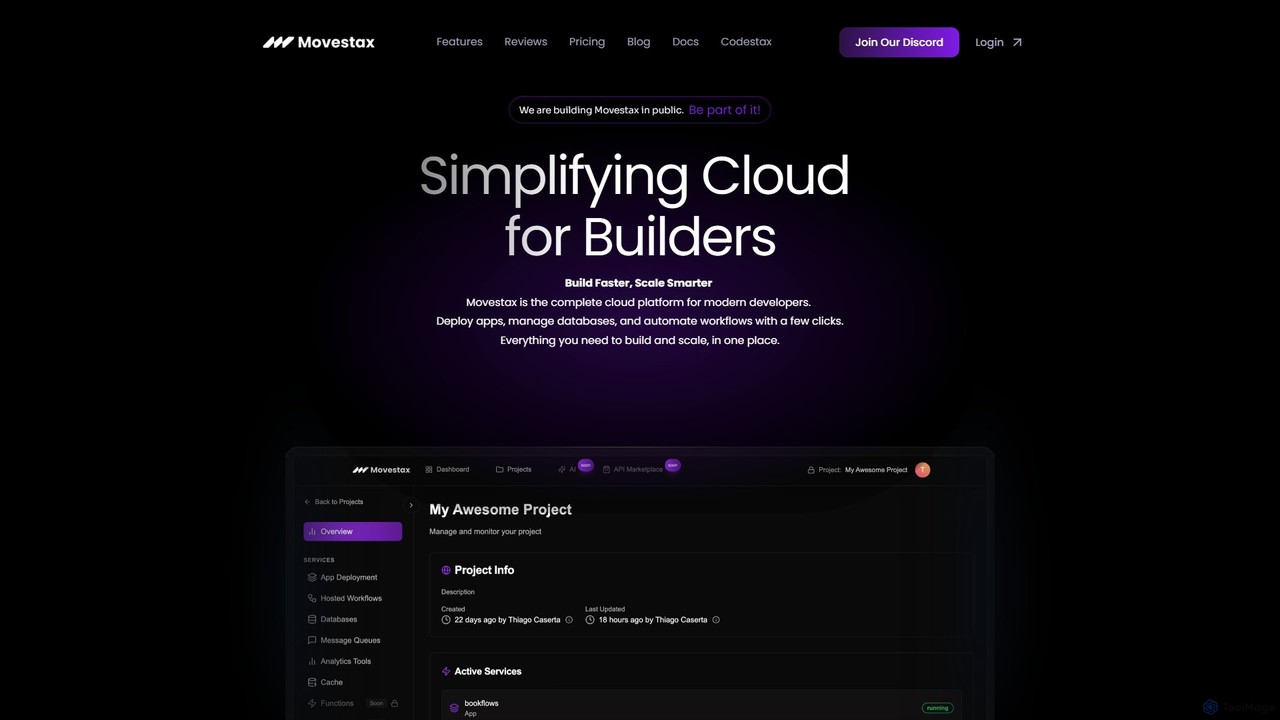
Movestax is an AI-powered, serverless-first cloud platform designed for modern developers. It simplifies infrastructure management by unifying app deployment, serverless databases, and automated workflows. With its integrated AI assistant, CodeStax, you can generate and deploy full-stack applications from natural language prompts, drastically accelerating the development lifecycle from idea to production.
About Cloud Platform
AI Cloud Platforms are integrated environments that provide the infrastructure, tools, and services needed to build, train, and deploy machine learning models at scale. These platforms abstract away the complexity of managing hardware, offering on-demand access to powerful computing resources like GPUs and TPUs. They streamline the entire machine learning lifecycle, from data preparation and model development to deployment and monitoring, enabling developers and data scientists to accelerate innovation. This specialized focus on AI workflows distinguishes them as a crucial subset of developer tools.
Core Features
- Managed AI Services: Provides pre-trained models via APIs for tasks like vision, speech, and natural language processing, allowing for rapid integration of AI capabilities.
- ML Development Environments: Offers hosted notebooks (e.g., Jupyter), SDKs, and support for major frameworks like TensorFlow and PyTorch.
- Scalable Compute Resources: Delivers on-demand access to specialized hardware such as GPUs and TPUs for efficient model training and inference.
- MLOps Toolchain: Includes tools for experiment tracking, model versioning, automated deployment pipelines (CI/CD), and performance monitoring.
Use Cases
AI Cloud Platforms are essential for data scientists, machine learning engineers, and application developers. They are widely used in industries like tech, finance, and healthcare for developing custom recommendation engines, fraud detection systems, medical image analysis tools, and large language model applications.
How to Choose
When selecting an AI Cloud Platform, consider the breadth of its managed AI services, compatibility with your preferred development frameworks, and the pricing model for compute resources (pay-as-you-go vs. reserved instances). Also, evaluate the platform's MLOps capabilities for managing the model lifecycle and its integration with your existing data infrastructure.

Cloud PlatformUse Cases
Train a Custom Image Recognition Model
A data science team at an e-commerce company needs to build a model to automatically categorize new product images. Using an AI Cloud Platform, they upload their dataset to a managed storage service. They then launch a pre-configured Jupyter notebook environment with access to powerful GPUs. The team uses TensorFlow to write and train their model, leveraging the platform's experiment tracking tools to log parameters and compare results from different training runs. This approach significantly reduces setup time and allows them to focus on model optimization rather than infrastructure management.
Deploy a Real-time NLP API Service
A software developer is building an application that requires real-time sentiment analysis of user comments. Instead of building a model from scratch, they use a pre-trained NLP model available through the AI Cloud Platform's API. After testing, they need to deploy it for production. Using the platform's MLOps tools, they package the model into a container and deploy it as a serverless endpoint. This endpoint automatically scales based on traffic, ensuring low latency and high availability without the need for manual server provisioning or management, making it a cost-effective solution.
Automate Document Processing Pipeline
A financial institution needs to process thousands of loan applications daily, extracting key information like names, addresses, and income. They use an AI Cloud Platform to build an automated pipeline. First, documents are scanned and uploaded. The platform's managed OCR service converts images to text. Next, a custom-trained Named Entity Recognition (NER) model, built on the platform, extracts the required data fields. The structured data is then saved to a database for review. This end-to-end automation reduces manual data entry by over 90% and speeds up the application review process significantly.
Build a Scalable Recommendation Engine
A media streaming service wants to provide personalized content recommendations to its millions of users. Their ML engineers use an AI Cloud Platform to build and operate the recommendation engine. They leverage the platform's distributed data processing service to prepare user interaction data. Then, they train a collaborative filtering model on a cluster of GPU machines. The trained model is deployed as a high-throughput, low-latency API. The platform's monitoring tools track the model's performance and prediction accuracy in real-time, allowing for continuous improvement and retraining cycles.
Accelerate Scientific Research with Large-Scale Computing
A university research lab is working on protein folding simulations, a computationally intensive task. By using an AI Cloud Platform, they gain access to thousands of GPU cores on demand, which would be prohibitively expensive to purchase and maintain locally. They use the platform's orchestration tools to manage large-scale, parallel computing jobs. This allows them to run complex simulations in hours instead of months, drastically accelerating their research timeline and enabling them to test more hypotheses and analyze vast amounts of simulation data efficiently.
Develop and Host a Generative AI Application
A startup aims to launch a new text-to-image generation service. They use an AI Cloud Platform that provides access to state-of-the-art foundation models. Instead of training a large model themselves, they fine-tune a pre-trained model on their specific dataset using the platform's training infrastructure. For the application backend, they use serverless functions to handle API requests, which call the fine-tuned model for inference. This architecture allows them to build a powerful generative AI service quickly and cost-effectively, scaling automatically with user demand without managing any servers.