Developer Tools Best in category 1 results Cloud Services AI Tool

Popular AI tools in the Cloud Services field of Developer Tools include AWS, etc., helping you quickly improve efficiency.

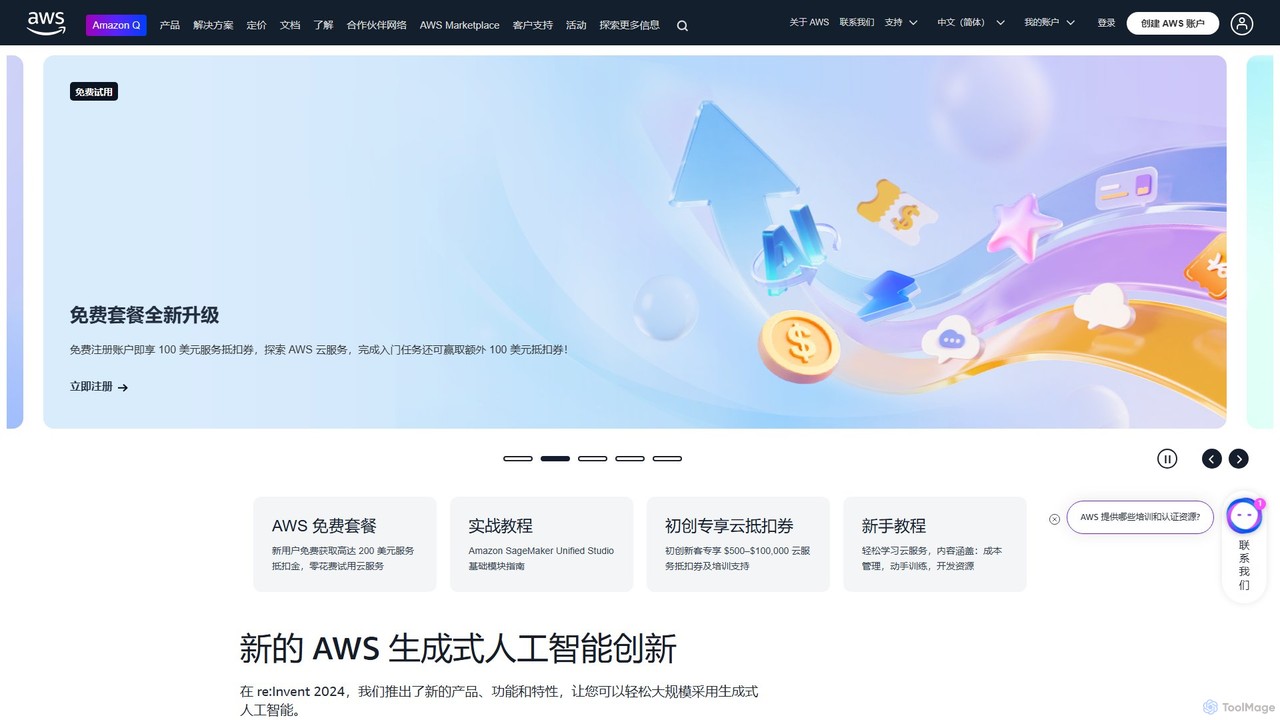
AWS

AWS

Amazon Web Services (AWS) is the world's most comprehensive and broadly adopted cloud platform, offering over 200 fully …

62.3M

About Cloud Services

Cloud Services are AI-powered and general infrastructure tools that provide on-demand computing resources and platforms over the internet, enabling developers to build, deploy, and scale applications without managing physical hardware. These services leverage distributed architectures to offer scalable storage, compute, networking, and specialized AI/ML platforms. They empower developers to accelerate innovation, reduce operational overhead, and focus on core product development.

Core Features

  • Scalable Compute & Storage: On-demand virtual machines, containers (e.g., Kubernetes), serverless functions, and object/block storage that automatically scale with demand.
  • Managed Databases: Fully managed relational (e.g., PostgreSQL, MySQL) and NoSQL (e.g., MongoDB, DynamoDB) database services, reducing administrative burden.
  • AI/ML Platforms: Services for building, training, and deploying machine learning models, including specialized APIs for vision, speech, and natural language processing.
  • Networking & Content Delivery: Virtual private clouds, load balancers, DNS services, and Content Delivery Networks (CDNs) for secure, high-performance global access.
  • Developer Tools Integration: CI/CD pipelines, code repositories, monitoring, and logging services integrated within the cloud ecosystem.

Use Cases

Developers utilize cloud services for hosting web applications, deploying microservices architectures, running big data analytics, and orchestrating complex AI/ML workflows. They are essential for startups needing rapid prototyping and enterprises requiring robust, globally distributed infrastructure.

How to Choose

Evaluate providers based on service offerings (IaaS, PaaS, SaaS), pricing models (pay-as-you-go, reserved instances), ecosystem maturity, security features, compliance certifications, and developer support. Consider data residency requirements and integration with existing tools.

Cloud ServicesUse Cases

1

Deploying Scalable Web Applications

Developers use cloud compute instances (VMs, containers) and managed databases to host web applications that can handle fluctuating user traffic, ensuring high availability and performance. This allows a small team to launch a global service, automatically scaling resources up or down based on real-time demand, saving operational costs and manual intervention.

2

Building & Deploying Machine Learning Models

Data scientists and ML engineers leverage cloud AI/ML platforms to train models with vast datasets, then deploy them as API endpoints for real-time inference in applications. This significantly reduces the infrastructure setup time and provides access to specialized hardware (GPUs/TPUs) for faster model training and deployment.

3

Implementing Serverless Backend APIs

Backend developers create event-driven APIs using serverless functions (e.g., AWS Lambda, Azure Functions), reducing infrastructure management and paying only for execution time. This approach allows for rapid development of microservices, automatic scaling, and cost optimization, as resources are only consumed when code is actively running.

4

Orchestrating Containerized Microservices

DevOps teams deploy and manage complex microservices architectures using container orchestration services (e.g., Kubernetes), ensuring portability, scalability, and resilience across environments. This allows for consistent deployment across development, staging, and production, simplifying updates and rollbacks while maximizing resource utilization.

5

Managing Big Data Storage & Analytics

Data engineers store petabytes of data in cloud object storage and use managed data warehousing or analytics services to process, query, and gain insights from large datasets. This provides a cost-effective and highly scalable solution for handling massive amounts of data, enabling advanced analytics and business intelligence without managing underlying infrastructure.

6

Setting Up CI/CD Pipelines for Software Delivery

Development teams integrate cloud-native CI/CD tools with code repositories to automate the build, test, and deployment processes, accelerating software release cycles. This ensures that code changes are continuously integrated and delivered, reducing manual errors and enabling faster iteration and feedback loops for developers.

Cloud ServicesFrequently Asked Questions