ToolMage
Sign in

Best 2 Data Orchestration AI tools for Developer Tools

Popular Data Orchestration AI tools in Developer Tools include Dagster and Orchestra, helping you work more efficiently.

Dagster
Freemium

Dagster

Dagster is a modern, open-source data orchestrator designed for building, scaling, and observing AI and data pipelines. It acts as a unified control plane, allowing teams to model data assets, track lineage, and ensure data quality with confidence. By integrating software engineering best practices like local testing and reusable components, Dagster helps data engineers and ML teams ship products faster and more reliably.

Machine Learning Operations
Visits 158.7KFavorites 133Likes 158
Orchestra
Freemium

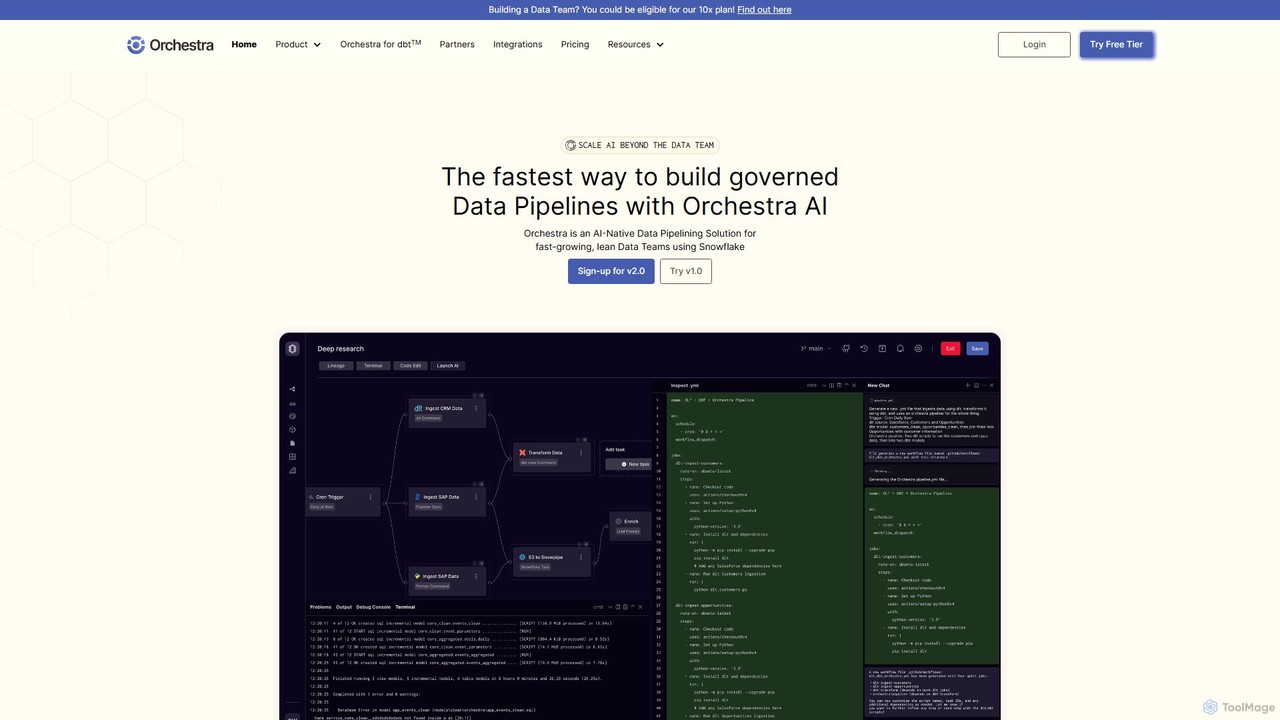
Orchestra

Orchestra is a unified control plane for data orchestration and pipelining, designed for lean data teams. It offers an AI-native solution to build, monitor, and manage governed data pipelines with end-to-end observability, proactive alerting, and extensive integrations. It simplifies complex data workflows, reduces maintenance time, and ensures data is reliable and AI-ready.

Business Intelligence
Visits 77.2KFavorites 140Likes 150

About Data Orchestration

Data Orchestration tools are a class of developer tools that automate the complex processes of collecting, transforming, and delivering data across diverse systems. These tools streamline data pipelines, ensuring data is prepared and moved efficiently for analytics, machine learning, and operational needs. They provide a unified platform to manage data flows, enhance data quality, and accelerate data-driven initiatives within the broader developer ecosystem.

Core Features

  • Pipeline Automation: Automate the entire data lifecycle from ingestion to delivery, reducing manual effort.
  • Data Transformation: Enable cleaning, enriching, and restructuring data to fit target system requirements.
  • Workflow Scheduling: Schedule data jobs and dependencies, ensuring timely and ordered execution.
  • Monitoring & Alerting: Provide real-time visibility into data pipeline health and alert on failures or anomalies.
  • Integration Connectors: Offer pre-built connectors for various data sources, destinations, and processing engines.

Use Cases

Data orchestration is vital for organizations dealing with large volumes of data from disparate sources. It's used by data engineers to build robust data platforms, by MLOps teams to feed training data to AI models, and by business intelligence analysts to ensure up-to-date dashboards.

How to Choose

When selecting a Data Orchestration tool, consider its integration capabilities with your existing data stack, scalability to handle growing data volumes, ease of use for pipeline development, and robust monitoring and error handling features. Evaluate its cost-effectiveness and community support for long-term viability.

Data Orchestration use cases

1

Automating ML Model Training Data Pipelines

Data scientists and MLOps engineers use data orchestration to automate the extraction, transformation, and loading (ETL) of raw data into features suitable for machine learning model training. This ensures that models are consistently trained on fresh, high-quality data, reducing manual data preparation time and accelerating model deployment cycles.

2

Building Real-time Analytics Dashboards

Business intelligence teams leverage data orchestration to continuously collect data from operational databases, streaming sources, and third-party APIs, then transform and load it into data warehouses or data lakes. This enables the creation of real-time or near real-time analytics dashboards, providing up-to-date insights for critical business decisions.

3

Ensuring Data Compliance and Governance

Data governance officers and compliance teams utilize data orchestration to implement automated data masking, anonymization, and auditing processes across various data stores. This ensures sensitive data is handled according to regulatory requirements (e.g., GDPR, CCPA) throughout its lifecycle, minimizing compliance risks and maintaining data integrity.

4

Migrating Data Between Cloud Environments

Cloud architects and DevOps teams employ data orchestration to manage complex data migration projects, moving large datasets between different cloud providers or on-premise and cloud environments. These tools handle data validation, transformation, and synchronization during migration, ensuring data consistency and minimizing downtime.

5

Integrating Disparate Business Applications

Enterprise architects and IT managers use data orchestration to integrate data from various business applications like CRM, ERP, and marketing automation platforms. By creating automated data flows, they ensure consistent data across systems, enabling a unified view of customers and operations, and supporting cross-functional business processes.

6

Powering AI-driven Personalization Engines

Product managers and data engineers in e-commerce or media companies use data orchestration to collect user interaction data, product catalogs, and historical purchase information. This data is then processed and fed into AI personalization engines, enabling dynamic content recommendations, targeted advertising, and customized user experiences.

Data Orchestration FAQ

What is Data Orchestration?

Data Orchestration is the automated management of data workflows, ensuring data is efficiently moved, transformed, and delivered across various systems. It involves scheduling, monitoring, and managing complex data pipelines to support analytics, machine learning, and operational processes.

How does Data Orchestration differ from ETL?

While ETL (Extract, Transform, Load) is a core component, Data Orchestration is a broader concept. ETL focuses on the specific process of moving and transforming data. Orchestration encompasses ETL but also includes managing dependencies, scheduling, error handling, monitoring, and coordinating multiple data pipelines and tools across an entire data ecosystem.

What are the key benefits of using Data Orchestration tools?

Key benefits include increased efficiency through automation, improved data quality and consistency, reduced manual errors, faster time-to-insight for analytics and AI, enhanced scalability for growing data volumes, and better compliance with data governance policies.

Who typically uses Data Orchestration tools?

Data Orchestration tools are primarily used by data engineers, MLOps engineers, cloud architects, and IT operations teams. These professionals are responsible for building, maintaining, and monitoring the data pipelines that power an organization's data-driven applications and analytics.

What should I consider when choosing a Data Orchestration platform?

When choosing a platform, consider its integration capabilities with your existing data sources and tools, its scalability for future growth, the robustness of its monitoring and alerting features, its ease of use for pipeline development, and its support for various data transformation techniques. Also, evaluate its cost model and community support.