Developer Tools Best in category 1 results Directories AI Tool

Popular AI tools in the Directories field of Developer Tools include Tierlify, etc., helping you quickly improve efficiency.

Free
Tierlify

Tierlify

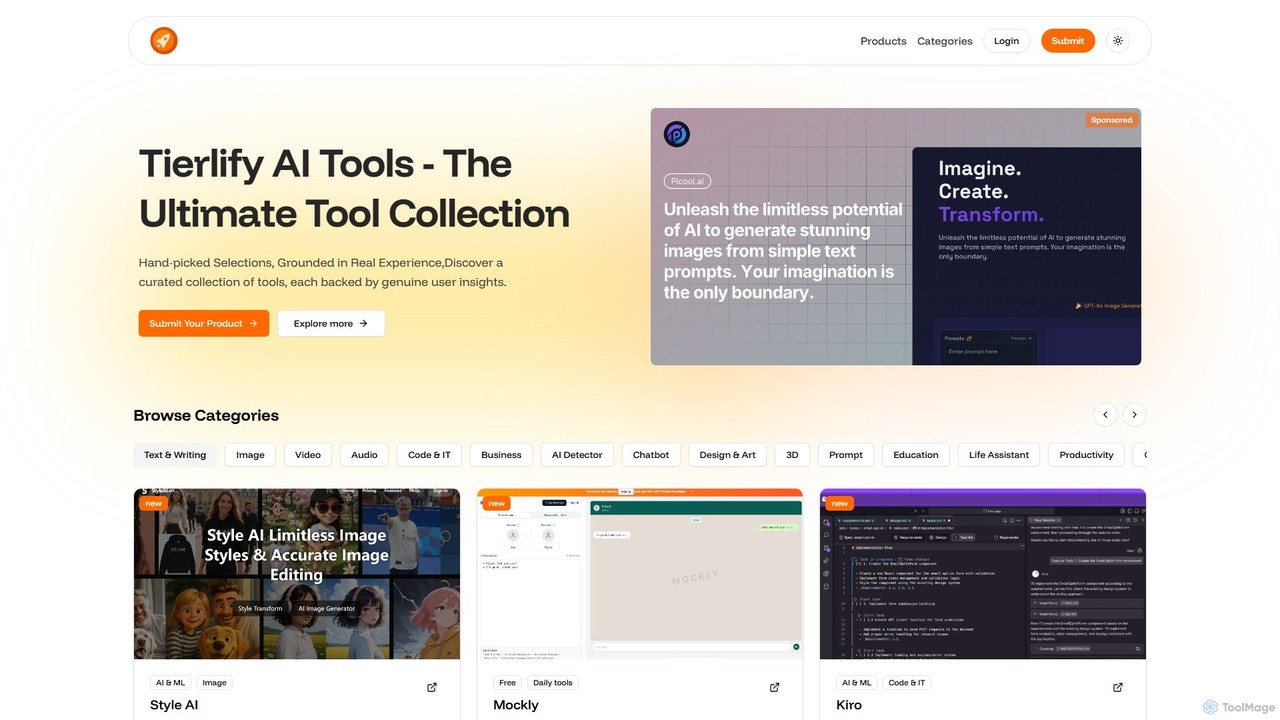
Tierlify is a curated directory of AI tools, offering a hand-picked collection of applications across categories like text, …

1.8K

About Directories

AI Directories are specialized developer tools that provide curated, structured, and searchable catalogs of AI models, APIs, and datasets. They function as centralized registries, aggregating information on capabilities, providers, pricing, and technical specifications. This allows developers to efficiently discover, compare, and select the most suitable AI resources for their applications, significantly reducing research and integration time. Unlike simple lists, these directories often offer API access to their own data, enabling programmatic discovery and dynamic tool selection within software.

Core Features

  • Structured Resource Cataloging: Provides detailed, tagged, and categorized information for each AI resource, including performance benchmarks and API endpoints.
  • Advanced Search & Filtering: Enables users to search for tools based on specific criteria like task (e.g., text generation), pricing model, provider, or integration compatibility.
  • API Access: Offers programmatic access to the directory's database, allowing applications to dynamically query and retrieve information about AI tools.
  • Community Reviews & Ratings: Aggregates user feedback, ratings, and usage statistics to help developers assess the quality and reliability of different AI services.
  • Version Tracking: Monitors and documents updates, new versions, or deprecations of listed AI models and APIs.

Use Cases

AI Directories are primarily used by software developers, MLOps engineers, and data scientists who are building applications that leverage third-party AI services. They are essential in scenarios requiring dynamic tool selection, such as building AI agentic workflows or creating marketplaces of AI capabilities. Product managers and researchers also use them for market analysis and to track the evolution of the AI landscape.

How to Choose

When selecting an AI Directory, consider the breadth and quality of its listings—how comprehensive and up-to-date is the catalog? Evaluate the power and flexibility of its search and filtering capabilities. For programmatic use, assess the quality of its API documentation, reliability, and the richness of the data it provides. Finally, consider the strength of its community features, such as user reviews and benchmarks, as these provide valuable real-world insights.

DirectoriesUse Cases

1

Building an AI Application Marketplace

A developer is creating a platform that allows users to access various third-party AI services. Instead of manually curating and updating a list of tools, they integrate with an AI Directory's API. This allows their platform to programmatically fetch a real-time, searchable list of available AI models. Users can filter tools by category (e.g., 'Image Generation', 'Voice Synthesis'), provider, and pricing. This approach saves hundreds of development hours and ensures the marketplace is always up-to-date with the latest AI tools without manual intervention.

2

Automating AI Model Selection in a Workflow

An MLOps team needs to build a data processing pipeline that automatically selects the most cost-effective sentiment analysis API for incoming text data. They write a script that queries an AI Directory's API, filtering for all 'sentiment analysis' tools. The script then compares the pricing tiers and performance benchmarks provided by the directory for each tool. Based on this data, it dynamically routes the processing job to the API that offers the best balance of cost and accuracy for that specific task, optimizing operational expenses automatically.

3

Competitive Analysis for AI Product Strategy

A product manager at an AI startup is tasked with defining the roadmap for a new text-to-speech (TTS) product. They use an AI Directory to conduct market research. By filtering for all existing TTS tools, they can quickly analyze the competitive landscape, including key players, common features, and prevalent pricing models (e.g., per-character, subscription-based). The directory's data on user ratings and release dates helps them identify market gaps and opportunities for differentiation, leading to a more informed and strategic product roadmap.

4

Powering an AI Agent's Tool Discovery

A developer is building an autonomous AI agent designed to solve complex, multi-step problems. The agent needs the ability to find and use external tools on the fly. The developer integrates the agent with an AI Directory's API. When the agent determines it needs a specific capability, like 'currency conversion' or 'weather forecast', it queries the directory to find a suitable API. It then uses the API endpoint and parameter information provided by the directory to execute the tool and get the result, making the agent more versatile and capable without hardcoding every possible tool.

5

Monitoring External API Dependencies

A large enterprise relies on dozens of external AI APIs for its operations. An MLOps engineer is responsible for ensuring service reliability. They use an AI Directory that offers version tracking and alerts. By registering their critical API dependencies with the directory service, they receive automatic notifications whenever a provider releases a new version, announces a deprecation, or if there's a change in the API's status. This proactive monitoring allows the team to plan for necessary code updates well in advance, preventing service disruptions caused by unexpected changes in third-party tools.

6

Academic Research on the AI Landscape

A university research group is studying the proliferation and evolution of large language models (LLMs). They use the historical data and cataloging features of an AI Directory to track the release dates, parameter counts, and training data sources of various LLMs over the past few years. The directory's structured data allows them to perform quantitative analysis on trends in the AI industry, such as the rate of model size increase or the shift in focus from general-purpose to specialized models. This provides a reliable, aggregated data source, saving them from the tedious task of manually scraping information from hundreds of different websites and research papers.

DirectoriesFrequently Asked Questions