ToolMage
Sign in

Best 1 Generative Models AI tools for Developer Tools

Popular Generative Models AI tools in Developer Tools include Ligo Biosciences, helping you work more efficiently.

Ligo Biosciences

Ligo Biosciences

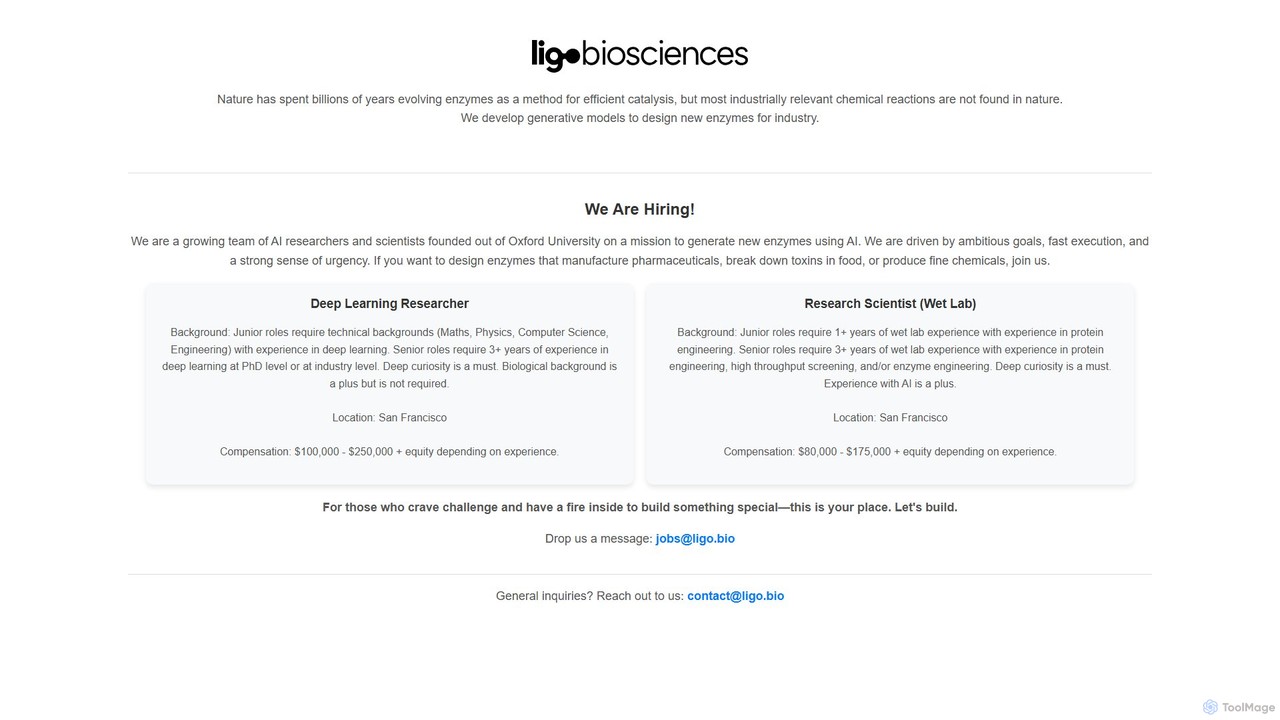
Ligo Biosciences is a research-driven company that leverages generative AI models to design novel enzymes for industrial applications. Originating from Oxford University, they create custom biocatalysts for pharmaceuticals, fine chemical production, and food safety, accelerating innovation beyond the limits of naturally occurring enzymes.

Generative Models
Visits 6.5KFavorites 158Likes 145

About Generative Models

Generative Models are a class of artificial intelligence models designed to learn the underlying patterns and structures of input data to create new, original data that resembles the training set. These powerful models, often leveraging architectures like GANs, VAEs, and Diffusion Models, enable the synthesis of realistic images, text, audio, and even code. As a key component within developer tools, generative models empower engineers and researchers to build innovative applications for content creation, data augmentation, and complex simulations, pushing the boundaries of AI capabilities.

Core Features

  • Data Synthesis: Generates novel data instances (e.g., images, text, audio) that share characteristics with the training data.
  • Pattern Learning: Identifies and encodes complex statistical distributions and relationships within large datasets.
  • Conditional Generation: Creates outputs based on specific input conditions or prompts, allowing for targeted content creation.
  • Feature Extraction: Learns meaningful representations of data, which can be used for downstream tasks like classification or anomaly detection.

Applicable Scenarios

Generative models are crucial for developers in various fields. Game developers use them to create diverse in-game assets like textures and character variations. Researchers apply them for synthetic data generation to augment limited datasets for training other AI models, particularly in sensitive domains like healthcare. Content platforms leverage these models to automatically generate personalized marketing copy or unique visual elements, streamlining creative workflows.

How to Choose

When selecting a generative model or framework, consider the specific data type you intend to generate (e.g., images, text, audio) and the desired output quality. Evaluate the computational resources required for training and inference, as some models are significantly more demanding. Assess the flexibility for fine-tuning and customization to meet unique project requirements, and consider the availability of pre-trained models and community support for faster development cycles.

Generative Models use cases

1

Generating Realistic Product Images

E-commerce businesses use generative models to create diverse product images from limited samples, showcasing items in various settings or styles without expensive photoshoots. This allows online retailers to quickly generate high-quality visuals for their catalogs, marketing campaigns, and social media, significantly reducing costs and time associated with traditional photography while offering customers a richer visual experience.

2

Automated Game Asset Creation

Game developers leverage generative models to rapidly produce variations of textures, character models, or environmental elements, accelerating the design and development process. By inputting basic concepts or parameters, artists can generate numerous unique assets, allowing for quicker iteration and exploration of creative ideas, ultimately enriching game worlds with diverse and consistent visual styles while saving significant manual labor.

3

Synthetic Data for AI Training

Researchers and data scientists employ generative models to create large, diverse synthetic datasets, especially useful when real-world data is scarce, sensitive, or expensive to collect. This synthetic data can be used to train other AI models, improving their robustness and performance without compromising privacy or incurring high acquisition costs, making it invaluable for fields like healthcare, finance, and autonomous driving.

4

Personalized Marketing Content Generation

Marketing teams utilize generative models to automatically generate tailored ad copy, social media posts, or email subject lines based on user preferences and campaign goals, enhancing engagement. By analyzing target audience data, these models can produce highly relevant and engaging content at scale, optimizing conversion rates and freeing up human marketers to focus on strategy rather than repetitive content creation.

5

Drug Discovery and Material Design

Scientists apply generative models to propose novel molecular structures or material compositions with desired properties, significantly speeding up the initial stages of research and development. By exploring vast chemical or material spaces, these models can suggest candidates that meet specific criteria, reducing the need for extensive laboratory experimentation and accelerating the discovery of new drugs, catalysts, or advanced materials.

6

Code Autocompletion and Generation

Developers integrate generative models into IDEs to suggest or even write entire blocks of code based on context and comments, boosting productivity and reducing boilerplate coding. These AI assistants can learn from vast code repositories to offer intelligent suggestions, generate functions, or complete complex statements, allowing developers to focus on higher-level problem-solving and accelerate software development cycles.

Generative Models FAQ

What are Generative Models?

Generative Models are a type of artificial intelligence that learns to create new data instances similar to the data they were trained on. They typically feature the ability to synthesize realistic content, learn complex data distributions, and often operate without explicit programming for each output. Common use cases include generating images, text, audio, and synthetic datasets for various applications.

How do Generative Models differ from Discriminative Models?

Generative Models focus on learning the distribution of data to generate new samples, answering "how is this data created?". Discriminative Models, conversely, learn to distinguish between different classes of data, answering "what is this data?". For example, a generative model can create a new cat image, while a discriminative model can tell if an image contains a cat or a dog. Generative models are often more complex but offer broader application potential beyond classification.

What are the main types of Generative Models?

The main types of Generative Models include Generative Adversarial Networks (GANs), Variational Autoencoders (VAEs), and Diffusion Models. GANs use a generator and a discriminator network in a competitive process. VAEs learn a compressed representation of data and then decode it to generate new samples. Diffusion Models progressively add noise to data and then learn to reverse this process to generate clear samples. Each type has unique strengths in terms of output quality, training stability, and computational requirements.

Who benefits most from using Generative Models?

Generative Models primarily benefit developers, researchers, and content creators. Developers use them to build AI applications that require new content generation or data augmentation. Researchers leverage them for scientific discovery, synthetic data creation, and exploring complex data distributions. Content creators, including artists, writers, and marketers, utilize these models to accelerate creative workflows, generate diverse content variations, and personalize outputs at scale.

How do Generative Models fit into the "Developer Tools" category?

Generative Models are a specialized subset within the "Developer Tools" category because they provide the core algorithms and frameworks that developers use to build advanced AI applications. Developers integrate these models into their software, train them with specific datasets, and deploy them to power features like automated content generation, intelligent design, or data simulation. They are fundamental building blocks for creating innovative AI-driven solutions.