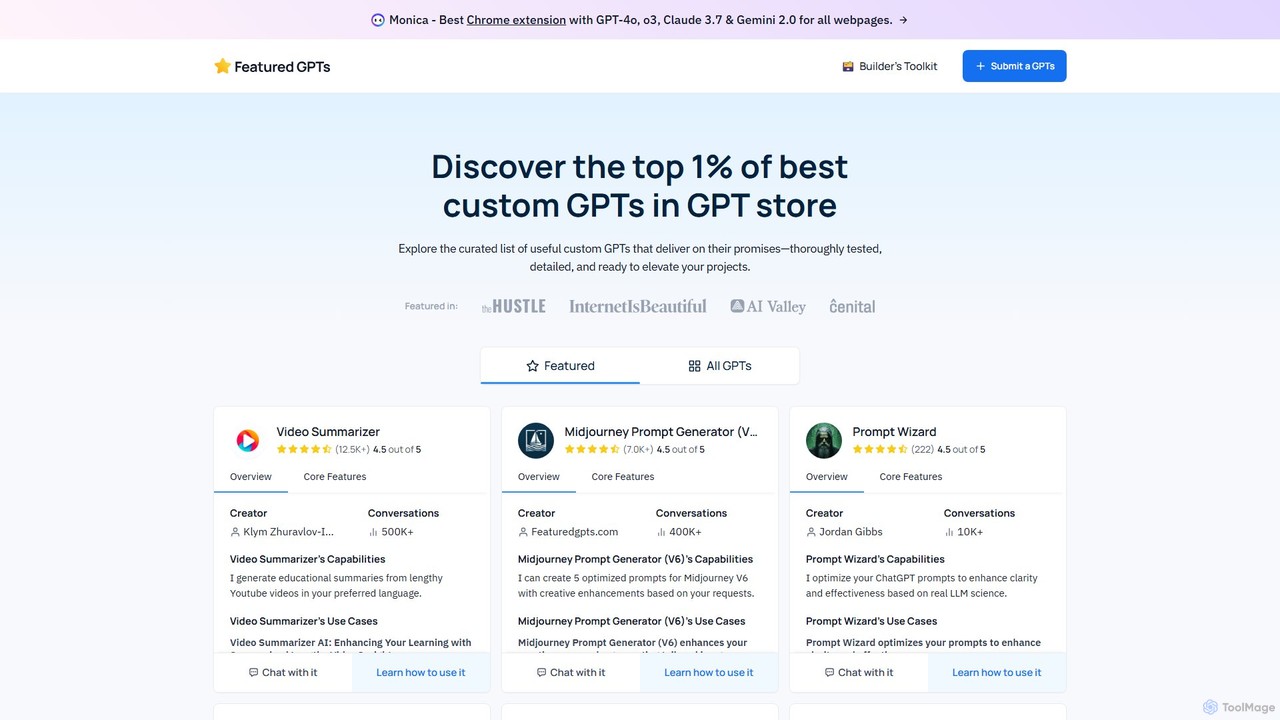
GPT Builders are AI-powered platforms that enable users to create customized versions of large language models (LLMs), such as OpenAI's GPTs, for specific applications. These tools abstract away complex coding, offering intuitive interfaces to define behaviors, integrate custom knowledge bases, and set interaction styles. They empower individuals and businesses to deploy tailored AI assistants, chatbots, or content generators that precisely meet their unique operational needs.
Core Features
- No-Code/Low-Code Interface: Provides visual editors and drag-and-drop functionalities for easy customization without programming expertise.
- Knowledge Base Integration: Allows uploading proprietary documents, databases, or web content for the custom GPT to reference and learn from.
- Action & API Integration: Enables connecting custom GPTs with external services and APIs to perform real-world tasks and automate workflows.
- Behavior & Persona Definition: Users can define the GPT's tone, style, and specific instructions to ensure consistent and targeted interactions.
- Testing & Iteration Environment: Offers dedicated tools to test, refine, and iterate on the custom GPT's performance before final deployment.
Use Cases
From automating customer support to generating specialized content, GPT Builders are utilized across various sectors. They allow marketing teams to create brand-specific content generators, educators to build interactive learning assistants, and small businesses to develop internal knowledge retrieval systems, significantly enhancing productivity and personalization.
How to Choose
When selecting a GPT Builder, consider the platform's ease of use, the depth of customization options (e.g., knowledge base size, API integrations), the cost structure, and the community support. Evaluate its compatibility with existing workflows and the security features for handling sensitive data, ensuring it aligns with your technical comfort level and specific project requirements.