Is This Image NSFW?
A free, AI-powered web tool that instantly checks if an image is Not Safe For Work (NSFW). Based …
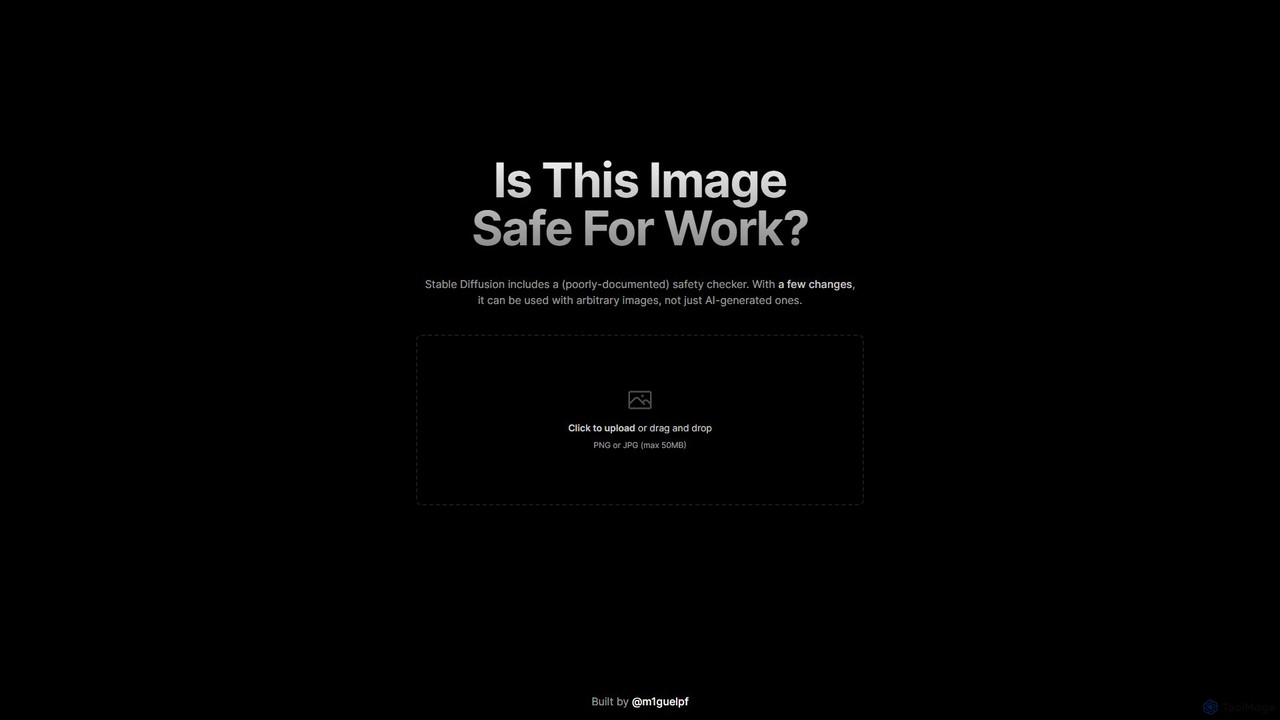
A free, AI-powered web tool that instantly checks if an image is Not Safe For Work (NSFW). Based on the Stable Diffusion safety checker, it allows users to upload any PNG or JPG image via a simple drag-and-drop interface to ensure content appropriateness for professional or public settings.
About Image Analysis
Image Analysis tools are AI-powered solutions designed to automatically extract meaningful information, patterns, and insights from visual data. Leveraging advanced computer vision and machine learning algorithms, these tools can interpret images and videos to identify objects, recognize faces, detect anomalies, and classify content. They provide developers and businesses with the capability to automate visual inspection, enhance security, and gain actionable intelligence from vast amounts of imagery, streamlining complex visual processing tasks.
Core Features
- Object Detection & Recognition: Automatically identifies and locates specific objects within images or video frames.
- Image Classification: Categorizes images into predefined classes based on their content.
- Semantic Segmentation: Labels each pixel in an image with a class, providing detailed understanding of image composition.
- Facial Recognition & Analysis: Detects and identifies human faces, often including emotion or attribute analysis.
- Anomaly Detection: Identifies unusual patterns or outliers in visual data that deviate from normal behavior.
Use Cases
Image Analysis tools are crucial for developers building intelligent applications across various sectors. They enable automated quality control in manufacturing by detecting defects, power advanced security systems through facial recognition, and facilitate detailed environmental monitoring from satellite imagery. These tools are also vital for medical imaging analysis, assisting in the early detection of diseases by highlighting abnormalities in scans.
How to Choose
When selecting an Image Analysis tool, consider the specific task requirements, such as the type of objects to detect or the complexity of classification. Evaluate the accuracy and robustness of the underlying AI models, especially in diverse conditions. Assess integration capabilities with existing development environments and data pipelines. Finally, review scalability options, processing speed, and the cost model to ensure it aligns with project scope and budget.

Image AnalysisUse Cases
Automated Quality Control in Manufacturing
Manufacturing engineers can deploy image analysis tools on production lines to automatically inspect products for defects, such as scratches, misalignments, or missing components. By continuously analyzing images captured from cameras, the AI can identify anomalies in real-time, triggering alerts or rejecting faulty items. This significantly reduces manual inspection time, improves product consistency, and lowers operational costs by catching defects early in the production process.
Medical Image Diagnosis Assistance
Radiologists and medical professionals utilize image analysis tools to assist in the diagnosis of diseases. These tools can analyze X-rays, MRIs, and CT scans to highlight subtle anomalies, tumors, or other pathological indicators that might be difficult for the human eye to detect. By providing quantitative measurements and visual cues, AI-powered image analysis enhances diagnostic accuracy, speeds up the interpretation process, and supports earlier intervention for patients.
Retail Shelf Monitoring and Inventory Management
Retailers can leverage image analysis to monitor product placement and inventory levels on store shelves. Cameras capture real-time images, which AI then processes to identify out-of-stock items, misplaced products, or incorrect pricing labels. This automation helps store managers ensure planogram compliance, optimize stock replenishment, and improve the overall shopping experience by keeping shelves well-stocked and organized, leading to increased sales and operational efficiency.
Security and Surveillance Anomaly Detection
Security professionals deploy image analysis tools in surveillance systems to enhance monitoring capabilities. These tools can analyze video feeds from CCTV cameras to detect unusual activities, such as unauthorized access, suspicious packages, or crowd disturbances, in real-time. By automatically flagging potential threats, AI reduces the need for constant human vigilance, improves response times to security incidents, and provides valuable forensic evidence for investigations.
Agricultural Crop Health Monitoring
Farmers and agronomists use image analysis tools with drone or satellite imagery to monitor crop health across large fields. AI models can detect early signs of plant diseases, pest infestations, or nutrient deficiencies by analyzing changes in leaf color, texture, or growth patterns. This enables precision agriculture, allowing targeted intervention with pesticides or fertilizers, reducing waste, improving crop yields, and ensuring sustainable farming practices.
Autonomous Vehicle Perception and Navigation
Developers in the autonomous driving sector rely heavily on image analysis tools for vehicle perception and navigation. These tools process real-time camera feeds to perform object detection (cars, pedestrians, traffic signs), lane keeping assistance, and obstacle avoidance. By accurately interpreting the surrounding environment, AI-powered image analysis enables self-driving cars to make informed decisions, ensuring safety and efficiency on the road, and advancing the future of transportation.