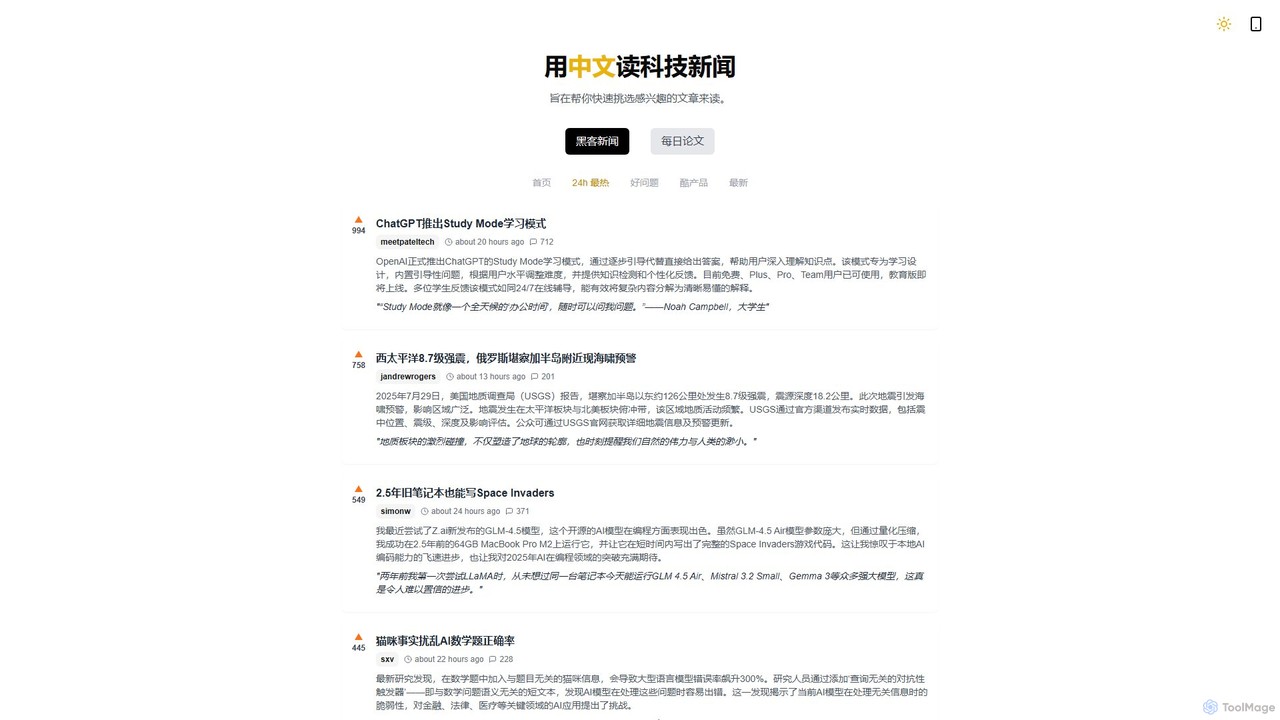
Zeli
Zeli is an AI-powered platform that translates and summarizes top tech news from Hacker News and academic papers …
Zeli is an AI-powered platform that translates and summarizes top tech news from Hacker News and academic papers into Chinese. It helps Chinese-speaking tech enthusiasts, developers, and researchers stay updated with the latest global trends and discussions without language barriers, providing curated content and concise summaries.
About Information
Information tools are AI-powered solutions designed to help developers efficiently access, process, and synthesize vast amounts of data and knowledge. These tools leverage advanced natural language processing, machine learning, and intelligent search algorithms to transform raw, unstructured data into actionable insights. They streamline critical development tasks like code comprehension, automated documentation analysis, and proactive system monitoring, enabling developers to make faster, more informed decisions throughout the software development lifecycle and enhance overall productivity.
Core Features
- Intelligent Code Search: Understands code context and intent, providing relevant code snippets and examples beyond simple keyword matching.
- Automated Documentation Analysis: Summarizes complex technical documents, extracts key information, and answers specific questions from large knowledge bases.
- Log and Data Pattern Recognition: Uses AI to identify anomalies, trends, and critical events within system logs, metrics, and operational data.
- Knowledge Graph Generation: Automatically builds structured knowledge representations from unstructured text, linking related concepts and entities for better understanding.
- Semantic Information Retrieval: Goes beyond keywords to understand the meaning and context of queries, delivering more precise and relevant results from diverse data sources.
Applicable Scenarios
Developers often struggle with navigating large codebases, understanding complex system behaviors, or finding specific information scattered across various documentation sources. AI-powered Information tools are crucial for accelerating onboarding, debugging, and feature development by providing intelligent, context-aware access to critical project and system information.
How to Choose
When selecting AI-powered Information tools, consider the specific types of data you need to process (e.g., code, logs, text), the accuracy and relevance of its AI models, and its integration capabilities with existing developer workflows (IDEs, CI/CD). Evaluate its natural language understanding capabilities, scalability with your data volume, and the ease of customizing its knowledge base for your specific needs.

InformationUse Cases
Accelerating Codebase Onboarding
New developers use AI information tools to quickly understand large, unfamiliar codebases by querying the code semantically, identifying key functions, and understanding dependencies. This reduces ramp-up time significantly, allowing them to contribute effectively much sooner than with manual exploration.
Intelligent Debugging and Troubleshooting
Developers leverage AI to analyze error logs, system metrics, and incident reports, automatically identifying root causes, suggesting fixes, or pointing to relevant documentation and past solutions. This speeds up problem resolution, minimizing downtime and improving system reliability.
Automating API Documentation Q&A
Development teams deploy AI tools that can answer complex questions about internal APIs and services based on their documentation, reducing the need for direct human support and improving developer self-service. This frees up senior developers to focus on more complex tasks.
Extracting Requirements from Unstructured Data
Product managers and developers use AI to parse user feedback, support tickets, and market research documents, automatically extracting feature requests, pain points, and sentiment to inform product development. This ensures that product roadmaps are data-driven and aligned with user needs.
Maintaining Up-to-Date Internal Knowledge Bases
Teams utilize AI to continuously scan and update internal wikis, design documents, and technical specifications, ensuring that all team members have access to the most current and relevant information without manual curation. This reduces information silos and ensures consistency across projects.
Semantic Search for Technical Resources
Engineers employ AI-powered search engines to find highly specific technical articles, research papers, or open-source projects across the internet or internal repositories, understanding the intent behind their queries rather than just keywords. This significantly improves the relevance and speed of information discovery for complex technical challenges.