ToolMage
Sign in

Best 1 Libraries & Sdks AI tools for Developer Tools

Popular Libraries & Sdks AI tools in Developer Tools include AI SDK, helping you work more efficiently.

AI SDK
Free

AI SDK

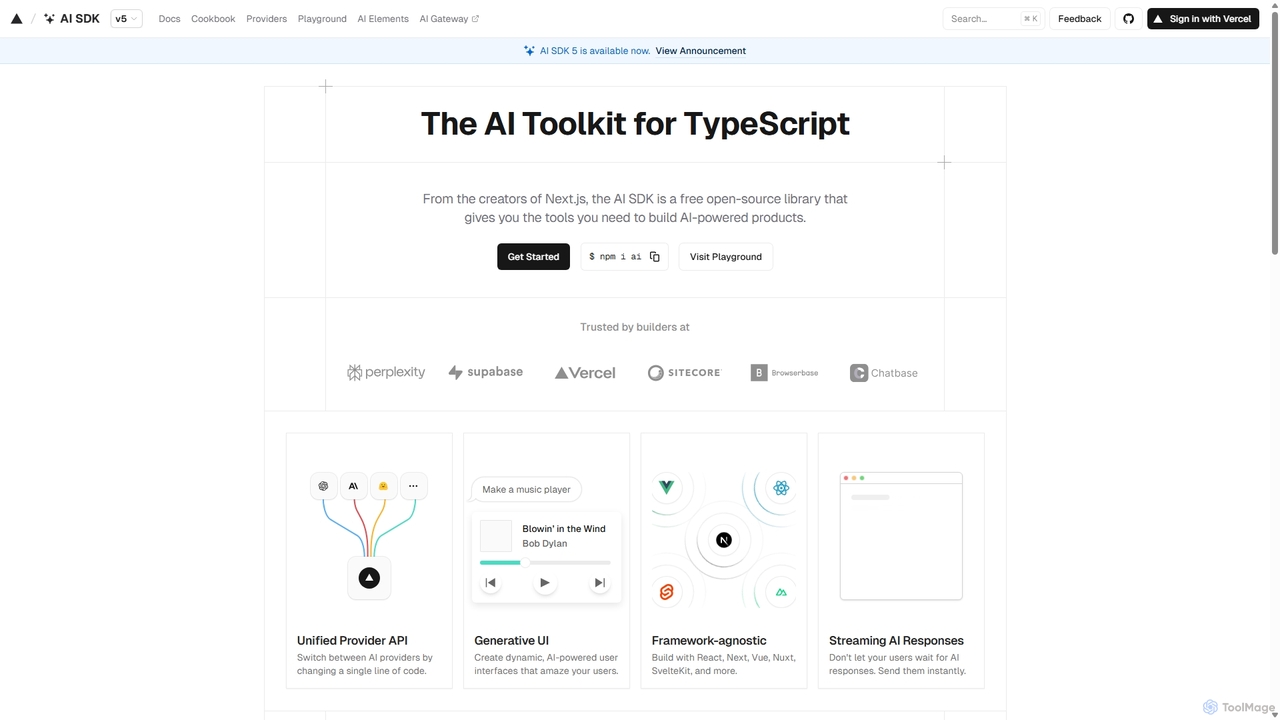
AI SDK by Vercel is a free, open-source TypeScript toolkit designed to help developers build AI-powered applications. It provides a unified API to seamlessly integrate with various large language models like OpenAI, Anthropic, and Google Gemini. The SDK is framework-agnostic, supporting React, Next.js, Vue, Svelte, and more, enabling the creation of features like streaming responses and generative UIs with minimal effort.

Model Integration
Visits 7.2KFavorites 137Likes 160

About Libraries & Sdks

Libraries & SDKs are essential pre-built code packages and development kits designed to streamline the integration of artificial intelligence functionalities into software applications. As a core component of developer tools, they encapsulate complex AI models, algorithms, and data processing routines into accessible APIs, abstracting away intricate technical details. These tools empower developers to rapidly build and deploy AI-powered features, significantly reducing development time and effort across various projects.

Core Features

  • Pre-trained Models: Access to ready-to-use AI models for common tasks like image recognition, natural language understanding, or speech synthesis, reducing the need for extensive training.
  • API Access: Simplified interfaces for interacting with AI services, enabling easy data input, model inference, and result retrieval without deep AI expertise.
  • Development Tools: Often includes debuggers, emulators, and comprehensive documentation to assist in the development, testing, and optimization process.
  • Performance Optimization: Engineered for efficient execution of AI workloads, frequently optimized for specific hardware, cloud environments, or edge devices.
  • Cross-platform Compatibility: Support for various operating systems (e.g., Windows, Linux, macOS, Android, iOS) and programming languages (e.g., Python, Java, C++), enhancing flexibility.

Applicable Scenarios

Developers leverage AI libraries and SDKs in diverse contexts, from integrating intelligent search into web applications to embedding real-time object detection in mobile apps. They are crucial for startups building innovative AI products, enterprises enhancing existing software with smart features like predictive analytics, and researchers prototyping new AI concepts without starting from scratch. These tools enable rapid iteration and deployment of AI capabilities across industries.

How to Choose

Selecting the right AI library or SDK involves evaluating several factors: the specific AI task (e.g., NLP, computer vision, machine learning inference), compatibility with your existing tech stack and programming language, the availability of pre-trained models, performance requirements for your application, and the quality of documentation and community support. Consider licensing terms, scalability for future growth, and ease of integration into your development workflow.

Libraries & Sdks use cases

1

Integrating Natural Language Processing (NLP)

A software developer integrates an NLP SDK into a customer support platform to automatically analyze incoming customer queries. By leveraging pre-trained models for sentiment analysis and topic extraction, the system can quickly categorize issues, route them to the appropriate department, and even suggest automated responses, significantly reducing response times and improving customer satisfaction.

2

Implementing Computer Vision (CV) for Quality Control

A manufacturing engineer uses a Computer Vision library to develop an automated quality control system on an assembly line. The library's image recognition capabilities allow the system to detect defects in products in real-time, such as misaligned components or surface imperfections, ensuring consistent product quality and reducing manual inspection errors by up to 90%.

3

Accelerating Machine Learning Model Deployment

A data scientist utilizes an ML SDK to streamline the deployment of a custom-trained predictive analytics model into a production environment. The SDK handles model serialization, versioning, and API endpoint creation, allowing the data scientist to deploy the model in minutes rather than hours, making it accessible for real-time inference in business intelligence dashboards.

4

Building Voice Assistants and Speech Recognition

A mobile app developer integrates a speech-to-text and text-to-speech SDK into a new productivity application. This enables users to interact with the app using voice commands, dictate notes, and receive spoken feedback, enhancing accessibility and user experience. The SDK handles complex audio processing and language model inference, simplifying the development of robust voice features.

5

Developing AI-powered Search Engines

A web platform team uses an AI search library to enhance the relevance and context-awareness of their internal document search engine. By integrating features like semantic search and personalized ranking, the library helps users find information more efficiently, reducing search time by 30% and improving overall knowledge management within the organization.

6

Enhancing Data Analytics with AI

A business analyst integrates an AI library for anomaly detection into their data analytics pipeline. This allows the system to automatically flag unusual patterns in sales data, customer behavior, or operational metrics that might indicate fraud, system errors, or emerging market trends, providing proactive insights and preventing potential losses.

Libraries & Sdks FAQ

What are AI Libraries & SDKs?

AI Libraries & SDKs are collections of pre-written code, tools, and documentation that simplify the process of integrating artificial intelligence functionalities into software applications. They provide ready-to-use components for common AI tasks like natural language processing, computer vision, or machine learning inference, abstracting away the underlying complexity of AI models and algorithms. This allows developers to add sophisticated AI capabilities without building them from scratch.

Why should developers use AI Libraries & SDKs?

Developers should use AI Libraries & SDKs primarily for efficiency and speed. They significantly reduce development time by providing pre-built, optimized components, allowing developers to focus on core application logic rather than intricate AI model development. These tools also lower the technical barrier to entry for AI, enabling a broader range of developers to integrate advanced functionalities. Furthermore, they often come with robust documentation and community support, ensuring reliability and easier troubleshooting.

What types of AI functionalities can be integrated using Libraries & SDKs?

AI Libraries & SDKs enable the integration of a wide array of AI functionalities. These include Natural Language Processing (NLP) for tasks like sentiment analysis, text summarization, and chatbot development; Computer Vision (CV) for object detection, facial recognition, and image classification; Machine Learning (ML) inference for predictive analytics and recommendation systems; and Speech AI for speech-to-text, text-to-speech, and voice assistant capabilities. They also support specialized areas like anomaly detection, fraud prevention, and content generation.

How to choose the right AI Library or SDK for a project?

Choosing the right AI Library or SDK involves several considerations. First, identify the specific AI task you need to accomplish (e.g., image classification, text generation). Second, check compatibility with your existing programming language and tech stack. Third, evaluate the availability and quality of pre-trained models, as well as the performance and scalability for your application's needs. Finally, assess the quality of documentation, community support, and licensing terms to ensure long-term viability and ease of maintenance.

What is the difference between an AI Library/SDK and an AI Framework?

The primary difference lies in their scope and level of abstraction. An AI Library/SDK provides ready-to-use components and APIs for specific AI tasks, focusing on integrating pre-built AI capabilities into applications. They abstract away much of the underlying complexity. An AI Framework (like TensorFlow or PyTorch), on the other hand, offers a comprehensive set of tools and functionalities for building, training, and deploying AI models from scratch. Frameworks provide more control and flexibility for custom model development, while libraries/SDKs prioritize ease of integration and rapid deployment of existing AI solutions.