LlamaIndex
LlamaIndex is a leading data framework for developers building LLM-powered applications. It specializes in connecting large language models …
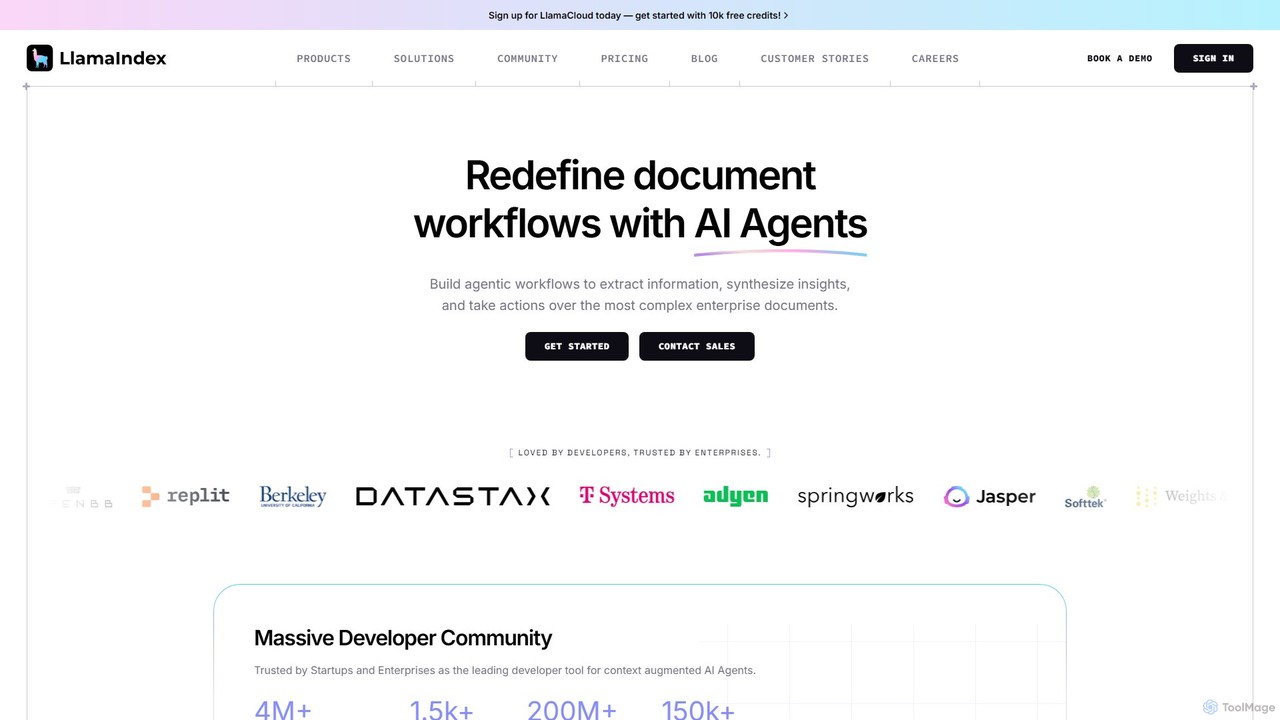
LlamaIndex is a leading data framework for developers building LLM-powered applications. It specializes in connecting large language models to private or domain-specific data sources, enabling the creation of powerful Retrieval-Augmented Generation (RAG) systems, knowledge assistants, and autonomous AI agents. It simplifies data ingestion, indexing, and querying for enterprise-grade solutions.
About Llm Frameworks
LLM Frameworks are specialized software libraries and tools designed to streamline the development, deployment, and management of applications powered by Large Language Models (LLMs). These frameworks abstract away complex tasks like prompt engineering, model integration, data retrieval, and agent orchestration, enabling developers to build sophisticated AI applications more efficiently. They provide structured approaches to interact with LLMs, manage conversational flows, and integrate external data sources, significantly accelerating the creation of intelligent systems.
Core Features
- Prompt Management: Tools for creating, testing, and versioning prompts to optimize LLM outputs.
- Retrieval Augmented Generation (RAG): Mechanisms to integrate external knowledge bases, allowing LLMs to access and synthesize up-to-date, domain-specific information.
- Agentic Workflows: Capabilities to design and orchestrate autonomous agents that can perform multi-step tasks using LLMs and external tools.
- Tool Integration: Seamless connection with external APIs, databases, and services to extend LLM functionality.
- Observability & Evaluation: Features for monitoring LLM interactions, debugging, and evaluating model performance and output quality.
Applicable Scenarios
Developers and data scientists leverage LLM frameworks to build advanced AI applications across various domains. This includes creating intelligent chatbots for customer service, developing sophisticated data analysis tools that summarize complex reports, and automating content generation pipelines for marketing teams. They are crucial for projects requiring robust, scalable, and maintainable LLM-powered solutions.
How to Choose
When choosing an LLM framework, consider its flexibility and extensibility for custom logic, the breadth of its integration ecosystem with different LLMs and tools, and its support for advanced features like RAG and agentic capabilities. Evaluate the community support and documentation quality, as well as the framework's performance characteristics and deployment options for your specific infrastructure needs.

Llm FrameworksUse Cases
Building Advanced Conversational AI Agents
A software development team uses an LLM framework to create a sophisticated customer support agent. The framework helps manage complex conversational flows, integrate with CRM systems to fetch user history, and utilize RAG to provide accurate answers from a product knowledge base, significantly reducing human agent workload and improving response times.
Automating Data Analysis and Reporting
A data scientist employs an LLM framework to automate the summarization and analysis of large datasets and research papers. The framework orchestrates calls to an LLM, extracts key insights, generates executive summaries, and even drafts initial reports, transforming raw data into actionable intelligence much faster than manual processes.
Developing Intelligent Content Generation Pipelines
A marketing agency leverages an LLM framework to build a dynamic content generation system. The framework allows them to define content templates, integrate with image generation tools, and manage prompt variations to produce high-quality blog posts, social media updates, and ad copy at scale, tailored to different campaigns and audiences.
Creating Personalized Learning Assistants
An educational technology company uses an LLM framework to develop an adaptive learning assistant. The framework enables the assistant to understand student queries, retrieve relevant educational content from a vast curriculum database (RAG), and provide personalized explanations and exercises, enhancing the learning experience.
Orchestrating Complex Business Workflows with LLMs
An enterprise solution architect utilizes an LLM framework to integrate LLM capabilities into existing business process automation. For example, the framework can manage a multi-step process where an LLM analyzes incoming emails, extracts key information, triggers actions in an ERP system, and drafts follow-up communications, streamlining operations.
Rapid Prototyping and Experimentation with LLMs
An AI researcher or developer uses an LLM framework for quick prototyping and experimentation with different LLMs, prompt strategies, and integration patterns. The framework's modular design and built-in tools allow for rapid iteration, testing various configurations, and evaluating performance without extensive boilerplate code, accelerating innovation.