Keywords AI
Keywords AI is a comprehensive LLM observability and monitoring platform designed for AI startups and developers. It provides …
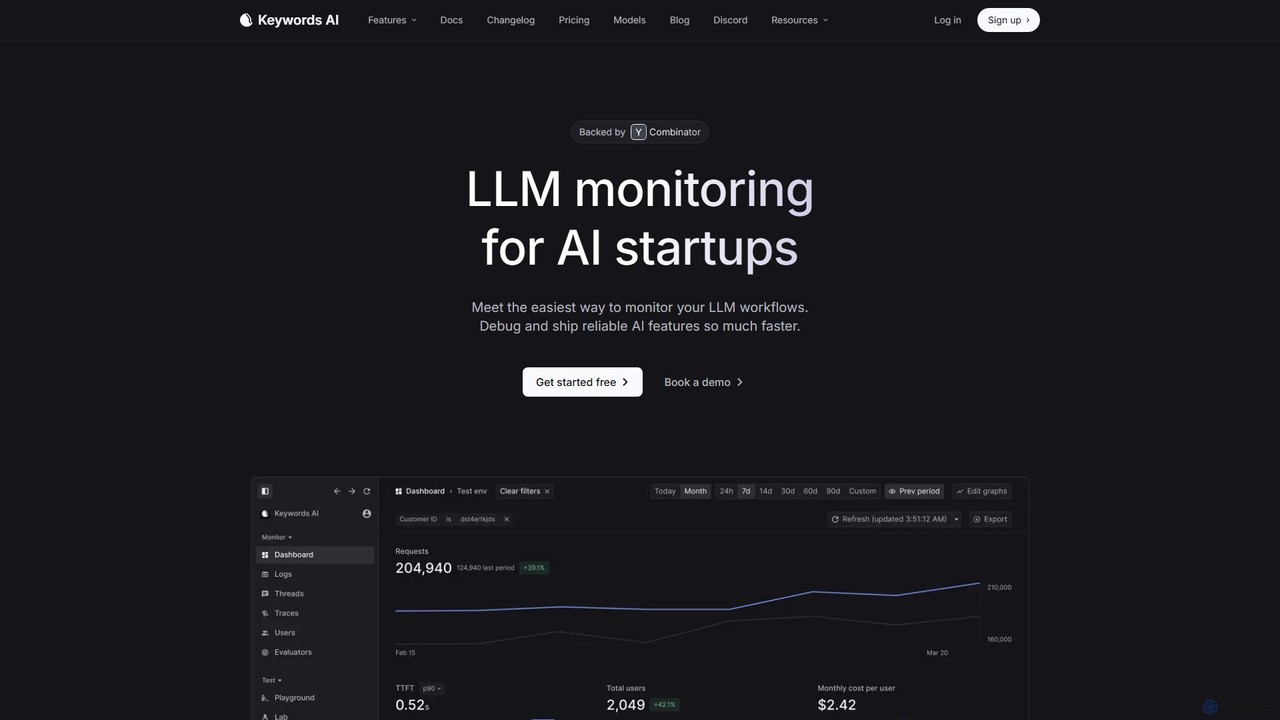
Keywords AI is a comprehensive LLM observability and monitoring platform designed for AI startups and developers. It provides a unified API to deploy, test, monitor, and optimize LLM workflows, supporting over 200 models with a simple, two-line integration to help teams build and ship reliable AI features faster.
About Llm Observability
LLM Observability tools are a specialized category of developer tools designed to monitor, analyze, and debug applications built on Large Language Models (LLMs). They provide deep insights into the entire lifecycle of an LLM request, from user input and prompt engineering to model processing and final output. This visibility is crucial for identifying performance bottlenecks, tracking operational costs, evaluating model accuracy, and ensuring responsible AI deployment. Unlike traditional application monitoring, these tools are tailored to the unique challenges of LLMs, such as tracking token usage, analyzing prompt-response pairs, and detecting hallucinations.
Core Features
- Request Tracing: Trace the complete journey of each LLM call, including prompts, intermediate steps, and final responses.
- Performance Monitoring: Track key metrics like latency, throughput, and token usage to optimize speed and efficiency.
- Cost Management: Monitor and attribute API costs from providers like OpenAI or Anthropic to specific features or users.
- Prompt & Response Analysis: Log, search, and analyze prompt-response pairs to debug issues, improve prompts, and evaluate model quality.
- Error & Anomaly Detection: Automatically identify and alert on issues such as API errors, high latency, or unexpected model behavior.
Use Cases
These tools are essential for engineering and product teams deploying LLM-powered applications in production. They are widely used in developing AI-driven customer support chatbots, content generation platforms, and complex data analysis systems where reliability, cost-effectiveness, and model performance are critical.
How to Choose
When selecting an LLM Observability tool, consider its integration capabilities with your specific LLM providers and frameworks. Evaluate the depth of its tracing and analytics features, its ability to track costs accurately, and its support for custom metrics and alerts. Also, assess the user interface for ease of debugging and the overall pricing model based on your expected data volume.

Llm ObservabilityUse Cases
Debugging Production LLM Application Failures
An AI engineer notices a spike in user complaints about a customer service chatbot providing irrelevant answers. Using an LLM observability platform, they filter for failed or low-rated conversations. The trace view reveals that a recent change to the system prompt is causing the model to misinterpret user intent. The engineer can quickly identify the problematic prompt version, revert the change, and resolve the issue without sifting through thousands of raw logs, reducing downtime significantly.
Optimizing LLM API Costs
A startup is building a feature that summarizes articles using GPT-4 and notices their monthly OpenAI bill is unexpectedly high. By integrating an LLM observability tool, the teams can visualize cost breakdowns by feature, user, and prompt templates. They discover that the summarization prompt is consuming excessive tokens. They use the platform's analytics to experiment with more efficient prompts, ultimately reducing the average token count per summary by 40% and controlling their operational expenses.
Evaluating and Comparing Prompt Performance
A product manager wants to improve the quality of an AI-powered content generation tool. The team uses an observability platform to run an A/B test on two different prompt variations. The platform automatically collects and tags all prompt-response pairs for each variation. The team can then analyze user feedback scores, response latency, and token usage side-by-side to quantitatively determine which prompt produces higher-quality results more efficiently, enabling data-driven decisions for prompt engineering.
Monitoring for AI Safety and Toxicity
A company deploying a public-facing AI assistant needs to ensure its responses are safe and non-toxic. They configure their LLM observability tool with custom monitors that scan model outputs for harmful language, bias, or personally identifiable information (PII). When a problematic response is detected, the system automatically flags it and sends an alert to the AI safety team for review. This proactive monitoring helps maintain brand reputation and comply with responsible AI guidelines.
Improving Latency in Chained LLM Calls
A developer is building a complex agent that involves multiple sequential calls to an LLM (a 'chain'). Users report that the agent is slow to respond. The developer uses the observability tool's trace visualization, which shows a waterfall diagram of the entire chain. They immediately identify that one specific step in the chain has unusually high latency. By focusing their optimization efforts on that single bottleneck, they successfully reduce the agent's overall response time by 50%.
Creating Datasets for Model Fine-Tuning
An ML team wants to fine-tune a base model for a specific medical Q&A task. Instead of manually creating a dataset, they use an LLM observability tool to collect high-quality prompt-response pairs from their production application. They can filter for interactions that received positive user feedback, manually review them for accuracy within the platform, and then export this curated data in the required format for fine-tuning. This process accelerates the creation of a high-quality training dataset.