
Developer Tools Best in category 1 results Machine Learning Libraries AI Tool

Popular AI tools in the Machine Learning Libraries field of Developer Tools include Cleora, etc., helping you quickly improve efficiency.

Free
Cleora

Cleora

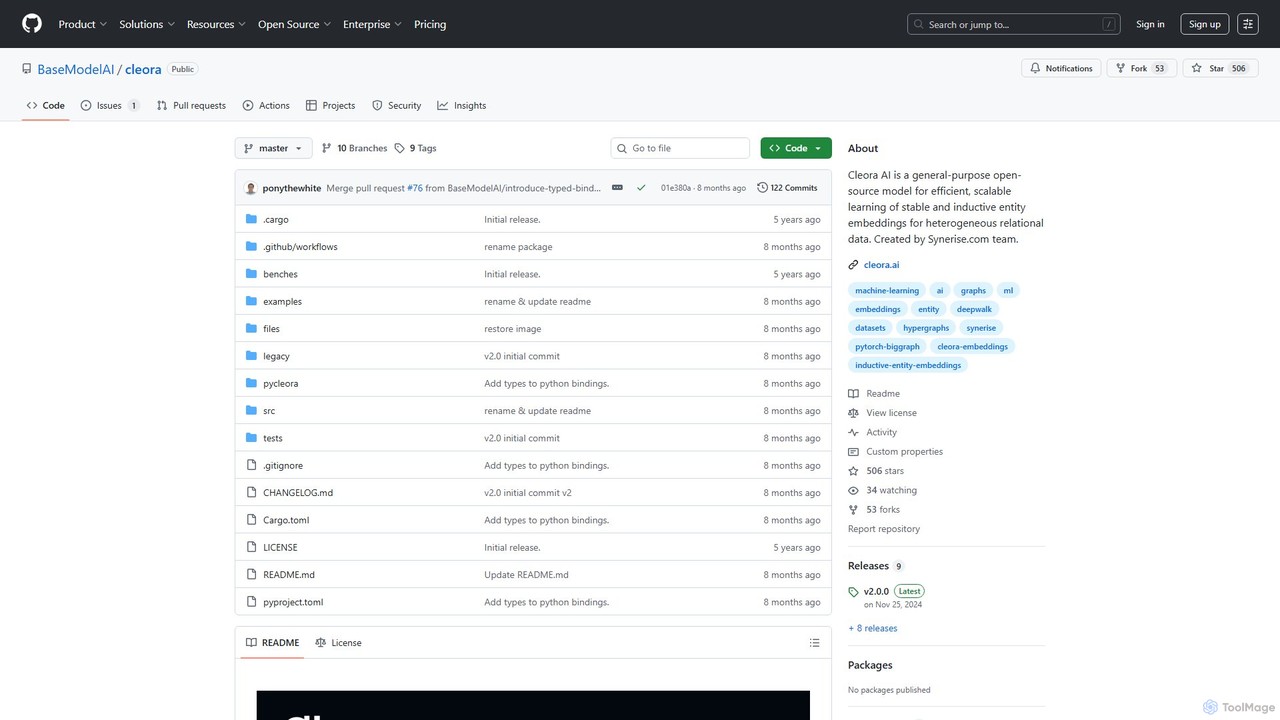
Cleora is an open-source, high-performance model for creating stable and inductive entity embeddings from large-scale, heterogeneous relational data …

52.3K

About Machine Learning Libraries

Machine Learning Libraries are specialized collections of pre-written code, algorithms, and tools designed to simplify and accelerate the development of machine learning models. As a crucial component within Developer Tools, these libraries abstract complex mathematical operations, providing high-level APIs that enable data scientists and developers to efficiently build, train, and deploy AI-powered applications. They empower users to focus on data and model architecture rather than low-level implementation details, significantly speeding up the machine learning workflow.

Core Features

  • Algorithm Implementations: Pre-built algorithms for classification, regression, clustering, and more, ready for immediate use.
  • Data Preprocessing Tools: Functions for cleaning, transforming, and preparing raw data for model training.
  • Model Evaluation Metrics: Standardized metrics and tools to assess model performance and identify areas for improvement.
  • Deep Learning Frameworks: Specialized modules for building and training neural networks, including convolutional and recurrent architectures.
  • Model Persistence: Capabilities to save and load trained models for future use or deployment.

Applicable Scenarios

Machine Learning Libraries are indispensable across various domains. Data scientists leverage them for predictive analytics in finance and healthcare, while software engineers integrate them into applications for recommendation systems or natural language processing. Researchers also use these libraries for rapid prototyping and experimentation with new AI models.

How to Choose

Selecting the right Machine Learning Library involves considering several factors: the specific type of ML task (e.g., deep learning, traditional ML), the required programming language, community support and documentation, performance needs, and ease of integration with existing systems. Evaluate the library's API design and scalability for your project's future growth.

Machine Learning LibrariesUse Cases

1

Building Predictive Analytics Systems

Data scientists utilize machine learning libraries to develop robust predictive models for various business needs. For instance, in finance, they can build models to forecast stock prices or detect fraudulent transactions by training algorithms on historical data, enabling proactive decision-making and risk mitigation.

2

Developing Recommendation Engines

E-commerce platforms and streaming services employ ML libraries to create personalized recommendation engines. Developers train collaborative filtering or content-based models on user behavior and item attributes to suggest relevant products, movies, or music, significantly enhancing user engagement and sales.

3

Implementing Natural Language Processing (NLP) Solutions

AI engineers and linguists use libraries to build sophisticated NLP applications. This includes developing sentiment analysis tools for customer feedback, chatbots for automated support, or text summarization systems, allowing businesses to process and understand vast amounts of textual data efficiently.

4

Training Computer Vision Models

Researchers and developers in fields like autonomous driving or medical imaging leverage deep learning libraries to train computer vision models. They can build object detection systems for identifying vehicles on roads or image classification models for diagnosing diseases from scans, pushing the boundaries of visual AI.

5

Automating Data Preprocessing Workflows

Data engineers and analysts frequently use ML libraries to automate complex data cleaning, transformation, and feature engineering tasks. This streamlines the preparation of raw datasets for model training, ensuring data quality and consistency, which is critical for accurate machine learning outcomes.

6

Rapid Prototyping and Research

Machine learning researchers and academics rely on these libraries for quickly prototyping and experimenting with new algorithms and model architectures. The high-level APIs and extensive functionalities allow for fast iteration and testing of hypotheses, accelerating innovation in the AI domain.

Machine Learning LibrariesFrequently Asked Questions