Trainloop AI
Trainloop AI is an end-to-end platform that simplifies the fine-tuning of AI reasoning models using advanced Reinforcement Learning …
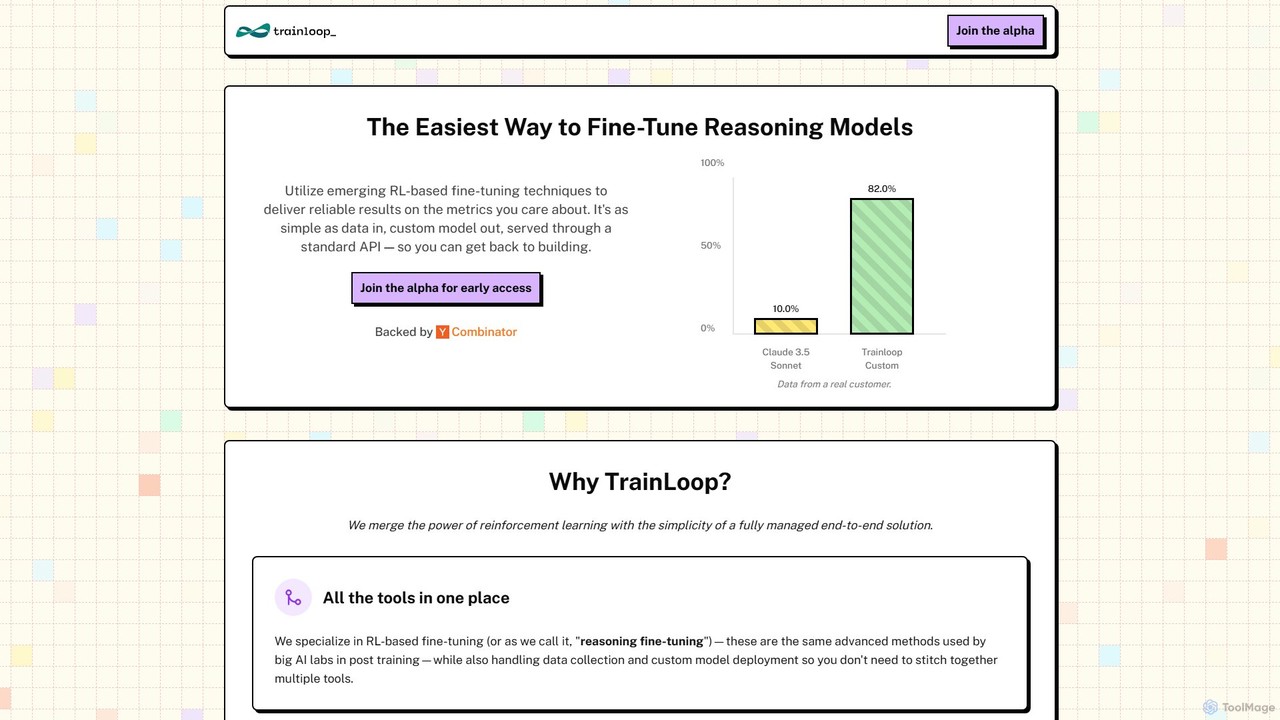
Trainloop AI is an end-to-end platform that simplifies the fine-tuning of AI reasoning models using advanced Reinforcement Learning (RL) techniques. It provides a complete solution from data collection to model deployment, enabling developers to build reliable, domain-expert AI models with less data and without complex prompt engineering.
About Model Fine Tuning
Model Fine Tuning is a specialized process within AI development that adapts a pre-trained artificial intelligence model to perform specific tasks with higher accuracy and relevance. This technique leverages the foundational knowledge of a large, general model and refines it using a smaller, task-specific dataset. As a crucial component of developer tools, model fine tuning enables engineers and data scientists to customize powerful AI capabilities for niche applications without the need for extensive computational resources or vast amounts of training data from scratch.
Core Features
- Transfer Learning: Utilizes knowledge from a pre-trained model on a large dataset to accelerate training on a new, related task.
- Domain Adaptation: Adjusts model parameters to perform optimally on data from a specific domain, improving relevance and accuracy.
- Hyperparameter Optimization: Allows for tuning of learning rates, batch sizes, and other parameters to achieve peak performance for the target task.
- Performance Evaluation: Provides metrics and tools to assess the fine-tuned model's effectiveness on validation datasets.
- Efficient Resource Utilization: Significantly reduces the computational cost and time compared to training a model from zero.
Use Cases
Model fine tuning is widely adopted by AI engineers and product developers to tailor generic AI models for specialized business needs. It's essential for creating highly accurate and context-aware AI solutions in various industries, from healthcare to finance, by adapting models to specific data characteristics and operational requirements.
How to Choose
When selecting model fine tuning tools, consider the supported model architectures (e.g., LLMs, vision models), the ease of data preparation and annotation, the flexibility of hyperparameter tuning, and integration with existing MLOps pipelines. Evaluate the cost-effectiveness, scalability, and the availability of pre-trained base models that align with your target domain and task.
Model Fine TuningUse Cases
Customizing LLMs for Enterprise Knowledge Bases
An enterprise AI engineer needs to adapt a large language model (LLM) to accurately answer questions based on the company's internal documentation, policies, and proprietary data. By fine-tuning the LLM with a curated dataset of internal documents and corresponding Q&A pairs, the engineer can significantly improve the model's understanding of domain-specific terminology and reduce hallucinations, leading to a more reliable internal chatbot or knowledge retrieval system that provides precise, context-aware responses to employees.
Adapting Vision Models for Industrial Quality Control
A manufacturing company's quality assurance team aims to automate the inspection of product defects on an assembly line. While general image recognition models exist, they struggle with the subtle, specific types of flaws unique to their products. By fine-tuning a pre-trained vision model with a dataset of their own product images, including both flawless and defective samples, the team can train the model to accurately identify even minute imperfections, reducing manual inspection time by 70% and improving overall product quality consistency.
Improving Sentiment Analysis for Industry-Specific Jargon
A financial services company wants to analyze customer feedback from various channels to gauge sentiment. Generic sentiment analysis models often misinterpret industry-specific terms (e.g., 'bear market' vs. 'bull market') or acronyms, leading to inaccurate sentiment scores. By fine-tuning a pre-trained natural language processing (NLP) model with a dataset of financial texts annotated with correct sentiment, the company can achieve a highly accurate sentiment analysis tool that understands the nuances of financial language, enabling better customer insights and risk assessment.
Personalizing Recommendation Engines for Niche Markets
An e-commerce platform specializing in artisanal crafts needs a recommendation engine that suggests highly relevant products to its diverse customer base. While general recommendation models exist, they often lack the specificity required for niche products. By fine-tuning a collaborative filtering or content-based recommendation model with their unique customer purchase history and product metadata, the platform can generate personalized recommendations that resonate deeply with individual customer preferences, increasing conversion rates by 15% and enhancing customer satisfaction.
Enhancing Speech Recognition for Specialized Medical Terminology
Healthcare providers require highly accurate speech-to-text transcription for medical dictations, but general speech recognition models often struggle with complex medical jargon, drug names, and specific patient conditions. By fine-tuning a pre-trained automatic speech recognition (ASR) model with a large dataset of transcribed medical conversations and clinical notes, developers can significantly improve the model's accuracy for medical terminology, achieving over 95% accuracy. This enables faster and more precise documentation, reducing errors and saving clinicians valuable time.
Optimizing Code Generation Models for Proprietary Frameworks
Software development teams often use AI code generation tools, but these tools typically generate generic code that doesn't adhere to their company's specific coding standards, internal libraries, or proprietary frameworks. By fine-tuning a large code generation model with a dataset of their own codebase, including examples of preferred coding styles and framework usage, developers can train the AI to produce code that is directly usable, reducing the need for extensive manual refactoring and accelerating development cycles by up to 30%.