ToolMage
Sign in

Best 1 Network Monitoring AI tools for Developer Tools

Popular Network Monitoring AI tools in Developer Tools include LatenceTech, helping you work more efficiently.

LatenceTech
Paid

LatenceTech

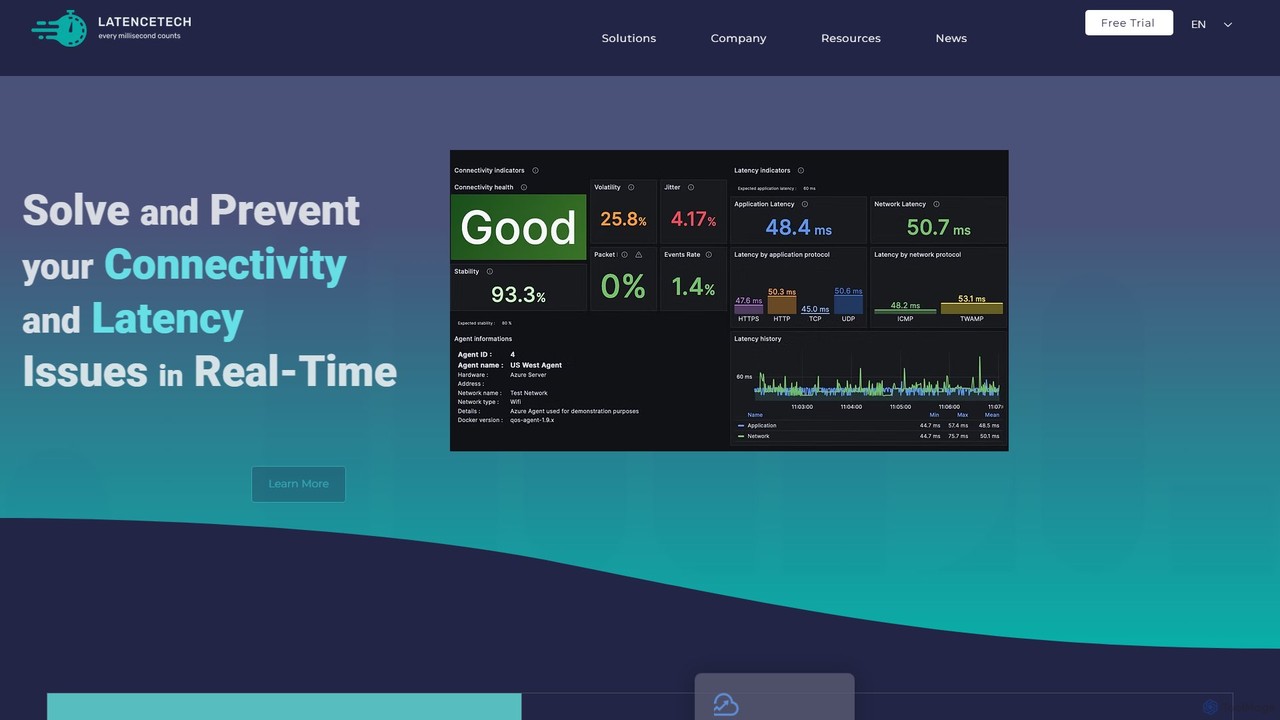
LatenceTech is an AI-powered platform for real-time wireless network monitoring and analytics. It helps businesses visualize, predict, and resolve connectivity and latency issues across various networks like 5G, LTE, Wi-Fi, and Satellite. By leveraging machine learning, it provides end-to-end visibility, predictive insights, and customizable solutions to ensure stable, low-latency performance for critical applications and innovations.

Network Monitoring
Visits 6.7KFavorites 106Likes 118

About Network Monitoring

Network Monitoring tools leverage artificial intelligence to provide real-time observation, analysis, and management of network performance, security, and availability. These AI-powered solutions utilize machine learning and advanced data analytics to process vast amounts of network data, identifying patterns and anomalies that human operators or traditional rule-based systems might miss. They are crucial for proactive issue identification, performance optimization, security threat detection, and automated incident response, moving beyond reactive troubleshooting to predictive network management.

Core Features

  • Anomaly Detection: Automatically identifies unusual network behavior that could indicate performance issues or security breaches.
  • Predictive Analytics: Forecasts potential network problems and resource needs based on historical data and current trends.
  • Root Cause Analysis: Pinpoints the underlying causes of network incidents, accelerating resolution times.
  • Performance Optimization: Provides insights and recommendations to enhance network speed, efficiency, and reliability.
  • Security Monitoring: Detects sophisticated threats and vulnerabilities by analyzing traffic patterns and user behavior.

Applicable Scenarios

Network Monitoring tools are essential for IT professionals, network administrators, and DevOps teams managing complex infrastructures. They are widely used in large enterprises for maintaining service level agreements, in cloud environments for optimizing resource allocation, and in telecommunications for ensuring network uptime and quality of service.

How to Choose

When selecting an AI Network Monitoring tool, evaluate its data ingestion capabilities across diverse network sources, the sophistication of its AI models for accurate anomaly detection and prediction, and its integration with existing IT infrastructure. Consider scalability to handle growing network demands, customization options for alerts and dashboards, and the clarity of its root cause analysis features.

Network Monitoring use cases

1

Proactive Anomaly Detection in Enterprise Networks

For large enterprises with complex network infrastructures, AI network monitoring tools continuously analyze traffic, logs, and device metrics. They automatically detect subtle anomalies, such as unusual data flows or unexpected device behavior, which could indicate a looming performance bottleneck or a security breach, allowing IT teams to intervene before services are impacted.

2

Optimizing Cloud Resource Utilization

Cloud architects and DevOps engineers use AI network monitoring to gain deep visibility into their dynamic cloud environments. The tools analyze network traffic patterns and resource consumption, providing insights to optimize bandwidth allocation, identify underutilized resources, and prevent costly overprovisioning, ensuring efficient and cost-effective cloud operations.

3

Securing IoT Device Fleets

Organizations managing extensive IoT deployments leverage AI network monitoring to secure their connected devices. These tools monitor communication patterns and data transfers from thousands of IoT sensors and gateways. By identifying deviations from normal behavior, they can quickly flag potential cyberattacks, unauthorized access attempts, or compromised devices, protecting sensitive data and operational integrity.

4

Automated Troubleshooting for Service Providers

Internet Service Providers (ISPs) and Managed Service Providers (MSPs) utilize AI network monitoring to automate the identification and resolution of network issues. The AI analyzes fault data and performance metrics across their vast networks, automatically diagnosing root causes for outages or degraded service, and often suggesting or initiating automated remediation steps, significantly reducing mean time to resolution (MTTR).

5

Predictive Maintenance for Network Infrastructure

Network operations teams employ AI network monitoring to predict hardware failures and capacity limitations. By analyzing historical performance data, device health metrics, and environmental factors, AI models can forecast when a router might fail or when a link will reach saturation, enabling proactive maintenance and upgrades to prevent service disruptions.

6

Real-time Traffic Analysis for Performance Bottlenecks

For businesses reliant on high-performance applications, AI network monitoring provides real-time analysis of network traffic. It identifies specific applications or users consuming excessive bandwidth, detects latency spikes, and visualizes traffic flows to pinpoint performance bottlenecks. This allows network engineers to quickly optimize configurations, prioritize critical traffic, and ensure smooth application delivery.

Network Monitoring FAQ

What are AI Network Monitoring tools?

AI Network Monitoring tools are software solutions that use artificial intelligence, primarily machine learning, to observe, analyze, and manage network performance, security, and availability. They go beyond traditional monitoring by automatically detecting anomalies, predicting future issues, and providing deeper insights into complex network behaviors.

How do AI Network Monitoring tools differ from traditional monitoring?

Traditional network monitoring relies heavily on predefined rules and thresholds, often generating alerts only after an issue has occurred. AI Network Monitoring, conversely, uses machine learning to learn normal network behavior, enabling it to detect subtle, unknown anomalies and predict potential problems before they impact services. This shifts the approach from reactive to proactive and predictive.

What are the key benefits of using AI for network monitoring?

The key benefits include enhanced anomaly detection, predictive insights into network health and capacity, faster root cause analysis, and improved security threat detection. AI reduces alert fatigue by prioritizing critical issues, automates routine tasks, and provides actionable recommendations, leading to greater network stability, efficiency, and reduced operational costs.

What should I consider when choosing an AI Network Monitoring solution?

When selecting a solution, consider its ability to integrate with your existing infrastructure, the breadth of data sources it can ingest (e.g., logs, flow data, device metrics), and the sophistication of its AI algorithms for accurate insights. Also, evaluate its scalability, ease of use, customization options for dashboards and alerts, and the vendor's support and update policies.

Can AI Network Monitoring help with network security?

Yes, AI Network Monitoring significantly enhances network security. By continuously analyzing traffic patterns, user behavior, and system logs, AI can detect sophisticated cyber threats, insider threats, and zero-day attacks that might bypass traditional security measures. It identifies unusual access patterns, data exfiltration attempts, and malware activity, providing early warnings and aiding in rapid incident response.